
Table of Contents
Asoke is a meaningful Sanskrit name for boys that carries a beautiful message of emotional freedom. Derived from ancient Indian roots, this name symbolizes liberation from grief and suffering. With historical connections to one of India’s greatest emperors, Asoke represents resilience and compassion. Explore the rich linguistic and cultural heritage behind this timeless name.
Meaning of Asoke
The name Asoke originates from the Sanskrit word ‘aśoka’ (अशोक), which literally translates to ‘without sorrow’ or ‘free from grief’. This compound word combines the negative prefix ‘a-‘ (meaning ‘not’ or ‘without’) with ‘śoka’ (meaning ‘sorrow’, ‘grief’, or ‘affliction’). In classical Sanskrit literature, this term appears in various contexts describing emotional states. The name also shares its etymology with the sacred Ashoka tree (Saraca asoca), which is mentioned in ancient Indian texts and associated with the Hindu god Kamadeva. Linguistically, this name demonstrates the precise morphological structure characteristic of Sanskrit compounds.
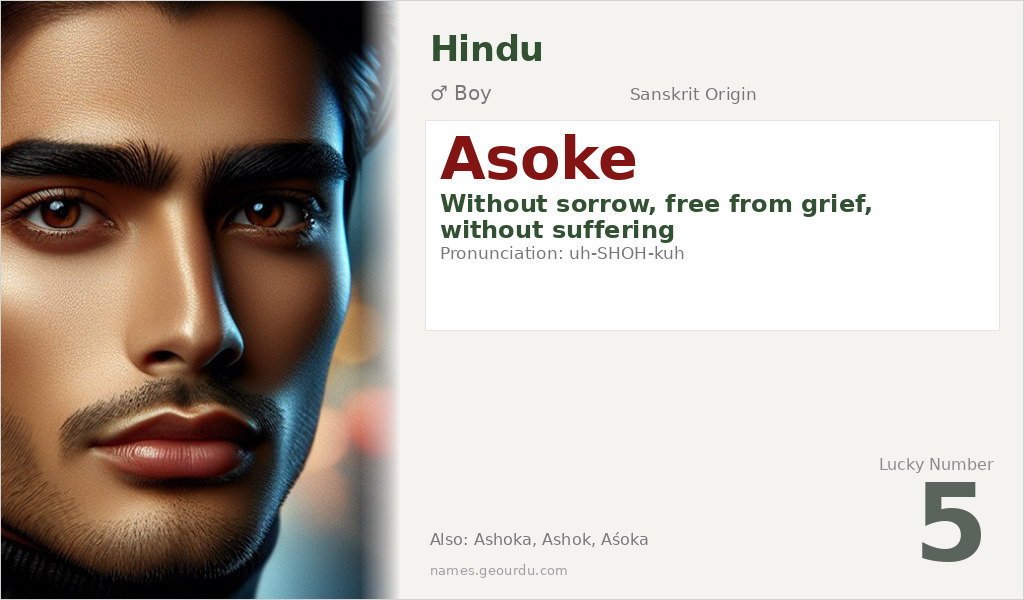
| 📛 Name | Asoke |
| 💎 Meaning | Without sorrow, free from grief, without suffering |
| 👤 Gender | Boy |
| 🕌 Religion | Hindu |
| 🌍 Origin | Sanskrit |
| 🗣 Pronunciation | uh-SHOH-kuh |
| ✍️ Urdu | اشوک |
| ✍️ Arabic | أشوكا |
| 🔢 Numerology | 5 |
| ✨ Spellings | Ashoka, Ashok, Aśoka, Asok |
Origin & Cultural Significance
Asoke has its origins in ancient Sanskrit, the classical language of India that dates back over 3,500 years. The name appears in early Indian literature and historical records, most notably associated with Emperor Ashoka (304-232 BCE) of the Maurya Dynasty, who ruled most of the Indian subcontinent. After witnessing the devastation of the Kalinga War, Emperor Ashoka embraced Buddhism and promoted non-violence, making his name synonymous with peace and compassion. The name continues to be used primarily in Hindu communities across India, Nepal, and the diaspora. Its cultural significance extends beyond personal names to include the sacred Ashoka tree mentioned in the Ramayana and other Hindu scriptures.
Personality Traits
People named Asoke are often associated with qualities of emotional strength and serenity. The meaning ‘without sorrow’ suggests someone who maintains inner peace even during challenging circumstances. They may naturally exhibit empathy and understanding toward others’ suffering. This name carries connotations of resilience and the ability to transform grief into wisdom.
Similar Names
If you like Asoke, consider: Ashok, Ashokan, Ashwath, Ananda, Sukha
Famous People Named Asoke
- Ashoka the Great — 3rd century BCE Mauryan emperor who ruled most of the Indian subcontinent and promoted Buddhism
- Ashok Kumar — legendary Indian actor known as the 'Dadamoni' of Indian cinema
Frequently Asked Questions About Asoke
What does Asoke mean?
Asoke means 'without sorrow' or 'free from grief' in Sanskrit, combining the prefix 'a-' (without) and 'śoka' (sorrow).
Is Asoke a boy or girl name?
Asoke is traditionally a masculine name in Hindu naming traditions, though variations like Ashoka can occasionally be used for girls in modern contexts.
What is the origin of Asoke?
Asoke originates from Sanskrit, the ancient classical language of India, with historical usage dating back over two millennia.





