
Table of Contents
Filasofa is a distinctive name that carries centuries of intellectual heritage. Derived from the Greek word for ‘philosopher,’ this name traveled through Arabic translations during the Islamic Golden Age to become a symbol of wisdom-seeking. While uncommon as a personal name today, it represents a bridge between classical philosophy and later intellectual traditions. Understanding Filasofa requires exploring its linguistic journey and philosophical roots.
Meaning of Filasofa
Filasofa originates from the Arabic ‘فيلسوف’ (faylasūf), which is a direct borrowing from the Greek ‘φιλόσοφος’ (philosophos). The Greek term combines ‘philo-‘ (loving) and ‘sophia’ (wisdom), literally meaning ‘lover of wisdom.’ During the 8th-10th centuries, Arabic scholars systematically translated Greek philosophical works, adopting this term to describe those engaged in rational inquiry. In Arabic, it specifically referred to practitioners of falsafa (philosophy) as distinct from kalam (theology). The name thus embodies the transmission of classical knowledge across civilizations.
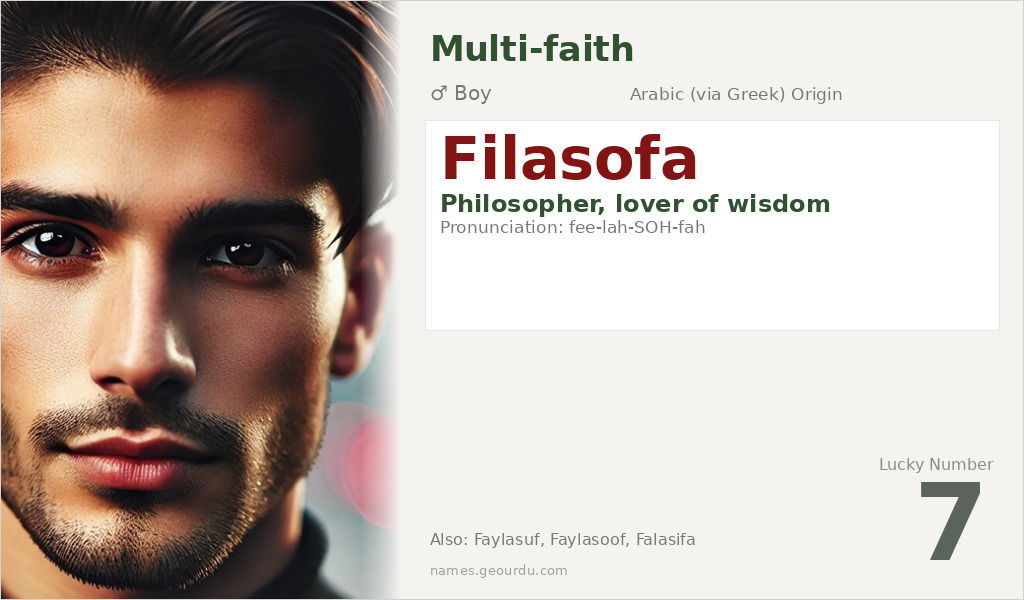
| 📛 Name | Filasofa |
| 💎 Meaning | Philosopher, lover of wisdom |
| 👤 Gender | Boy |
| 🕌 Religion | Multi-faith |
| 🌍 Origin | Arabic (via Greek) |
| 🗣 Pronunciation | fee-lah-SOH-fah |
| ✍️ Urdu | فیلسوفہ |
| ✍️ Arabic | فيلسوف |
| 🔢 Numerology | 7 |
| ✨ Spellings | Faylasuf, Faylasoof, Falasifa, Falsafa |
Origin & Cultural Significance
The name Filasofa emerged during the Islamic Golden Age when scholars in Baghdad, Cordoba, and other centers translated and commented on Greek philosophical texts. While primarily used as a descriptive term for philosophers rather than a common personal name, it appears in historical references to scholars like Al-Farabi and Ibn Sina (Avicenna). The term spread through Persian, Turkish, and Urdu intellectual traditions. Today, it’s more commonly found in academic contexts than as a given name, though it occasionally appears in regions with strong philosophical heritage.
Personality Traits
Those named Filasofa are typically associated with intellectual depth and contemplative nature. They often exhibit strong analytical skills, curiosity about fundamental truths, and respect for knowledge traditions. The name suggests someone who values reason, seeks understanding, and may challenge conventional thinking. While not necessarily religious, they often engage with spiritual or existential questions through rational inquiry.
Similar Names
If you like Filasofa, consider: Hakim, Aqil, Faris, Alim, Aristotle
Famous People Named Filasofa
- Al-Farabi (Abu Nasr Al-Farabi) — Known as 'The Second Teacher' after Aristotle, a prominent Islamic philosopher who wrote extensively on Greek philosophy
- Ibn Rushd (Averroes) — Andalusian philosopher who integrated Aristotelian philosophy with Islamic thought
Frequently Asked Questions About Filasofa
What does Filasofa mean?
Filasofa means 'philosopher' or 'lover of wisdom.' It comes from the Arabic 'فيلسوف' (faylasūf), which derives from the Greek 'φιλόσοφος' (philosophos).
Is Filasofa a boy or girl name?
Filasofa is traditionally a masculine name, though as a philosophical term it's gender-neutral in reference. In naming contexts, it's almost exclusively used for boys.
What is the origin of Filasofa?
Filasofa originates from Greek philosophy, transmitted through Arabic translations during the Islamic Golden Age. It's an Arabic adaptation of the Greek word for philosopher.





