
Table of Contents
Fakur is a distinctive Arabic name for boys that carries deep linguistic roots and cultural significance. Derived from classical Arabic vocabulary relating to pride and dignity, this name has been used for centuries across the Muslim world. While not among the most common names today, it maintains a presence in various Arabic-speaking regions and among Muslim communities globally. Understanding its true meaning and origins reveals why it remains a meaningful choice for parents seeking names with historical depth.
Meaning of Fakur
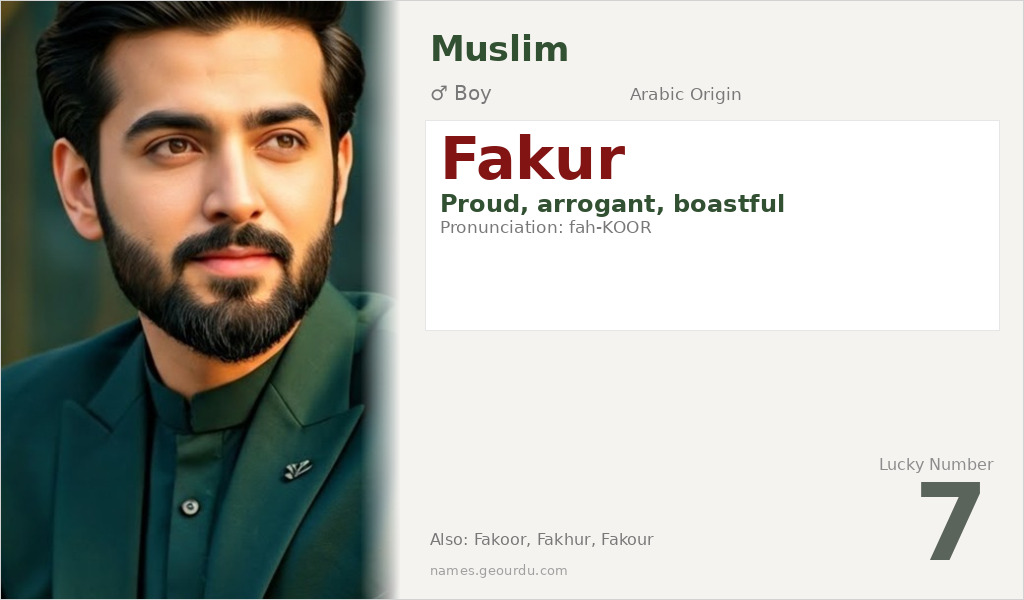
Fakur (فخور) is an Arabic masculine name with a clear and well-documented meaning: ‘proud,’ ‘arrogant,’ or ‘boastful.’ It originates from the trilateral root ف-خ-ر (f-kh-r), which forms the basis for numerous words related to pride, glory, and boasting in Arabic. The name is the active participle form of the verb fakhaara (فَخَرَ), meaning ‘to boast’ or ‘to take pride in.’ Classical Arabic dictionaries like Lisan al-Arab by Ibn Manzur (13th century) and Taj al-Arus by Murtada al-Zabidi (18th century) document this root and its derivatives extensively. In naming contexts, Fakur typically carries positive connotations of dignified pride and self-respect rather than negative arrogance, though the literal meaning remains ‘one who is proud.’
| 📛 Name | Fakur |
| 💎 Meaning | Proud, arrogant, boastful |
| 👤 Gender | Boy |
| 🕌 Religion | Muslim |
| 🌍 Origin | Arabic |
| 🗣 Pronunciation | fah-KOOR |
| ✍️ Urdu | فخور |
| ✍️ Arabic | فخور |
| 🔢 Numerology | 7 |
| ✨ Spellings | Fakoor, Fakhur, Fakour, Fakhour |
Origin & Cultural Significance
Fakur has its origins in classical Arabic language and literature, with documented usage dating back to pre-Islamic and early Islamic periods. The name appears in historical texts and poetry, reflecting the importance of the concept of fakhr (pride/glory) in Arab culture. While primarily used in Arabic-speaking regions, the name spread through Islamic expansion to Persian, Turkish, and South Asian contexts, though it remains most common in Arab communities. Unlike some names that have been adapted across cultures, Fakur has maintained its original Arabic form and meaning without significant alteration. Its usage has been consistent though never extremely widespread, appearing in historical records from Andalusia to the Indian subcontinent.
Personality Traits
Those named Fakur are often associated with qualities of confidence, dignity, and self-assurance. The name’s meaning suggests someone who carries themselves with pride and has strong principles. While this can sometimes manifest as reserve or formality, it typically indicates deep commitment to personal values and loyalty to family and community. The name implies a person who takes pride in their heritage and accomplishments, often striving for excellence in their endeavors.
Similar Names
If you like Fakur, consider: Fakhr, Fakher, Fakhir, Mufakhar, Fakhruddin
Famous People Named Fakur
- Fakur al-Islam — 12th century Islamic scholar from Andalusia known for his commentaries on hadith
- Fakur Khan — Historical figure mentioned in Mughal chronicles as a noble during Akbar's reign
Frequently Asked Questions About Fakur
What does Fakur mean?
Fakur means 'Proud,' 'Arrogant,' or 'Boastful' in Arabic. It comes from the root ف-خ-ر (f-kh-r) relating to pride and glory.
Is Fakur a boy or girl name?
Fakur is exclusively a masculine name in Arabic and Muslim naming traditions. The grammatical structure and usage throughout history confirm it as a boy's name.
What is the origin of Fakur?
Fakur originates from classical Arabic language, specifically from the root ف-خ-ر (f-kh-r) meaning 'pride' or 'boasting.' It has been used in Arab and Muslim communities for centuries.





