
Table of Contents
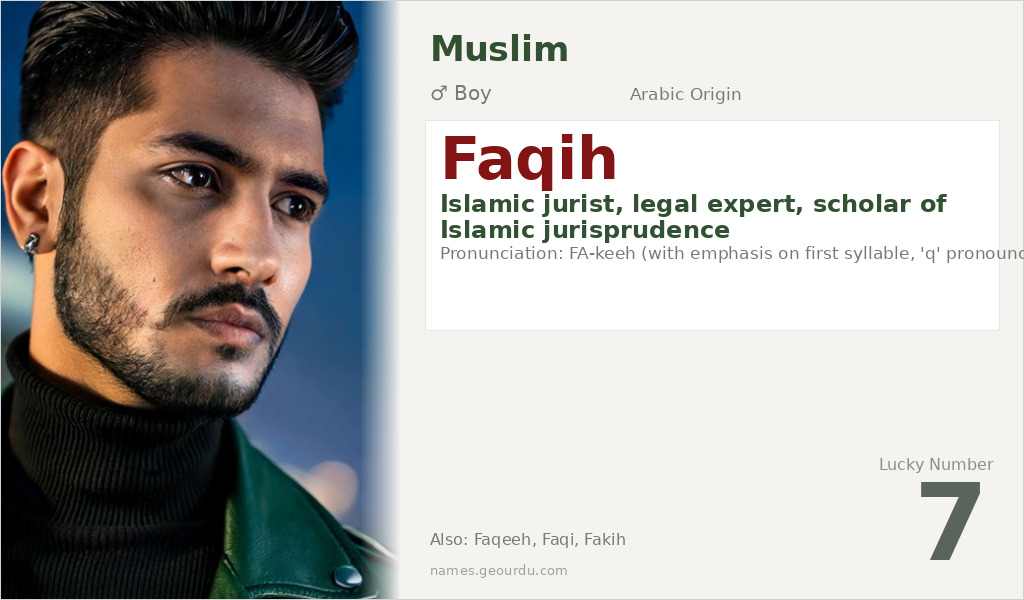
Faqih is a distinguished Arabic name with deep roots in Islamic scholarship and jurisprudence. Carrying the weight of intellectual tradition, this name has been borne by legal experts and religious scholars throughout Muslim history. Unlike many modern names, Faqih represents a specific professional and religious identity that reflects the importance of knowledge in Islamic culture. Today, it continues to be chosen by parents who value tradition, learning, and religious devotion.
Meaning of Faqih
Faqih (فَقِيه) is derived from the Arabic triliteral root ف-ق-ه (f-q-h), which fundamentally means ‘to understand’, ‘to comprehend’, or ‘to have deep knowledge’. In Islamic terminology, it specifically refers to an expert in fiqh (فقه), the human understanding and interpretation of Islamic law based on the Quran and Sunnah. The term appears in the Quran (9:122) where Muslims are encouraged to have a group who devote themselves to study and understanding of religion. Historically, a faqih was someone who had mastered the principles of Islamic jurisprudence and could derive legal rulings through ijtihad (independent reasoning). The name thus carries connotations of wisdom, legal expertise, and religious scholarship.
| 📛 Name | Faqih |
| 💎 Meaning | Islamic jurist, legal expert, scholar of Islamic jurisprudence |
| 👤 Gender | Boy |
| 🕌 Religion | Muslim |
| 🌍 Origin | Arabic |
| 🗣 Pronunciation | FA-keeh (with emphasis on first syllable, 'q' pronounced as a voiceless uvular stop) |
| ✍️ Urdu | فقیہ |
| ✍️ Arabic | فَقِيه |
| 🔢 Numerology | 7 |
| ✨ Spellings | Faqeeh, Faqi, Fakih, Fakīh |
Origin & Cultural Significance
Faqih originates from Classical Arabic and emerged as a title in early Islamic history during the development of Islamic legal schools (madhahib). It was initially an honorific for scholars like Abu Hanifa, Malik ibn Anas, Al-Shafi’i, and Ahmad ibn Hanbal—the founders of the major Sunni schools of jurisprudence. As a personal name, it gained popularity across the Muslim world from North Africa to Southeast Asia, particularly among families with scholarly traditions. While most common in Arabic-speaking regions, the name has been adopted in Persian, Urdu, Turkish, and other Muslim cultures due to its religious significance. In some regions, it may be combined with other elements (like Abdul-Faqih) but stands strongly as an independent name.
Personality Traits
The name Faqih suggests someone with an analytical mind and strong moral compass. Traditionally associated with scholarly pursuits, individuals with this name are often perceived as thoughtful, disciplined, and dedicated to principles. They may exhibit patience in decision-making and value evidence-based reasoning over emotional reactions. While these associations stem from the name’s meaning rather than deterministic personality traits, they reflect cultural expectations that can influence how bearers of the name are perceived and socialized.
Similar Names
If you like Faqih, consider: Fahim, Faris, Faiz, Fahad, Faruq
Famous People Named Faqih
- Faqih Ali — 19th century Islamic scholar from Zanzibar who wrote extensively on Shafi'i jurisprudence
- Faqih Usman — Indonesian Islamic scholar and independence activist who helped establish Islamic education systems
Frequently Asked Questions About Faqih
What does Faqih mean?
Faqih means 'Islamic jurist' or 'legal expert' in Arabic. It specifically refers to someone learned in fiqh (Islamic jurisprudence) who can interpret religious law.
Is Faqih a boy or girl name?
Faqih is exclusively a boy's name in all Muslim cultures where it is used. There is no feminine equivalent in common usage.
What is the origin of Faqih?
Faqih originates from Classical Arabic and has been used since early Islamic history as both a title for legal scholars and later as a personal name across the Muslim world.





