
Table of Contents
Dhul Fiqar is a powerful Arabic name with deep roots in Islamic history and tradition. As the name of Prophet Muhammad’s legendary double-pointed sword, it carries connotations of strength, protection, and divine favor. This name has been cherished in Muslim communities for centuries, particularly among Shia Muslims who revere Ali ibn Abi Talib, the sword’s most famous wielder. Today, it remains a meaningful choice for parents seeking a name with historical significance and spiritual resonance.
Meaning of Dhul Fiqar
Dhul Fiqar (ذو الفقار) is an Arabic compound name with precise linguistic components. ‘Dhul’ (ذو) means ‘possessor of’ or ‘owner of,’ a common prefix in Arabic names. ‘Fiqar’ (الفقار) derives from the root ف-ق-ر (f-q-r) and specifically means ‘vertebrae’ or ‘spine.’ The complete name therefore translates to ‘Possessor of the Vertebrae,’ a reference to the distinctive notched appearance of Prophet Muhammad’s sword that resembled spinal vertebrae. This etymology is well-documented in classical Arabic sources including historical accounts of the Battle of Uhud. The name’s meaning is consistently recorded across Arabic, Persian, Urdu, and other Islamic languages without significant variation.
| 📛 Name | Dhul Fiqar |
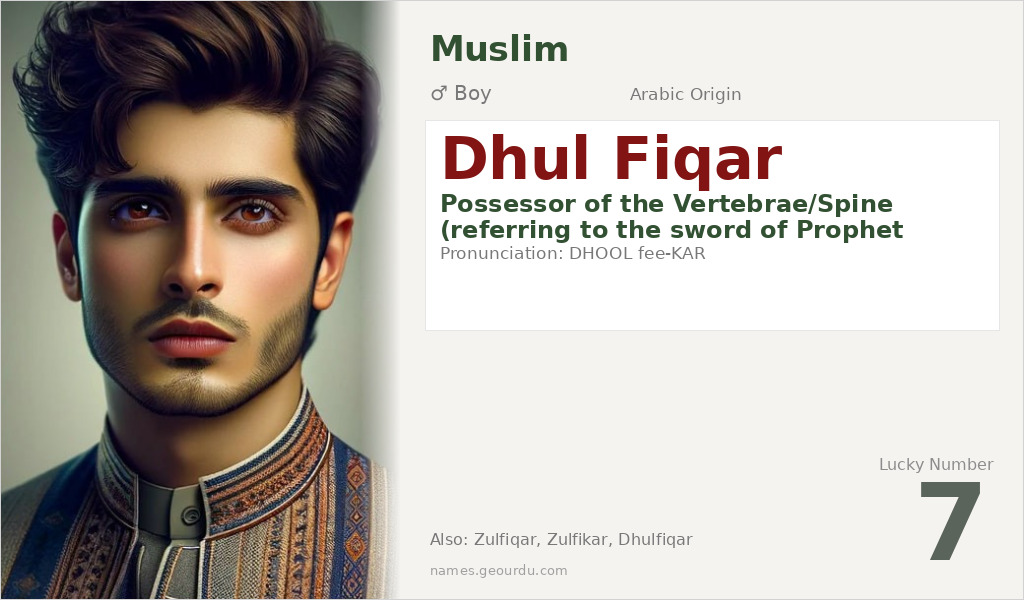
| 💎 Meaning | Possessor of the Vertebrae/Spine (referring to the sword of Prophet Muhammad) |
| 👤 Gender | Boy |
| 🕌 Religion | Muslim |
| 🌍 Origin | Arabic |
| 🗣 Pronunciation | DHOOL fee-KAR |
| ✍️ Urdu | ذوالفقار |
| ✍️ Arabic | ذو الفقار |
| 🔢 Numerology | 7 |
| ✨ Spellings | Zulfiqar, Zulfikar, Dhulfiqar, Zulficar, Zulfiqar |
Origin & Cultural Significance
The name Dhul Fiqar originates from 7th century Arabia during the early Islamic period. It gained prominence after the Battle of Uhud (625 CE) when Prophet Muhammad reportedly gave his distinctive double-pointed sword to his cousin and son-in-law Ali ibn Abi Talib. The sword became a powerful symbol in Islamic iconography, particularly in Shia Islam where it represents Ali’s bravery and divine appointment. Over centuries, the name spread throughout the Muslim world from North Africa to Southeast Asia, often spelled as Zulfiqar in Persian and Urdu contexts. It remains especially popular in South Asian Muslim communities and among those with reverence for Islamic history.
Personality Traits
Those named Dhul Fiqar are often associated with protective and courageous qualities, mirroring the sword’s symbolic meaning. They may exhibit strong leadership tendencies, a sense of justice, and loyalty to their principles. The name’s historical connection to Ali ibn Abi Talib adds layers of spiritual dedication and moral fortitude to its personality associations. Parents choosing this name often hope to instill values of bravery, protection, and faith in their children.
Similar Names
If you like Dhul Fiqar, consider: Ali, Hamza, Khalid, Saif, Qasim
Famous People Named Dhul Fiqar
- Zulfiqar Ali Bhutto — Former Prime Minister of Pakistan
- Zulfikar Ghose — Pakistani-American novelist and poet
Frequently Asked Questions About Dhul Fiqar
What does Dhul Fiqar mean?
Dhul Fiqar means 'Possessor of the Vertebrae' in Arabic, specifically referring to the notched, spine-like appearance of Prophet Muhammad's legendary double-pointed sword.
Is Dhul Fiqar a boy or girl name?
Dhul Fiqar is exclusively a boy's name in all Muslim cultures where it is used, reflecting its association with martial symbolism and male historical figures.
What is the origin of Dhul Fiqar?
The name originates from 7th century Arabic Islamic tradition, specifically from the sword of Prophet Muhammad that was given to Ali ibn Abi Talib during the Battle of Uhud.





