
Table of Contents
Farjad is a distinguished Persian name with a rich linguistic heritage that has traveled across cultures and regions. Meaning ‘Excellent, Eminent, or Distinguished,’ this name carries connotations of superiority and outstanding qualities. While particularly popular in Persian-speaking communities, it has found resonance in various cultures influenced by Persian traditions. The name’s elegant sound and meaningful etymology make it a compelling choice for parents seeking a name with intellectual and moral depth.
Meaning of Farjad
Farjad originates from the Persian language, specifically from the root word ‘farj’ (فرج) which signifies excellence, eminence, or distinction. The suffix ‘-ad’ in Persian names typically denotes possession or quality, making Farjad essentially mean ‘possessing excellence’ or ‘characterized by distinction.’ This etymology is well-documented in Persian linguistic sources and naming traditions. The name appears in classical Persian literature and historical records, consistently associated with superior qualities. Unlike some names that have evolved multiple meanings across languages, Farjad maintains its core meaning of excellence across Persian-influenced cultures. Its linguistic construction follows common Persian naming patterns for indicating desirable personal attributes.
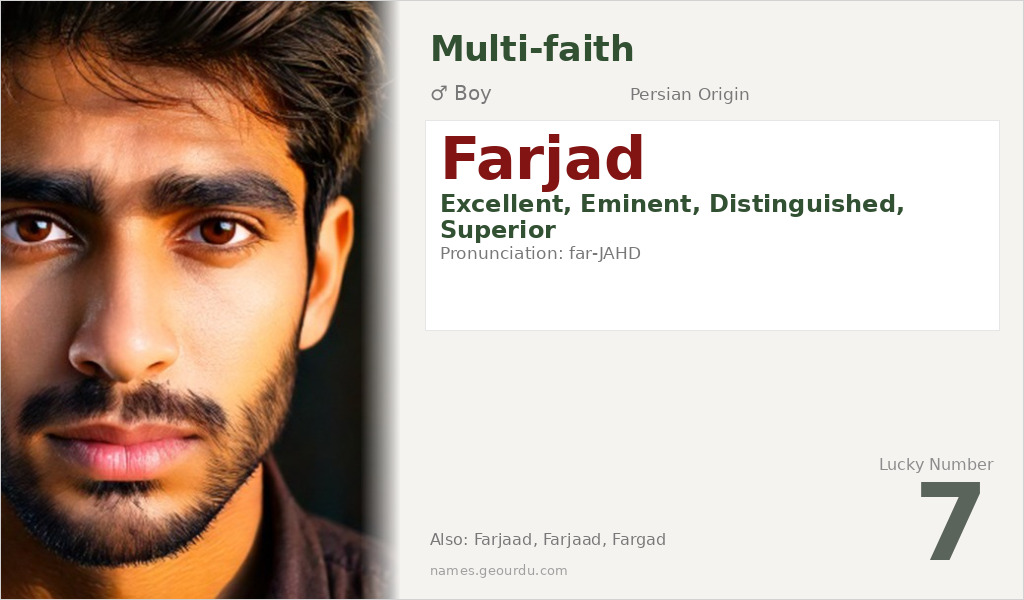
| 📛 Name | Farjad |
| 💎 Meaning | Excellent, Eminent, Distinguished, Superior |
| 👤 Gender | Boy |
| 🕌 Religion | Multi-faith |
| 🌍 Origin | Persian |
| 🗣 Pronunciation | far-JAHD |
| ✍️ Urdu | فرجاد |
| ✍️ Arabic | فرجاد |
| 🔢 Numerology | 7 |
| ✨ Spellings | Farjaad, Farjaad, Fargad, Fargad |
Origin & Cultural Significance
Farjad has its origins in Persian culture and language, dating back to classical Persian naming traditions. While the name is used by Muslims in regions like Iran, Afghanistan, Pakistan, and parts of Central Asia, it is not exclusively Islamic in origin or usage. The name appears in pre-Islamic Persian contexts and continues to be used by Zoroastrians and other communities in Persian-influenced regions. Its adoption into Muslim naming practices occurred through cultural exchange rather than religious prescription. The name’s popularity has remained consistent in Persian-speaking communities while also spreading to neighboring regions through historical trade routes and cultural diffusion. Today, it represents a cultural heritage that transcends specific religious boundaries while maintaining its Persian linguistic roots.
Personality Traits
Those named Farjad are often associated with intellectual prowess, discernment, and a pursuit of excellence. The name’s meaning naturally suggests someone who strives for distinction in their endeavors, whether academic, professional, or personal. Cultural perceptions typically view Farjad as thoughtful, analytical individuals with strong leadership potential and a natural inclination toward learning. These personality associations stem directly from the name’s etymology and historical usage patterns in Persian literature and society.
Similar Names
If you like Farjad, consider: Farhad, Farzad, Farshad, Fariborz, Faramarz
Famous People Named Farjad
- Farjad Nabi — Pakistani film director and screenwriter known for 'Zinda Bhaag'
- Farjad Kiani — Iranian musician and composer specializing in traditional Persian music
Frequently Asked Questions About Farjad
What does Farjad mean?
Farjad means 'Excellent, Eminent, Distinguished, or Superior' in Persian. The name derives from the Persian root 'farj' meaning excellence combined with the suffix '-ad' indicating possession of that quality.
Is Farjad a boy or girl name?
Farjad is exclusively a boy's name in all cultures where it is used. There are no recorded instances of it being used as a girl's name in Persian naming traditions or related cultures.
What is the origin of Farjad?
Farjad originates from the Persian language and culture. While commonly used by Muslims in Persian-influenced regions, it is not exclusively Islamic and has roots in pre-Islamic Persian naming traditions that continue across multiple faith communities.





