
Table of Contents
Dzulfaqar is a powerful Arabic name with deep roots in Islamic history and tradition. Most famously associated with the legendary double-pointed sword of Ali ibn Abi Talib, this name carries connotations of strength, justice, and spiritual significance. While primarily used in Muslim communities, its historical resonance makes it recognizable across various cultures. Understanding its true meaning requires exploring its linguistic components and historical context.
Meaning of Dzulfaqar
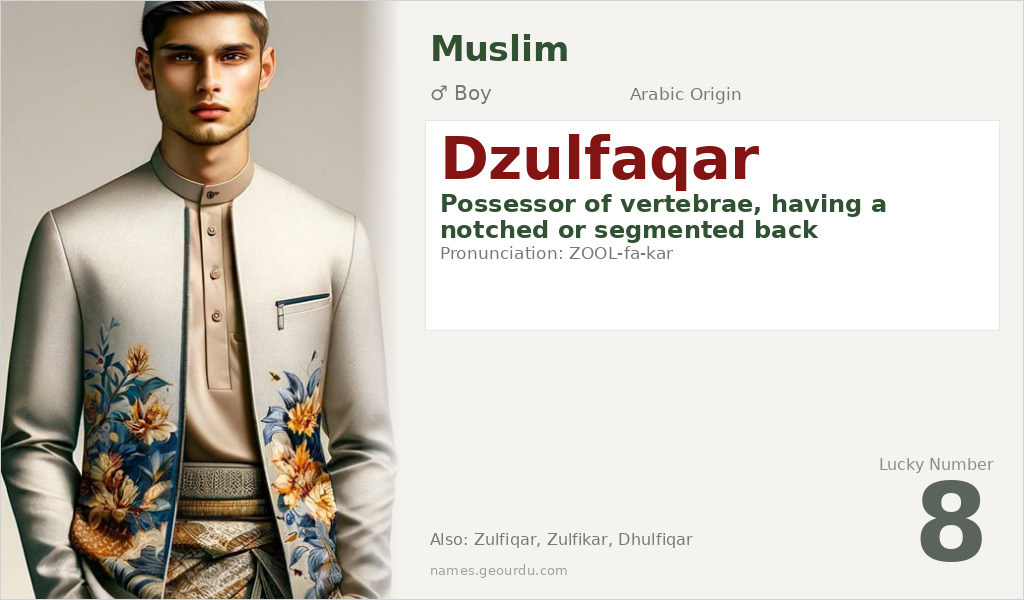
Dzulfaqar is an Arabic compound name composed of two elements: ‘Dhu’ (ذو) meaning ‘possessor of’ or ‘owner of’, and ‘faqar’ (فقار) meaning ‘vertebrae’ or ‘backbone’. The complete meaning is therefore ‘possessor of vertebrae’ or ‘having a notched/segmented back’. This name is inextricably linked to the sword Zulfiqar, which according to Islamic tradition was given to Ali ibn Abi Talib by Prophet Muhammad. The sword was described as having a blade with notches or segments resembling spinal vertebrae, hence the descriptive name. In classical Arabic literature, ‘faqar’ specifically refers to the vertebrae of the spine, making this a precise anatomical reference rather than a metaphorical one.
| 📛 Name | Dzulfaqar |
| 💎 Meaning | Possessor of vertebrae, having a notched or segmented back |
| 👤 Gender | Boy |
| 🕌 Religion | Muslim |
| 🌍 Origin | Arabic |
| 🗣 Pronunciation | ZOOL-fa-kar |
| ✍️ Urdu | ذوالفقار |
| ✍️ Arabic | ذُو الْفَقَار |
| 🔢 Numerology | 8 |
| ✨ Spellings | Zulfiqar, Zulfikar, Dhulfiqar, Dhu al-Faqar, Zulficar, Zulfaqar |
Origin & Cultural Significance
The name Dzulfaqar originates from classical Arabic and holds particular significance in Islamic history and culture. Its most famous association is with the sword Zulfiqar, which became a symbol of Ali ibn Abi Talib’s military prowess and spiritual authority. The name appears in early Islamic historical texts and has been used as a personal name primarily among Muslims, particularly in South Asia, the Middle East, and among diaspora communities. While the sword itself is legendary, the name’s usage as a personal name reflects admiration for Ali’s qualities of courage, justice, and faith. It remains popular in countries like Pakistan, India, Bangladesh, Iran, and Arab nations, often chosen for its historical and religious resonance.
Personality Traits
Those named Dzulfaqar are often perceived as strong, principled individuals with leadership qualities. The name’s association with Ali ibn Abi Talib suggests traits of courage, justice, and protection. In many cultures where this name is used, it carries expectations of moral integrity and resilience. While personality traits cannot be definitively assigned to names, the historical and cultural weight of Dzulfaqar may influence how bearers and others perceive these qualities.
Similar Names
If you like Dzulfaqar, consider: Ali, Hasan, Husayn, Hamza, Khalid
Famous People Named Dzulfaqar
- Ali ibn Abi Talib — First Imam in Shia Islam and fourth Caliph in Sunni Islam, original bearer of the sword Zulfiqar
- Zulfiqar Ali Bhutto — Former Prime Minister of Pakistan (1971-1977)
Frequently Asked Questions About Dzulfaqar
What does Dzulfaqar mean?
Dzulfaqar means 'possessor of vertebrae' or 'having a notched back' in Arabic. It's famously associated with the sword of Ali ibn Abi Talib, which was described as having a segmented blade resembling spinal vertebrae.
Is Dzulfaqar a boy or girl name?
Dzulfaqar is exclusively a boy's name in all cultural contexts where it is used. There are no recorded instances of it being used as a girl's name in any language or tradition.
What is the origin of Dzulfaqar?
Dzulfaqar originates from classical Arabic. It gained prominence through its association with the sword Zulfiqar in Islamic history and has been used as a personal name primarily in Muslim communities across South Asia, the Middle East, and beyond.





