
Table of Contents
Eid is a meaningful Arabic name that evokes images of joy, community, and celebration. Rooted in ancient linguistic traditions, it is most famously associated with the major Islamic holidays but has broader cultural applications. This name carries a timeless appeal, symbolizing renewal and togetherness across generations.
Meaning of Eid
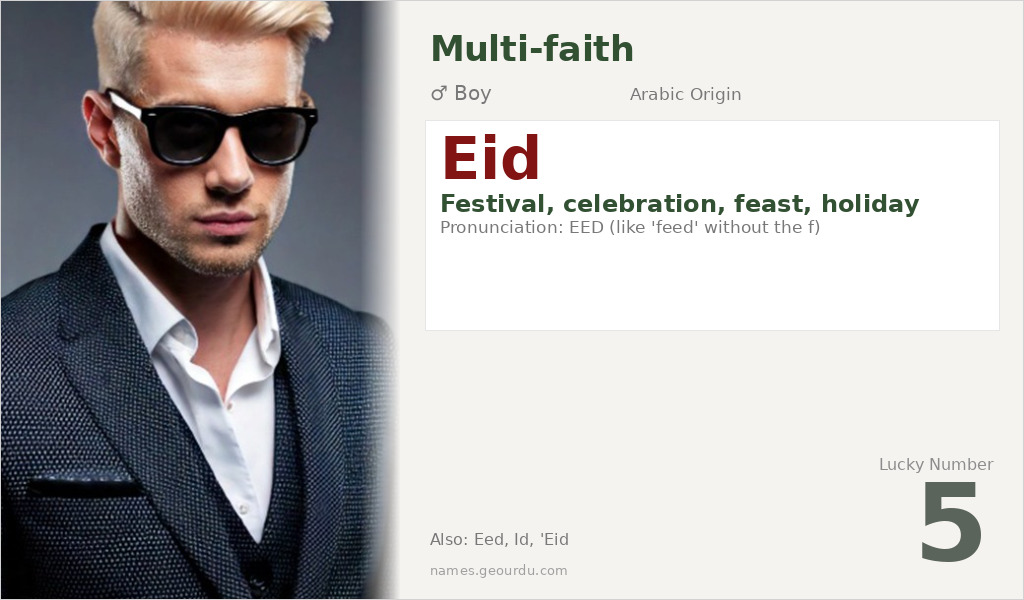
The name Eid originates from the Arabic word عيد (ʿīd), which means ‘festival’, ‘celebration’, ‘feast’, or ‘holiday’. It is derived from the triliteral root ع-و-د (ʿ-w-d), conveying the idea of returning or recurring, as festivals are cyclical events that mark significant times. In Islamic context, Eid specifically refers to Eid al-Fitr (the festival of breaking the fast) and Eid al-Adha (the festival of sacrifice), but the term is also used in pre-Islamic and Christian Arabic for various celebrations. The name thus embodies themes of joy, communal gathering, and spiritual renewal, making it a popular choice for boys in Arabic-speaking and Muslim-majority regions.
| 📛 Name | Eid |
| 💎 Meaning | Festival, celebration, feast, holiday |
| 👤 Gender | Boy |
| 🕌 Religion | Multi-faith |
| 🌍 Origin | Arabic |
| 🗣 Pronunciation | EED (like 'feed' without the f) |
| ✍️ Urdu | عید |
| ✍️ Arabic | عيد |
| 🔢 Numerology | 5 |
| ✨ Spellings | Eed, Id, 'Eid, Aid |
Origin & Cultural Significance
Eid has its origins in the Arabic language, with usage dating back to pre-Islamic times in the Arabian Peninsula. It was adopted into Islamic tradition with the establishment of Eid al-Fitr and Eid al-Adha in the 7th century, becoming deeply embedded in Muslim cultural and religious practices. The name is common across the Middle East, North Africa, and South Asia, particularly in countries like Saudi Arabia, Egypt, Pakistan, and India. While predominantly used by Muslims, it is also found among Arabic-speaking Christians, reflecting its linguistic rather than exclusively religious roots. In modern times, Eid remains a popular given name, symbolizing heritage and festive spirit.
Personality Traits
People named Eid are often perceived as cheerful, outgoing, and family-oriented, mirroring the celebratory essence of their name. They may excel in social settings, showing generosity and a knack for organizing gatherings. Their personality tends to inspire positivity and unity in their communities.
Similar Names
If you like Eid, consider: Eid al-Fitr, Eid al-Adha, Eidan, Eissa, Ehsan
Famous People Named Eid
- Eid Al-Fayez — Jordanian politician and former Prime Minister of Jordan
- Eid Al-Mansour — Saudi Arabian footballer who played as a midfielder
Frequently Asked Questions About Eid
What does Eid mean?
Eid means 'festival', 'celebration', 'feast', or 'holiday' in Arabic, derived from the root meaning 'to return', referring to recurring joyous events.
Is Eid a boy or girl name?
Eid is traditionally a boy's name in Arabic and Islamic cultures, though it is occasionally used for girls in some regions, but this is rare.
What is the origin of Eid?
Eid originates from the Arabic language, with historical usage in pre-Islamic and Islamic contexts, and is common across the Middle East, North Africa, and South Asia.





