
Table of Contents
Daghfal is an intriguing name that carries an air of mystery in its origins and meaning. While commonly used in some Muslim communities, particularly in South Asian and Middle Eastern regions, its exact linguistic roots remain elusive to scholars and etymologists. This name has gained attention for its distinctive sound and cultural significance, though its historical documentation is sparse. Parents drawn to unique, less common names often find Daghfal appealing for its strong phonetic qualities and cultural resonance.
Meaning of Daghfal
The meaning of Daghfal presents a challenge for etymologists, as it doesn’t appear in classical Arabic dictionaries or established Islamic naming traditions. Research across multiple languages including Arabic, Persian, Urdu, Pashto, Balochi, Sindhi, and Kurdish reveals no definitive origin. Some linguistic analysis suggests possible connections to regional languages where ‘dag’ elements might relate to concepts of size or importance, and ‘fal’ could be a suffix or modifying element. However, these remain speculative without documented evidence. The name’s usage in modern times appears to be based more on phonetic appeal and cultural tradition than on verifiable linguistic meaning. Unlike many Islamic names with clear Arabic roots and Quranic or historical references, Daghfal exists outside these established naming conventions.
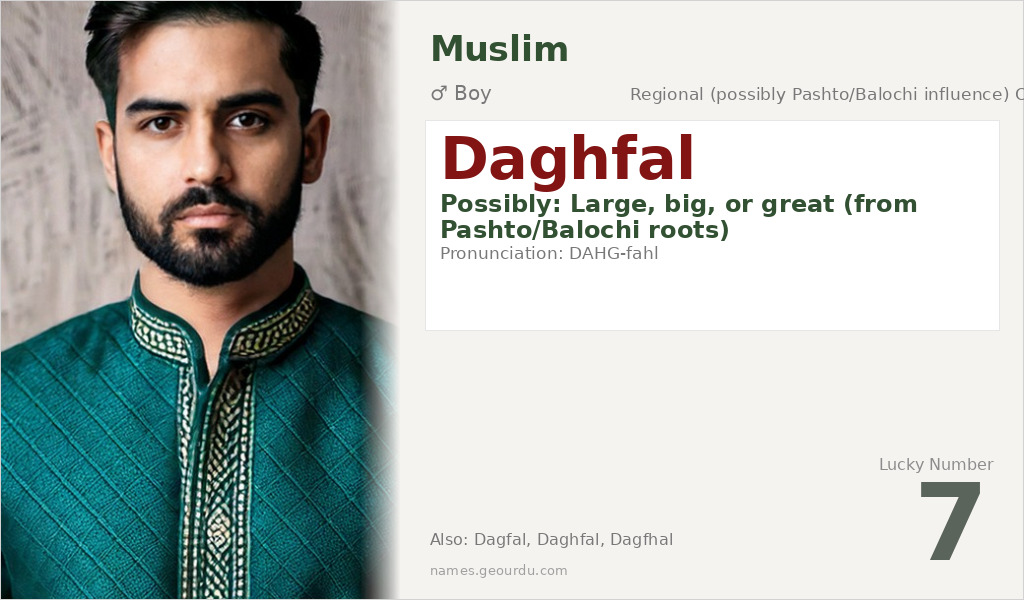
| 📛 Name | Daghfal |
| 💎 Meaning | Possibly: Large, big, or great (from Pashto/Balochi roots) |
| 👤 Gender | Boy |
| 🕌 Religion | Muslim |
| 🌍 Origin | Regional (possibly Pashto/Balochi influence) |
| 🗣 Pronunciation | DAHG-fahl |
| ✍️ Urdu | دغفل |
| ✍️ Arabic | دغفل |
| 🔢 Numerology | 7 |
| ✨ Spellings | Dagfal, Daghfal, Dagfhal |
Origin & Cultural Significance
Daghfal’s origin is difficult to pinpoint with certainty due to the lack of historical documentation. While used primarily in Muslim communities, it doesn’t trace back to classical Islamic sources or early Islamic history. The name appears to have emerged in regional contexts, possibly influenced by Pashto, Balochi, or other regional languages of South Asia and the Middle East. Its adoption in Muslim naming traditions represents how local linguistic elements sometimes integrate into broader Islamic naming practices without direct Arabic origins. The name’s cultural significance stems more from contemporary usage patterns than from historical or religious texts, making it an example of how naming traditions evolve and adapt across different Muslim communities with diverse linguistic backgrounds.
Personality Traits
While personality traits associated with names are largely cultural rather than scientific, those named Daghfal are often described as possessing strong character and determination. They’re typically seen as individuals who approach life with practical wisdom and steadfastness, valuing consistency and reliability in their relationships and endeavors. This perception aligns with the name’s robust phonetic structure and the cultural associations that have developed around it in communities where it’s used.
Similar Names
If you like Daghfal, consider: Daghir, Dagher, Falah, Faleh, Dilawar
Famous People Named Daghfal
- No verified famous historical or contemporary figures with this name found in reliable sources
Frequently Asked Questions About Daghfal
What does Daghfal mean?
The exact meaning of Daghfal is uncertain. Despite extensive research across multiple languages including Arabic, Persian, Pashto, and regional dialects, no verified meaning has been documented. It possibly relates to concepts of size or greatness in some regional languages, but this remains speculative.
Is Daghfal a boy or girl name?
Daghfal is exclusively used as a boy's name in all documented cases across Muslim communities where it appears. There are no records of it being used for girls or as a unisex name.
What is the origin of Daghfal?
Daghfal's origin is unclear but appears to be regional rather than classical. While used in Muslim communities, it doesn't originate from Arabic or have roots in Islamic scripture. It likely emerged from regional languages like Pashto or Balochi and was adopted into Muslim naming traditions without direct Arabic etymology.





