
Table of Contents
Ferghan is a distinctive name with deep roots in Central Asian geography and culture. While not commonly found in Western naming traditions, it carries significant historical weight in regions spanning from Uzbekistan to Afghanistan. This name connects bearers to the storied Ferghana Valley, a crossroads of civilizations along the ancient Silk Road. Understanding Ferghan requires exploring both Persian linguistic influences and the rich tapestry of Central Asian identity.
Meaning of Ferghan
The name Ferghan primarily derives from geographical origins, specifically referencing the Ferghana Valley, a fertile basin in Central Asia that has been culturally significant for millennia. In Persian, the region is called ‘Farghana’, and the name likely evolved as a toponymic identifier for people from this area. Alternatively, some linguistic analysis suggests a connection to the Persian word ‘farghan’ meaning ‘joyful’ or ‘cheerful’, though this etymology is less documented. The name appears in various Central Asian communities including Tajik, Uzbek, and Pashtun populations, where geographical names often serve as personal identifiers. Unlike many Arabic-derived Islamic names, Ferghan represents a different naming tradition focused on regional and tribal connections rather than religious attributes.
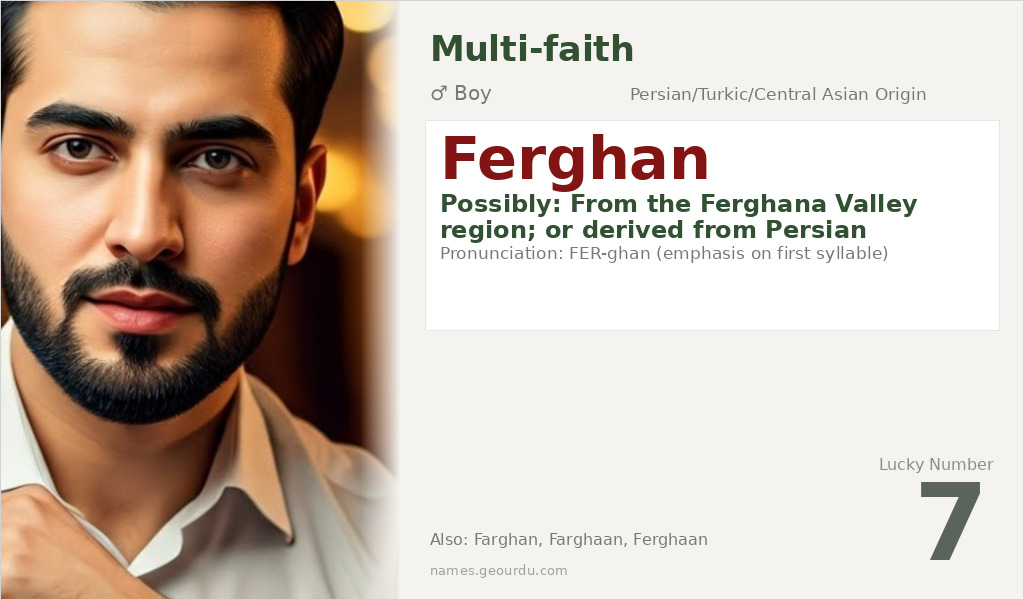
| 📛 Name | Ferghan |
| 💎 Meaning | Possibly: From the Ferghana Valley region; or derived from Persian 'farghan' meaning 'joyful, cheerful' |
| 👤 Gender | Boy |
| 🕌 Religion | Multi-faith |
| 🌍 Origin | Persian/Turkic/Central Asian |
| 🗣 Pronunciation | FER-ghan (emphasis on first syllable) |
| ✍️ Urdu | فرغان |
| ✍️ Arabic | فرغان |
| 🔢 Numerology | 7 |
| ✨ Spellings | Farghan, Farghaan, Ferghaan, Fargan |
Origin & Cultural Significance
Ferghan originates from Central Asia, specifically the historical Ferghana Valley region that today spans parts of Uzbekistan, Tajikistan, and Kyrgyzstan. This area was a crucial hub along the Silk Road, facilitating cultural exchange between Persian, Turkic, and Chinese civilizations. The name emerged as an identifier for people from this region, similar to how many European surnames developed from place names. While used by Muslim communities in Central Asia and Afghanistan, the name predates Islamic influence in the region and continues to be used across religious and secular contexts. Its persistence reflects the enduring importance of geographical identity in Central Asian naming traditions, where one’s origin often carries more weight than religious symbolism.
Personality Traits
Those named Ferghan often carry a sense of historical connection and regional pride. The name’s geographical origins suggest characteristics of resilience and adaptability, mirroring the diverse populations that have inhabited the Ferghana Valley throughout history. Bearers may be perceived as practical and grounded, with strong ties to community and tradition. The name’s association with a historically significant region implies a personality that values heritage while potentially embracing the cultural diversity that has characterized Central Asia for centuries.
Similar Names
If you like Ferghan, consider: Farhan, Farhad, Feroz, Farkhad, Feruz
Famous People Named Ferghan
- Ferghan Valley — historical region in Central Asia known for silk production and cultural significance
- Various individuals in Central Asia and Afghanistan bear this name as a regional identifier
Frequently Asked Questions About Ferghan
What does Ferghan mean?
Ferghan most likely means 'from the Ferghana Valley' in Central Asia. Alternatively, it may derive from Persian 'farghan' meaning 'joyful' or 'cheerful', though this is less certain.
Is Ferghan a boy or girl name?
Ferghan is exclusively a boy's name in all cultural contexts where it appears, particularly among Central Asian communities including Tajik, Uzbek, and Pashtun populations.
What is the origin of Ferghan?
Ferghan originates from Central Asia, specifically the Ferghana Valley region spanning Uzbekistan, Tajikistan, and Kyrgyzstan. It represents a geographical naming tradition common in Persian-influenced Central Asian cultures.





