
Table of Contents
Ghiyath is a distinguished Arabic name with deep roots in Islamic culture and history. Meaning ‘Helper’ or ‘One who provides succor,’ this name carries connotations of support, reliability, and compassion. From medieval sultans to modern families, Ghiyath has been chosen for boys who are expected to be pillars of strength for their communities. Its connection to one of Allah’s attributes adds spiritual significance for Muslim parents.
Meaning of Ghiyath
Ghiyath originates from the Arabic root غ-ی-ث (gh-y-th), which relates to helping, aiding, and providing assistance. The name is the active participle form of ‘ghātha,’ meaning ‘to come to the rescue’ or ‘to give timely help.’ In linguistic terms, it specifically denotes someone who offers support, particularly in difficult circumstances. This meaning is well-documented in classical Arabic dictionaries like Lisān al-ʿArab and modern etymological sources. The name appears in Islamic theology as Al-Ghiyāth (The Helper), one of the 99 Names of Allah, though when used for humans it typically stands alone or as part of compound names like Ghiyathuddin (Helper of the Faith).
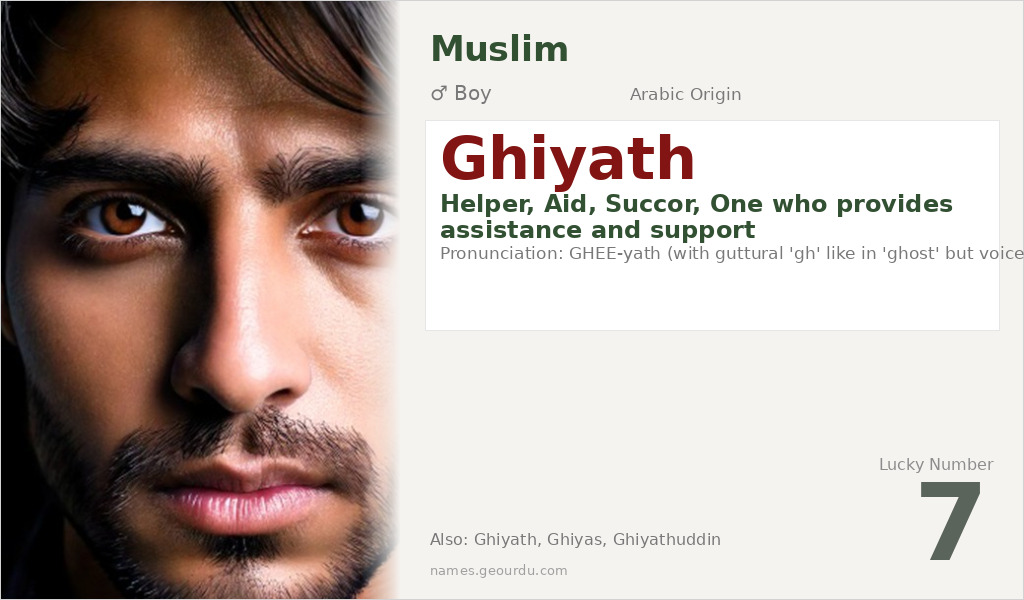
| 📛 Name | Ghiyath |
| 💎 Meaning | Helper, Aid, Succor, One who provides assistance and support |
| 👤 Gender | Boy |
| 🕌 Religion | Muslim |
| 🌍 Origin | Arabic |
| 🗣 Pronunciation | GHEE-yath (with guttural 'gh' like in 'ghost' but voiced) |
| ✍️ Urdu | غیاث |
| ✍️ Arabic | غیاث |
| 🔢 Numerology | 7 |
| ✨ Spellings | Ghiyath, Ghiyas, Ghiyathuddin, Ghiyasuddin, Ghiyath ud-Din |
Origin & Cultural Significance
Ghiyath has its origins in pre-Islamic and classical Arabic, with usage documented in early Islamic history. The name gained prominence during the medieval period, particularly among Muslim rulers and scholars in the Middle East and South Asia. Historical figures like Ghiyath al-Din Muhammad of the Ghurid Empire and Ghiyath al-Din Tughluq of the Delhi Sultanate helped popularize the name across the Islamic world. Today, it remains common in Arabic-speaking countries, as well as among Muslim communities in South Asia (Pakistan, India, Bangladesh), where it’s appreciated for its meaningful etymology and historical resonance. While sometimes used by Sindhi, Pashto, and Urdu speakers, the name maintains its Arabic linguistic roots.
Personality Traits
Those named Ghiyath are often associated with supportive and dependable qualities. They tend to be natural caregivers who prioritize helping others, whether in family, professional, or community contexts. This name suggests someone with strong ethical values, a sense of duty, and the emotional intelligence to provide comfort during challenging times. While individual personalities vary, the name’s meaning often inspires expectations of reliability and compassion.
Similar Names
If you like Ghiyath, consider: Nasir, Muin, Mansur, Ghalib, Ghaus
Famous People Named Ghiyath
- Ghiyath al-Din Tughluq — Founder of the Tughlaq Dynasty in Delhi Sultanate (14th century)
- Ghiyath al-Din Muhammad — Ghurid Sultan who expanded Islamic rule in South Asia (12th century)
Frequently Asked Questions About Ghiyath
What does Ghiyath mean?
Ghiyath means 'Helper,' 'Aid,' or 'Succor' in Arabic, derived from the root غ-ی-ث (gh-y-th) meaning 'to help.'
Is Ghiyath a boy or girl name?
Ghiyath is exclusively a boy's name in Arabic and Islamic naming traditions, though some similar-sounding names might be used differently in other cultures.
What is the origin of Ghiyath?
Ghiyath originates from classical Arabic and has been used in Islamic cultures for centuries, with notable historical bearers in medieval Muslim empires.





