
Table of Contents
Hanash is a distinctive Arabic name with deep historical roots in early Islamic tradition. While its literal meaning might surprise some, this name carries significant cultural heritage as it was borne by companions of the Prophet Muhammad. Understanding Hanash requires looking beyond surface translations to appreciate its place in Arabic naming conventions and Islamic history.
Meaning of Hanash
The name Hanash originates from the Arabic root ‘ḥ-n-sh’ (ح ن ش), which specifically denotes a snake or serpent. In classical Arabic literature and lexicons, ‘ḥanash’ appears as a term for certain types of snakes. This etymology is well-documented in authoritative Arabic dictionaries like Lisān al-ʿArab and Al-Qāmūs al-Muḥīṭ. Unlike some modern interpretations, the name’s meaning is not derived from hadith narration but rather from this established Arabic vocabulary. The connection to hadith comes from historical figures who bore the name, not from the name’s linguistic meaning itself.
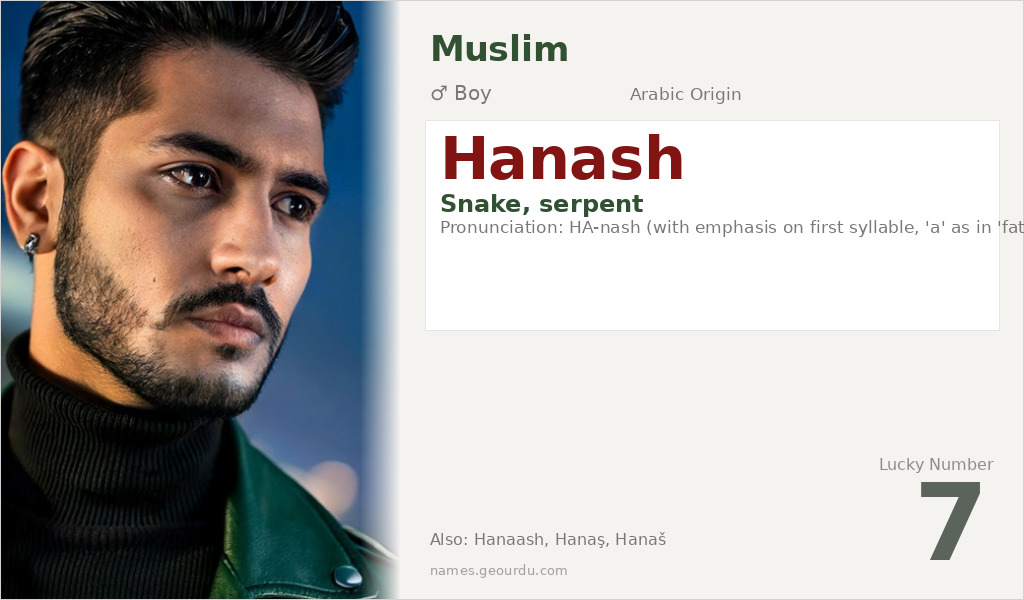
| 📛 Name | Hanash |
| 💎 Meaning | Snake, serpent |
| 👤 Gender | Boy |
| 🕌 Religion | Muslim |
| 🌍 Origin | Arabic |
| 🗣 Pronunciation | HA-nash (with emphasis on first syllable, 'a' as in 'father') |
| ✍️ Urdu | حنش |
| ✍️ Arabic | حنش |
| 🔢 Numerology | 7 |
| ✨ Spellings | Hanaash, Hanaş, Hanaš |
Origin & Cultural Significance
Hanash has its origins in pre-Islamic and early Islamic Arabia. The name appears in historical records primarily through Hanash ibn Abdullah al-San’ani, a companion (ṣaḥābī) of Prophet Muhammad from the San’a region of Yemen. He narrated several hadiths that appear in collections like Musnad Ahmad and Sunan al-Nasā’ī. The name represents a traditional Arabic naming pattern where animal names were common, often symbolizing desirable traits rather than literal characteristics. While used historically in Arab communities, the name remains relatively rare in modern times compared to more popular Arabic names.
Personality Traits
In Arabic naming traditions, names often influence perceived personality traits. For Hanash, the serpentine association suggests attributes like wisdom, protection, and strategic thinking—qualities often attributed to snakes in Middle Eastern symbolism. Those named Hanash might be seen as observant, resourceful individuals who approach challenges with careful consideration. The historical association with early Islamic scholars adds a dimension of spiritual depth and traditional values to the name’s character implications.
Similar Names
If you like Hanash, consider: Hanan, Hani, Hashim, Hassan, Hussein
Famous People Named Hanash
- Hanash ibn Abdullah al-San'ani — Companion of Prophet Muhammad and hadith narrator from 7th century Arabia
- Hanash al-San'ani — Early Islamic scholar and transmitter of prophetic traditions
Frequently Asked Questions About Hanash
What does Hanash mean?
Hanash means 'snake' or 'serpent' in Arabic, derived from the root word 'ḥ-n-sh' (ح ن ش).
Is Hanash a boy or girl name?
Hanash is exclusively a masculine name in Arabic and Islamic naming traditions, with no recorded usage as a female name.
What is the origin of Hanash?
Hanash originates from classical Arabic language and early Islamic history, most notably associated with Hanash ibn Abdullah al-San'ani, a companion of Prophet Muhammad from 7th century Arabia.





