
Table of Contents
Haseeb is a distinguished Arabic name with deep roots in Islamic culture, carrying connotations of respect and nobility. Popular among Muslim families worldwide, this name has maintained its appeal across generations while retaining its meaningful essence. From historical figures to modern athletes, bearers of this name often embody the dignified qualities it represents. Let’s explore the rich linguistic heritage and contemporary significance of this timeless name.
Meaning of Haseeb
Haseeb originates from the Arabic root ‘ḥ-s-b’ (ح-س-ب), which encompasses concepts of respect, honor, and esteem. The specific form ‘ḥasīb’ functions as an adjective meaning ‘respected, esteemed, noble, or honorable.’ This root appears in various Arabic words, including ‘ḥasab’ referring to noble lineage or pedigree, and ‘ḥisāb’ meaning calculation or accounting—though the name’s primary meaning relates to social standing rather than mathematics. The name has been documented in classical Arabic texts and historical records, consistently maintaining its association with dignity and respectability. Unlike some names that evolve significantly over time, Haseeb has preserved its core meaning across centuries of usage in Arab and Muslim communities.
| 📛 Name | Haseeb |
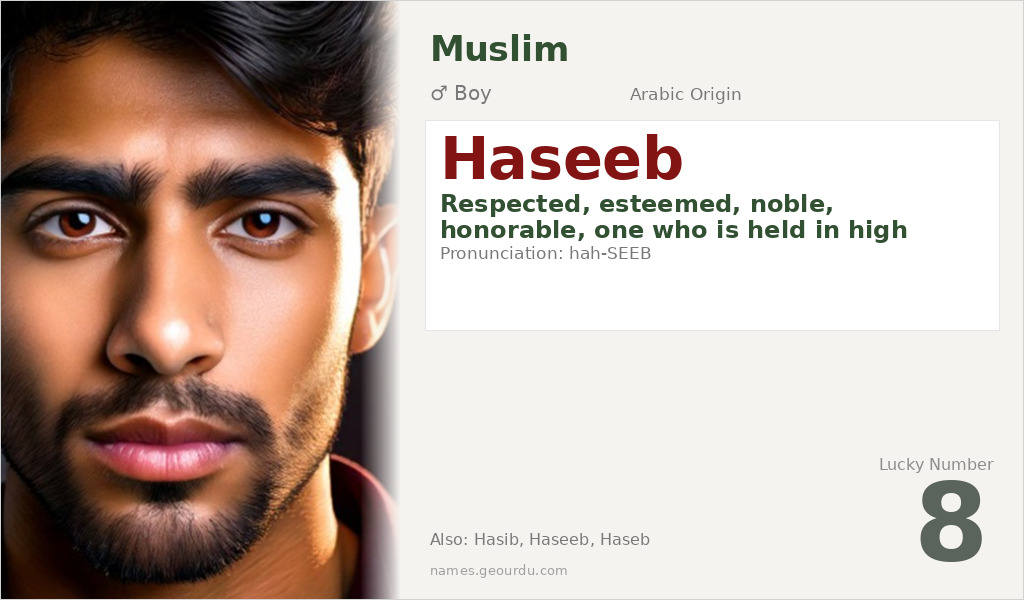
| 💎 Meaning | Respected, esteemed, noble, honorable, one who is held in high regard |
| 👤 Gender | Boy |
| 🕌 Religion | Muslim |
| 🌍 Origin | Arabic |
| 🗣 Pronunciation | hah-SEEB |
| ✍️ Urdu | حسیب |
| ✍️ Arabic | حَسِيب |
| 🔢 Numerology | 8 |
| ✨ Spellings | Hasib, Haseeb, Haseb, Haseeb, Haseeb |
Origin & Cultural Significance
Haseeb emerged from classical Arabic language and culture, where names reflecting virtuous qualities were highly valued. The name appears in early Islamic history and literature, though it gained particular popularity in various Muslim-majority regions including the Middle East, South Asia, and parts of Africa. In countries like Pakistan, India, Bangladesh, and Arab nations, Haseeb became established as a traditional name while maintaining its Arabic linguistic roots. The name’s association with respect and nobility made it appealing to families seeking meaningful names with positive connotations. Today, it remains in use across the Muslim world and among diaspora communities, often chosen for its dignified sound and established heritage.
Personality Traits
Those named Haseeb are frequently described as possessing natural dignity and a strong sense of honor. They often approach life with seriousness and responsibility, earning respect through consistent, principled behavior. While they may appear reserved initially, they typically prove to be loyal and dependable individuals who value meaningful relationships over superficial connections. Their thoughtful nature often makes them effective problem-solvers who consider multiple perspectives before acting.
Similar Names
If you like Haseeb, consider: Hashem, Hassan, Hussein, Haris, Hamza, Hadi, Hakim, Hatim, Haytham, Hisham
Famous People Named Haseeb
- Haseeb Ahsan — Pakistani cricketer who played for Pakistan national team in the 1970s
- Haseeb Hameed — English cricketer of Pakistani descent who plays for Nottinghamshire and England
Frequently Asked Questions About Haseeb
What does Haseeb mean?
Haseeb means 'respected, esteemed, noble, honorable' in Arabic, derived from the root 'ḥ-s-b' relating to respect and dignity.
Is Haseeb a boy or girl name?
Haseeb is exclusively a boy's name in Arabic and Muslim naming traditions, with no feminine usage in historical or contemporary records.
What is the origin of Haseeb?
Haseeb originates from classical Arabic language and culture, specifically from the adjective 'ḥasīb' meaning 'respected, esteemed.' It has been used in Muslim communities for centuries.





