
Table of Contents
Hasham is a distinguished Arabic name with deep roots in Islamic history and culture. Carrying the beautiful meaning of ‘generous’ or ‘noble’, this name has been borne by significant historical figures and continues to be a popular choice for boys in Muslim communities worldwide. Its association with the Banu Hashim clan, the tribe of Prophet Muhammad, adds layers of historical prestige and religious significance. Discover the rich etymology, cultural context, and modern relevance of this classic name.
Meaning of Hasham
Hasham derives from the Arabic root ‘hashama’ (هشم), which literally means ‘to break’ or ‘to crush’. However, in the context of personal names, it evolved to specifically mean ‘one who breaks bread for others’ or ‘one who provides food generously’. This metaphorical meaning reflects the cultural importance of hospitality and generosity in Arab society. The name is most famously associated with ‘Amr al-‘Ulā, the great-grandfather of Prophet Muhammad, who earned the nickname Hasham for his practice of providing food to pilgrims during the Hajj season. Throughout Islamic history, the name has maintained its core connotations of munificence, dignity, and noble character. In contemporary usage across Arabic, Persian, Urdu, and other languages influenced by Islamic culture, Hasham consistently carries these positive attributes.
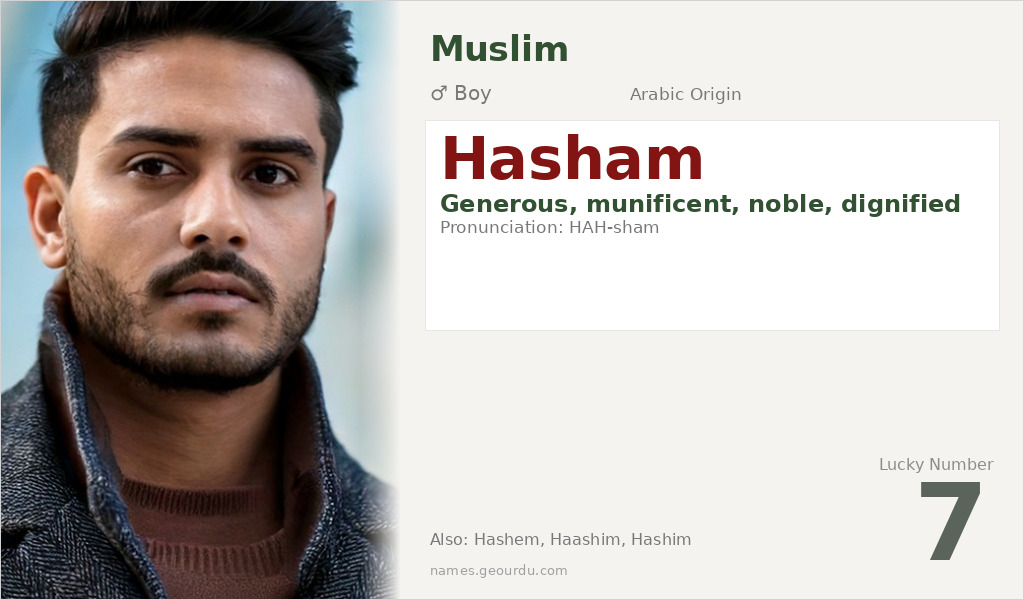
| 📛 Name | Hasham |
| 💎 Meaning | Generous, munificent, noble, dignified |
| 👤 Gender | Boy |
| 🕌 Religion | Muslim |
| 🌍 Origin | Arabic |
| 🗣 Pronunciation | HAH-sham |
| ✍️ Urdu | ہاشم |
| ✍️ Arabic | هاشم |
| 🔢 Numerology | 7 |
| ✨ Spellings | Hashem, Haashim, Hashim, Haşim |
Origin & Cultural Significance
Hasham originates from classical Arabic and holds particular significance in Islamic history as the name of the Banu Hashim (Hashimite) clan, the tribe of Prophet Muhammad. This clan was part of the larger Quraysh tribe in pre-Islamic Mecca and was known for its leadership and generosity. The name spread throughout the Muslim world following the expansion of Islam, becoming established in Persian, Turkish, Urdu, and other languages within Muslim-majority regions. In South Asia, it gained popularity through Islamic scholarly and cultural transmission, while in the Middle East it remains a classic name with historical prestige. The Hashimite dynasty, which has ruled Jordan since 1921, further reinforces the name’s association with leadership and nobility in modern contexts.
Personality Traits
Those named Hasham are often associated with qualities of generosity, dignity, and noble bearing. They tend to be natural providers who take seriously their responsibilities toward family and community. With historical connections to leadership and hospitality, individuals with this name may exhibit strong social intelligence and a desire to contribute positively to their surroundings. Their generous nature typically makes them well-respected and appreciated in both personal and professional relationships.
Similar Names
If you like Hasham, consider: Hashim, Karim, Jawad, Kareem, Sakhi
Famous People Named Hasham
- Hasham Ali — Pakistani cricketer who played for Lahore cricket team
- Hasham Khan — 17th century Pashtun warrior and tribal leader from the Khattak tribe
Frequently Asked Questions About Hasham
What does Hasham mean?
Hasham is an Arabic name meaning 'generous', 'munificent', 'noble', or 'dignified'. It specifically refers to someone who provides generously for others, with historical roots in the practice of providing food to pilgrims.
Is Hasham a boy or girl name?
Hasham is exclusively a boy's name in all cultural contexts where it is used, particularly in Muslim communities across Arabic, Persian, Urdu, and other linguistic traditions.
What is the origin of Hasham?
Hasham originates from classical Arabic and is deeply connected to Islamic history as the name of the Banu Hashim clan, the tribe of Prophet Muhammad. It spread throughout the Muslim world and is now used in various Muslim-majority cultures.





