
Table of Contents
Habil is a name rich with religious and historical significance, tracing back to the earliest human narratives in both biblical and Quranic traditions. As the Arabic form of Abel, this name carries profound spiritual meaning across Abrahamic faiths. Whether you’re drawn to its deep roots or its connection to one of humanity’s foundational stories, Habil offers a name with timeless resonance. This guide explores the complete etymology, cultural context, and modern usage of this ancient name.
Meaning of Habil
Habil originates from the Hebrew name Hevel (הֶבֶל), which literally means ‘breath,’ ‘vapor,’ or ‘transience’ in its original linguistic context. This Hebrew term appears in Ecclesiastes with the famous phrase ‘vanity of vanities, all is vanity’ (hevel havalim). In Arabic, the name became Habil (هابيل) and specifically refers to Abel, the second son of Adam and Eve in Abrahamic traditions. The transition from Hebrew to Arabic occurred through early Islamic contact with Judeo-Christian narratives, with the name being fully integrated into Quranic Arabic. While the literal Hebrew meaning reflects ephemerality, in Islamic context Habil is understood as the righteous son who was wrongfully killed, giving the name connotations of innocence and martyrdom.
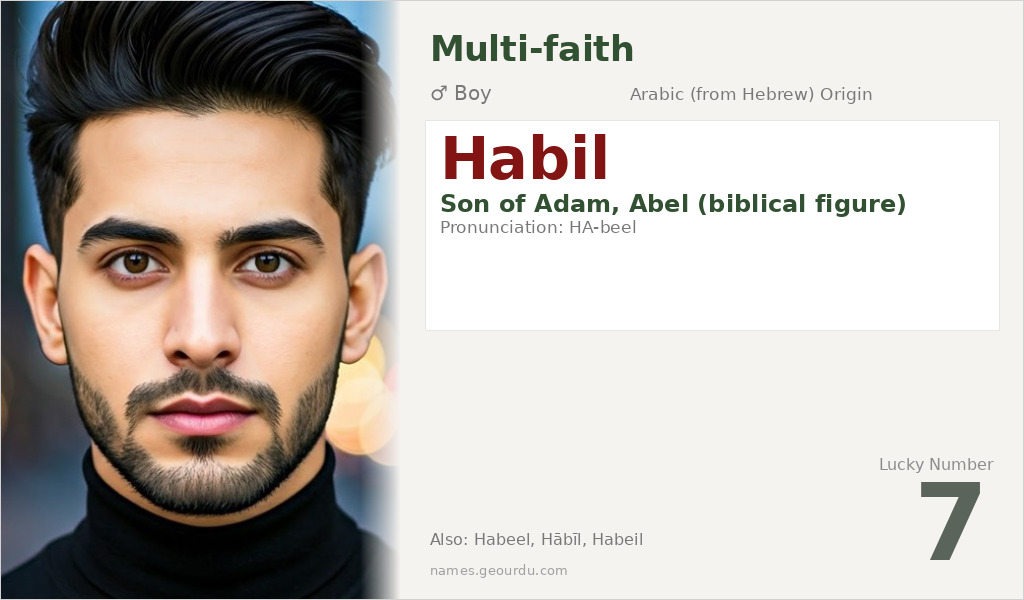
| 📛 Name | Habil |
| 💎 Meaning | Son of Adam, Abel (biblical figure) |
| 👤 Gender | Boy |
| 🕌 Religion | Multi-faith |
| 🌍 Origin | Arabic (from Hebrew) |
| 🗣 Pronunciation | HA-beel |
| ✍️ Urdu | ہابیل |
| ✍️ Arabic | هابيل |
| 🔢 Numerology | 7 |
| ✨ Spellings | Habeel, Hābīl, Habeil |
Origin & Cultural Significance
Habil’s origins are firmly rooted in Middle Eastern religious texts, appearing in both the Hebrew Bible (as Abel) and the Quran (as Habil). The name entered Arabic through early Islamic engagement with biblical stories during the 7th century CE. In Islamic tradition, Habil’s story is recounted in Surah Al-Ma’idah (5:27-32), where he and his brother Qabil (Cain) make offerings to God. The name has been used primarily in Muslim communities but also appears among Arabic-speaking Christians. While most common in Arabic-speaking regions, variations of the name exist in other languages that have absorbed biblical narratives, though the Arabic form Habil remains distinctive to Islamic and Arab cultural contexts.
Personality Traits
Based on the traditional narrative, individuals named Habil are often associated with qualities of righteousness, peacefulness, and moral integrity. The biblical and Quranic story portrays Habil as the innocent victim who maintains his principles even in conflict. This legacy suggests someone who values fairness, avoids confrontation when possible, and stands firm in their beliefs. While these associations come from religious texts rather than psychological studies, they continue to influence how the name is perceived in cultures familiar with the Abrahamic traditions.
Similar Names
If you like Habil, consider: Qabil, Adam, Idris, Yusuf, Harun
Famous People Named Habil
- Habil (Abel) — Biblical and Quranic figure, son of Adam and Eve
- Habil Aliyev — Azerbaijani musician and tar player
Frequently Asked Questions About Habil
What does Habil mean?
Habil means 'Son of Adam' and is the Arabic name for Abel, the biblical/Quranic figure. It originates from Hebrew Hevel meaning 'breath' or 'vapor.'
Is Habil a boy or girl name?
Habil is exclusively a boy's name, as it refers to a male biblical/Quranic figure – the son of Adam and brother of Qabil (Cain).
What is the origin of Habil?
Habil originates from Hebrew through Arabic adaptation. It's the Arabic form of the biblical name Abel, integrated into Islamic tradition through Quranic revelation.





