
Table of Contents
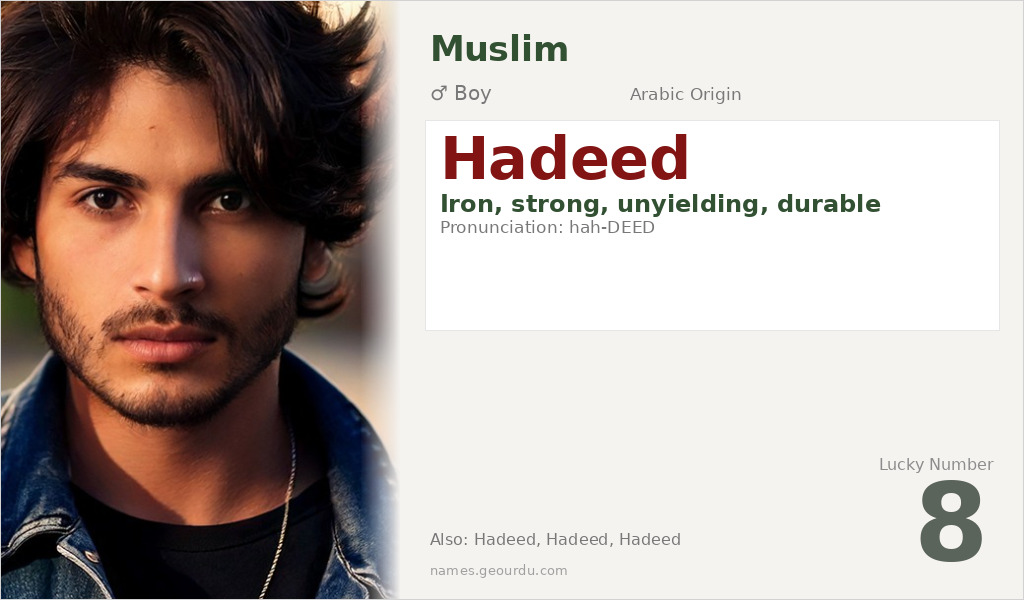
Hadeed is a powerful and meaningful name deeply rooted in Arabic language and Islamic tradition. Derived from the word for ‘iron,’ it evokes images of strength, resilience, and unbreakable character. Commonly chosen for boys in Muslim families, this name carries both linguistic elegance and spiritual significance, making it a timeless choice. Explore the rich etymology, cultural context, and personality traits associated with Hadeed in this comprehensive guide.
Meaning of Hadeed
Hadeed (حدید) is an Arabic name that directly translates to ‘iron,’ derived from the root Ḥ-D-D (ح-د-د), which conveys sharpness and edge. In the Quran, Surah Al-Hadid (Chapter 57) mentions iron as a material endowed with great power and utility for humanity, highlighting its symbolic importance in Islamic teachings. The name embodies qualities such as strength, durability, and firmness, often associated with a sharp mind and resilient spirit. Linguistically, it is a masculine noun used both as a common word and a proper name, reflecting its deep cultural resonance across Arabic-speaking and Muslim communities.
| 📛 Name | Hadeed |
| 💎 Meaning | Iron, strong, unyielding, durable |
| 👤 Gender | Boy |
| 🕌 Religion | Muslim |
| 🌍 Origin | Arabic |
| 🗣 Pronunciation | hah-DEED |
| ✍️ Urdu | حدید |
| ✍️ Arabic | حدید |
| 🔢 Numerology | 8 |
| ✨ Spellings | Hadeed, Hadeed, Hadeed, Hadeed |
Origin & Cultural Significance
Originating from Classical Arabic, Hadeed has been used for centuries in the Middle East and South Asia, particularly among Muslim populations. Its prominence is reinforced by its appearance in the Quran, where iron is praised for its benefits, linking the name to Islamic heritage and values. The name is prevalent in countries like Saudi Arabia, Pakistan, India, and Iran, often chosen to inspire qualities of endurance and steadfastness. While primarily Arabic, it has influenced naming traditions in related languages such as Urdu and Persian, maintaining its core meaning without significant variation.
Personality Traits
People named Hadeed are often seen as strong, determined, and reliable, mirroring the properties of iron—unyielding and durable. They may exhibit a sharp intellect and practical approach to life, with a tendency to stand firm in their beliefs and responsibilities. This name suggests a personality that is resilient in challenges and steadfast in commitments, making Hadeed a name associated with leadership and integrity.
Similar Names
If you like Hadeed, consider: Hadi, Hasan, Hamid, Hussein, Haroon
Famous People Named Hadeed
- Hadeed — Common as a surname in Arabic-speaking regions, e.g., in business or sports
- Hadeed — Fictional or historical figures in Islamic literature referencing strength or iron
Frequently Asked Questions About Hadeed
What does Hadeed mean?
Hadeed means 'iron' in Arabic, symbolizing strength, durability, and resilience, with roots in the Quranic Surah Al-Hadid.
Is Hadeed a boy or girl name?
Hadeed is exclusively a boy's name in Arabic and Islamic naming traditions, derived from a masculine noun.
What is the origin of Hadeed?
Hadeed originates from Arabic, with direct ties to Islamic culture through its mention in the Quran, and is used widely in Muslim communities.





