
Table of Contents
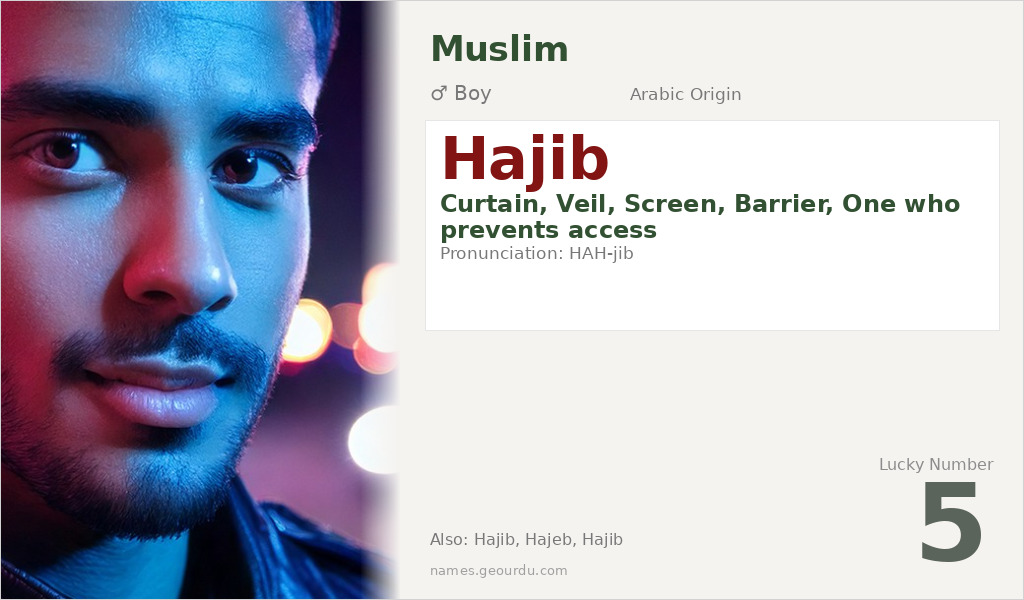
Hajib is a distinguished Arabic name for boys, rich in historical and linguistic significance. Stemming from the root meaning ‘to veil or screen’, it evokes images of protection and authority. Traditionally associated with the role of a chamberlain in Islamic courts, this name carries a legacy of dignity and responsibility. Explore the deep etymology and cultural context of Hajib in this comprehensive guide.
Meaning of Hajib
Hajib (حاجب) is derived from the Arabic triliteral root ح-ج-ب (ḥ-j-b), which conveys the core ideas of veiling, screening, concealing, or preventing access. As a masculine noun, ‘ḥājib’ literally translates to ‘curtain’, ‘veil’, ‘screen’, or ‘barrier’, and by extension, ‘one who performs this action’. In classical Arabic usage, it specifically referred to a chamberlain—a high official who controlled entry to a ruler, acting as a gatekeeper or protector. This etymological background highlights the name’s connotations of guardianship, separation, and authority, making it a meaningful choice symbolizing protection and dignity.
| 📛 Name | Hajib |
| 💎 Meaning | Curtain, Veil, Screen, Barrier, One who prevents access |
| 👤 Gender | Boy |
| 🕌 Religion | Muslim |
| 🌍 Origin | Arabic |
| 🗣 Pronunciation | HAH-jib |
| ✍️ Urdu | حاجب |
| ✍️ Arabic | حاجب |
| 🔢 Numerology | 5 |
| ✨ Spellings | Hajib, Hajeb, Hajib, Hajib |
Origin & Cultural Significance
Hajib originates from the Arabic language and is deeply embedded in Islamic history and culture. It gained prominence during the medieval Islamic empires, such as the Abbasid and Umayyad caliphates, where the ‘ḥājib’ was a key court official responsible for managing access to the caliph or sultan. This role underscored the name’s association with trust, power, and administrative duty. While primarily used in Muslim communities, the name’s linguistic roots are purely Arabic, without significant variants in Persian, Pashto, Urdu, or other regional languages, though it may be adopted in diverse Muslim cultures. Its historical usage as a title adds a layer of nobility and tradition to the name.
Personality Traits
Those named Hajib are often seen as composed and authoritative, reflecting the name’s meaning of screening and protection. They may naturally assume roles that involve safeguarding others or maintaining order, with a strong sense of duty and reliability. Their personality can blend discretion with leadership, making them respected figures in their circles, much like the historical chamberlains who bore this name.
Similar Names
If you like Hajib, consider: Hafiz, Haris, Hamid, Hasan, Hakim
Famous People Named Hajib
- Hajib ibn Yusuf — Historical figure, a chamberlain in the Abbasid court during the 9th century, known for his administrative role
- Hajib al-Dawla — Title used by various officials in medieval Islamic empires, meaning 'Chamberlain of the State'
Frequently Asked Questions About Hajib
What does Hajib mean?
Hajib means 'Curtain', 'Veil', 'Screen', 'Barrier', or 'One who prevents access' in Arabic, derived from the root ح-ج-ب (ḥ-j-b) meaning 'to veil or screen'. Historically, it referred to a chamberlain in Islamic courts.
Is Hajib a boy or girl name?
Hajib is exclusively a boy name in Arabic and Muslim naming traditions, as it is a masculine noun and historically associated with male officials.
What is the origin of Hajib?
Hajib originates from the Arabic language, with deep roots in Islamic history where it was used as a title for chamberlains in medieval courts, symbolizing protection and authority.





