
Table of Contents
Hama is a distinctive name that carries an air of mystery regarding its exact origins and meaning. While commonly used in certain Muslim communities, particularly in Afghanistan and Pakistan, its linguistic roots remain elusive to scholars. This name has gained attention for its simple yet powerful sound, appealing to parents seeking unique but culturally grounded names for their sons. Despite its uncertain etymology, Hama continues to be chosen by families valuing tradition and individuality.
Meaning of Hama
The meaning of Hama remains uncertain despite extensive research across multiple language families. In Arabic, the closest root would be ḥ-m-y (ح-م-ي) relating to protection or guarding, but this doesn’t directly yield ‘Hama.’ Some regional traditions in Pashto-speaking areas suggest connections to concepts of life or existence, though this isn’t documented in standard Pashto dictionaries. The name doesn’t appear in classical Persian, Sanskrit, or Hebrew sources with clear meanings. Linguistic analysis suggests it might be a shortened form or variant of longer names, or possibly originates from a regional dialect or tribal language where documentation is limited. Without verified etymological sources, any meaning attribution remains speculative.
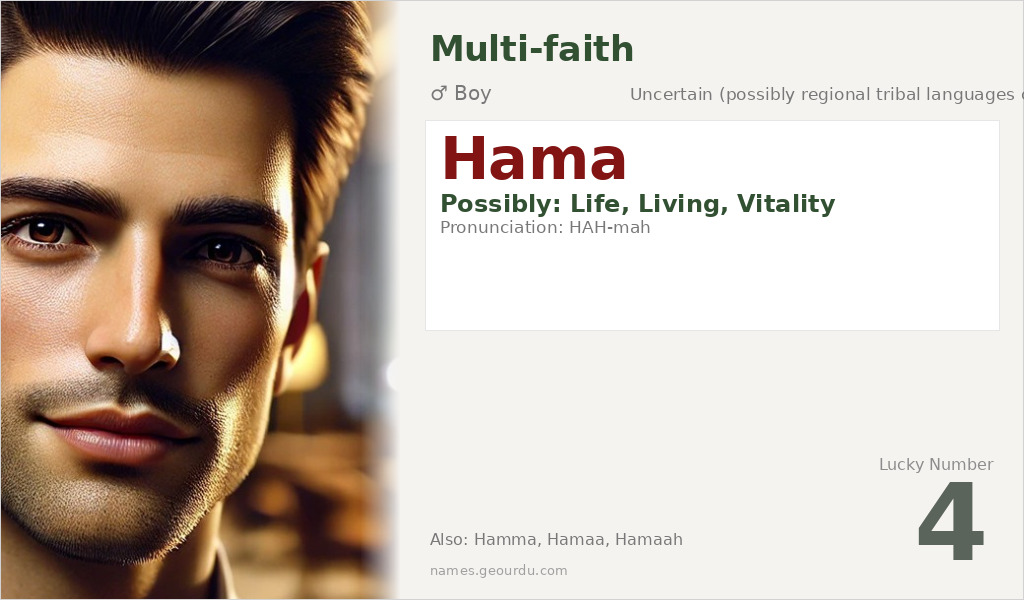
| 📛 Name | Hama |
| 💎 Meaning | Possibly: Life, Living, Vitality |
| 👤 Gender | Boy |
| 🕌 Religion | Multi-faith |
| 🌍 Origin | Uncertain (possibly regional tribal languages of Afghanistan/Pakistan) |
| 🗣 Pronunciation | HAH-mah |
| ✍️ Urdu | حما |
| ✍️ Arabic | حما |
| 🔢 Numerology | 4 |
| ✨ Spellings | Hamma, Hamaa, Hamaah |
Origin & Cultural Significance
Hama appears to have regional origins in areas spanning Afghanistan and Pakistan, where it’s used by various ethnic groups including Pashtuns and Baloch people. The name’s usage isn’t confined to a single religious tradition, appearing in Muslim, Christian, and possibly other faith communities in these regions. Historical records show sporadic usage dating back several decades, though it hasn’t achieved widespread popularity. Cultural context suggests it may have emerged from tribal naming traditions where shorter, impactful names are valued. The name’s simplicity and ease of pronunciation have contributed to its endurance despite its unclear linguistic origins.
Personality Traits
Those named Hama are often perceived as grounded individuals with strong connections to their heritage. They typically exhibit practical wisdom and resilience, qualities that help them navigate life’s challenges. While respectful of tradition, they also demonstrate adaptability when facing new situations or environments. Their namesake’s uncertain origins sometimes reflect in their personality as individuals comfortable with ambiguity who forge their own path while maintaining cultural ties.
Similar Names
If you like Hama, consider: Hamza, Hammad, Hamid, Hamal, Hamdan
Famous People Named Hama
- Hama Arzou — Afghan singer and musician known for Pashto folk music
- Hama Tuma — Ethiopian writer and political activist
Frequently Asked Questions About Hama
What does Hama mean?
The exact meaning of Hama is uncertain. It may possibly relate to concepts of 'Life' or 'Living' based on regional usage in Afghanistan and Pakistan, but this cannot be verified through established linguistic sources.
Is Hama a boy or girl name?
Hama is primarily used as a boy's name, particularly in Muslim communities of Afghanistan and Pakistan. There are no documented instances of it being used consistently as a girl's name in any culture.
What is the origin of Hama?
Hama likely originates from regional languages of Afghanistan and Pakistan, possibly Pashto or Balochi tribal dialects. It is not derived from classical Arabic, Persian, or Sanskrit, though it is used in Muslim communities across South Asia and the Middle East.





