
Table of Contents
Husam Ud Dawlah is a powerful Arabic name with deep historical roots in Islamic culture. Meaning ‘Sword of the State’, this name evokes images of protection, leadership, and governmental authority. Traditionally given to boys, it carries connotations of bravery and duty, often associated with rulers and military commanders. Explore the rich linguistic and cultural background of this distinguished name.
Meaning of Husam Ud Dawlah
Husam Ud Dawlah is an Arabic compound name with a clear and well-documented meaning. ‘Husam’ (حسام) translates to ‘sword’, derived from the root ح-س-م (ḥ-s-m), which relates to cutting or decisiveness. ‘Ud’ is the assimilated form of the Arabic definite article ‘al-‘ (ال), meaning ‘the’. ‘Dawlah’ (دولة) means ‘state’, ‘government’, or ‘dynasty’, from the root د-و-ل (d-w-l), associated with the rotation or alternation of power, as in political cycles. Thus, the full name literally means ‘Sword of the State’, symbolizing a defender or protector of the government. This name is historically used as a title or laqab (honorific) in Islamic societies, particularly during the medieval period, to denote military and political leaders.
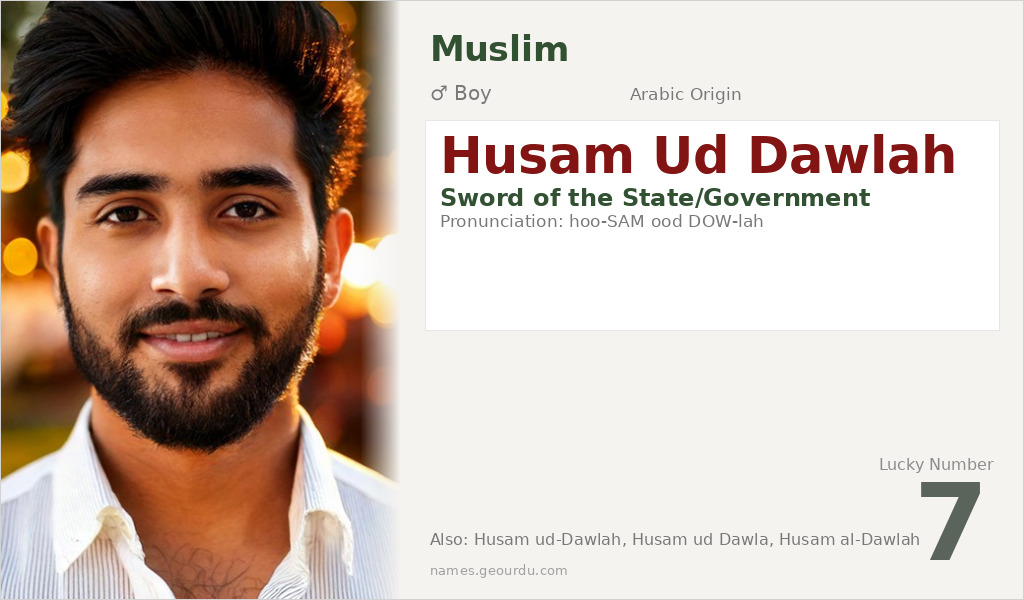
| 📛 Name | Husam Ud Dawlah |
| 💎 Meaning | Sword of the State/Government |
| 👤 Gender | Boy |
| 🕌 Religion | Muslim |
| 🌍 Origin | Arabic |
| 🗣 Pronunciation | hoo-SAM ood DOW-lah |
| ✍️ Urdu | حسام الدولہ |
| ✍️ Arabic | حسام الدولة |
| 🔢 Numerology | 7 |
| ✨ Spellings | Husam ud-Dawlah, Husam ud Dawla, Husam al-Dawlah, Husam al-Dawla |
Origin & Cultural Significance
Husam Ud Dawlah originates from classical Arabic and has been used historically across the Islamic world, especially in the Middle East and South Asia. It emerged as a laqab (honorific title) during the Abbasid and later periods, often bestowed upon rulers, generals, and nobles for their service to the state. The name reflects the fusion of martial and administrative ideals in Islamic governance, where the sword symbolized both military prowess and justice. While primarily associated with Arabic-speaking cultures, it has been adopted in regions like Persia, Turkey, and the Indian subcontinent through Islamic influence. Notable historical figures with this name include Buyid and Seljuk commanders, highlighting its aristocratic and leadership connotations.
Personality Traits
Those named Husam Ud Dawlah are often seen as natural leaders with a protective and authoritative demeanor. The name’s meaning suggests traits such as courage, decisiveness, and a strong sense of responsibility towards community or governance. Individuals with this name may exhibit strategic thinking and organizational skills, inspired by its historical use among rulers and defenders. While personality varies, the name carries an expectation of integrity and strength, aligning with its etymological roots in statecraft and martial virtue.
Similar Names
If you like Husam Ud Dawlah, consider: Husam, Dawlah, Saif ud-Dawlah, Nasir ud-Dawlah, Imad ud-Dawlah
Famous People Named Husam Ud Dawlah
- Husam ud-Dawlah — 11th-century Buyid ruler of Hamadan, known for his military campaigns and patronage of scholars
- Husam al-Dawla — historical title used by various Islamic rulers, including Fatimid and Seljuk commanders
Frequently Asked Questions About Husam Ud Dawlah
What does Husam Ud Dawlah mean?
Husam Ud Dawlah means 'Sword of the State' or 'Sword of the Government' in Arabic, combining 'Husam' (sword) and 'Dawlah' (state/government).
Is Husam Ud Dawlah a boy or girl name?
Husam Ud Dawlah is exclusively a boy name in Arabic and Islamic naming traditions, reflecting its martial and leadership connotations.
What is the origin of Husam Ud Dawlah?
Husam Ud Dawlah originates from Arabic and has been used historically as an honorific title in Islamic cultures, particularly in the Middle East and South Asia.





