Table of Contents
Kamil is a distinguished Arabic name that carries profound spiritual and linguistic weight. Primarily used for boys in Muslim communities worldwide, it embodies ideals of perfection and completeness. This name has traversed centuries, maintaining its relevance through its rich etymological roots and cultural adaptability. Discover the depth behind Kamil, from its classical origins to its modern-day resonance.
Meaning of Kamil
Kamil originates from the Arabic root K-M-L (ك-م-ل), which fundamentally means ‘to complete,’ ‘to perfect,’ or ‘to be whole.’ In Arabic philology, words derived from this root, such as ‘kamāl’ (perfection) and ‘istikmāl’ (completion), highlight the name’s association with achieving full potential. The adjective ‘kāmil’ is used in classical texts to describe a person of impeccable character or an object in its flawless state. Within Islamic tradition, the concept of ‘al-insān al-kāmil’ (the perfect human) refers to an ideal of spiritual completeness, often associated with prophets and saints. Thus, the name Kamil not only signifies literal perfection but also conveys aspirational moral and spiritual dimensions.
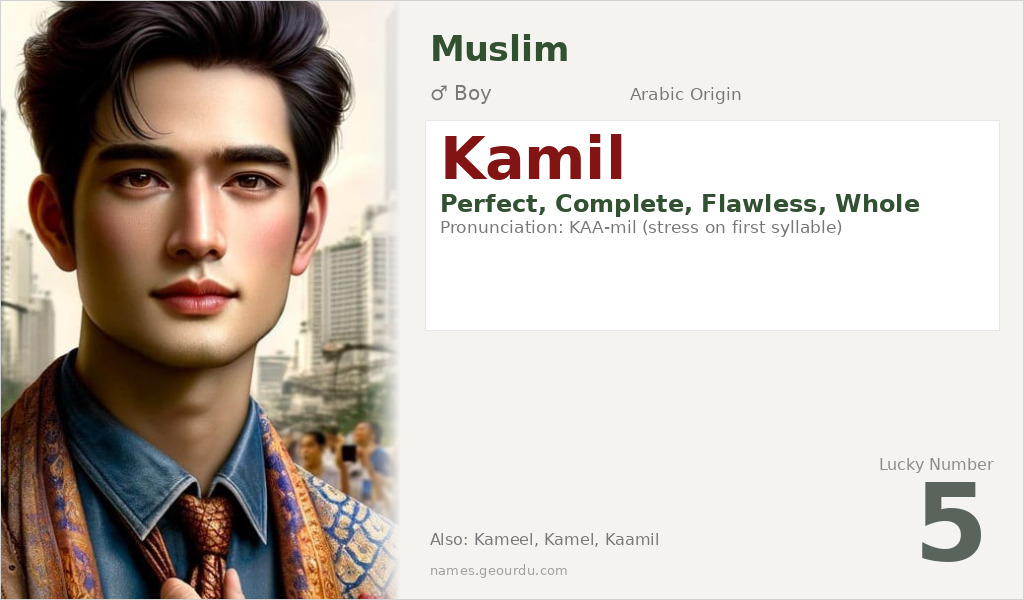
| 📛 Name | Kamil |
| 💎 Meaning | Perfect, Complete, Flawless, Whole |
| 👤 Gender | Boy |
| 🕌 Religion | Muslim |
| 🌍 Origin | Arabic |
| 🗣 Pronunciation | KAA-mil (stress on first syllable) |
| ✍️ Urdu | کامل |
| ✍️ Arabic | كامل |
| 🔢 Numerology | 5 |
| ✨ Spellings | Kameel, Kamel, Kaamil, Camille (French/Latin variant, though feminine in modern usage), Kâmil (with circumflex in Turkish) |
Origin & Cultural Significance
Kamil has its origins in pre-Islamic and classical Arabic, where it was used to denote completeness and perfection. With the advent of Islam, the name gained religious significance, appearing in discussions of theology and ethics, though it is not directly a Quranic name. It spread across the Muslim world through Arabic influence, becoming common in regions such as the Middle East, South Asia (e.g., Urdu-speaking communities), Turkey, and the Balkans. In Turkish, it is spelled ‘Kâmil’ and retains the same meaning. The name’s adoption reflects the cultural exchange within the Islamic civilization, where Arabic linguistic elements were integrated into local naming practices while preserving core meanings.
Personality Traits
Named after the ideal of perfection, individuals called Kamil often embody traits of diligence, integrity, and a quest for excellence. They may be seen as reliable and thorough, with a natural drive to complete tasks to the highest standard. This name can inspire a personality that values harmony, self-improvement, and moral clarity, making Kamils often respected for their consistent and principled approach to life.
Similar Names
If you like Kamil, consider: Kamal (meaning 'perfection' or 'beauty' in Arabic), Karam (meaning 'generosity' in Arabic), Karim (meaning 'generous' in Arabic), Salim (meaning 'safe, complete' in Arabic), Jamil (meaning 'beautiful' in Arabic)
Famous People Named Kamil
- Kamil al-Husayni — Grand Mufti of Jerusalem in early 20th century
- Kamil Grosicki — Polish professional footballer of Polish and Tatar descent
Frequently Asked Questions About Kamil
What does Kamil mean?
Kamil means 'perfect,' 'complete,' 'flawless,' or 'whole' in Arabic, derived from the root K-M-L (ك-م-ل).
Is Kamil a boy or girl name?
Kamil is traditionally a boy's name in Arabic and Muslim cultures, though the variant Camille is used for girls in French and other Western contexts.
What is the origin of Kamil?
Kamil originates from Arabic, with its roots in classical Arabic language and Islamic tradition, and has spread to various cultures including Persian, Urdu, and Turkish.