
Table of Contents
Khalilullah is a profoundly meaningful Arabic name with deep roots in Islamic tradition. More than just a beautiful combination of words, this name carries the weight of prophetic honor and spiritual intimacy. As you explore this name, you’ll discover its connection to one of Islam’s most revered prophets and understand why it remains a cherished choice for Muslim families worldwide. The name represents the highest form of divine friendship in Abrahamic faiths.
Meaning of Khalilullah
Khalilullah is a compound Arabic name with two distinct components that together create a powerful spiritual meaning. The first part, ‘Khalil’ (خليل), derives from the Arabic root kh-l-l (خ ل ل), which conveys concepts of friendship, intimacy, and close companionship. The second part, ‘Allah’ (الله), is the Arabic word for God, used by Muslims, Arabic-speaking Christians, and Jews. When combined, Khalilullah literally translates to ‘Friend of God’ or ‘Companion of Allah.’ This specific formulation is most famously associated with Prophet Ibrahim (Abraham), who is uniquely honored with this title in Islamic scripture. The Quran references Ibrahim as ‘Khalilullah’ in Surah An-Nisa (4:125), establishing this as a special prophetic designation rather than a general descriptive term.
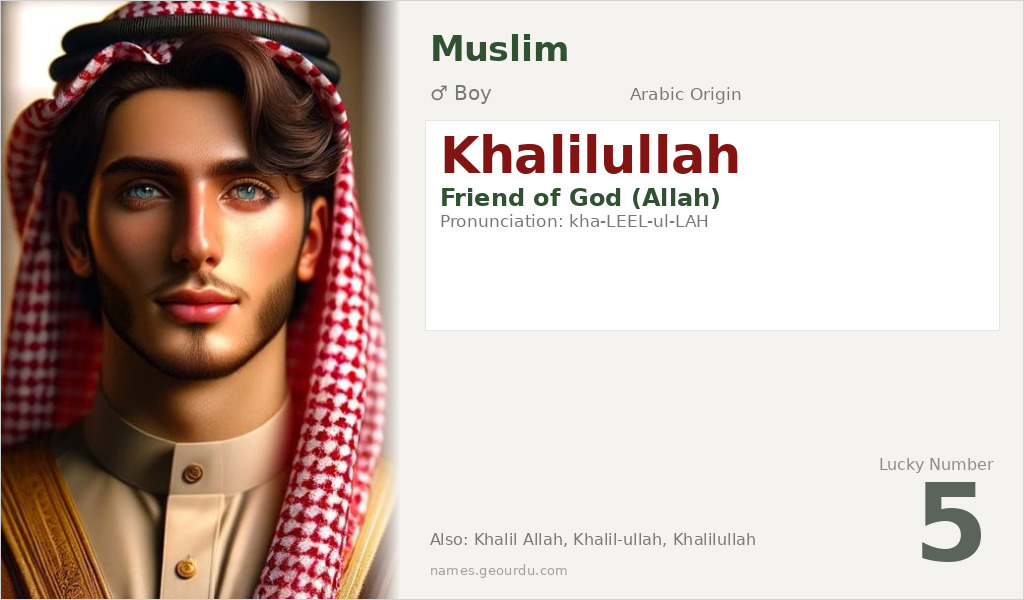
| 📛 Name | Khalilullah |
| 💎 Meaning | Friend of God (Allah) |
| 👤 Gender | Boy |
| 🕌 Religion | Muslim |
| 🌍 Origin | Arabic |
| 🗣 Pronunciation | kha-LEEL-ul-LAH |
| ✍️ Urdu | خلیل اللہ |
| ✍️ Arabic | خليل الله |
| 🔢 Numerology | 5 |
| ✨ Spellings | Khalil Allah, Khalil-ullah, Khalilullah |
Origin & Cultural Significance
Khalilullah originates from Classical Arabic and Islamic religious tradition, with its earliest documented usage in the Quranic text from the 7th century CE. The name gained prominence through its association with Prophet Ibrahim, who is revered in Islam as the patriarch of monotheism and the builder of the Kaaba in Mecca. While the name is primarily Arabic in linguistic origin, it has been adopted across the Muslim world, particularly in South Asia (Pakistan, India, Bangladesh), the Middle East, and Central Asia. In Afghanistan and Pakistan, the name appears in historical and literary contexts, most notably with the 20th century poet Khalilullah Khalili. The name’s usage reflects the widespread veneration of Prophet Ibrahim across Islamic cultures and the desire to honor his special relationship with the divine.
Personality Traits
Those named Khalilullah often embody qualities associated with spiritual leadership and steadfast faith. Drawing from the example of Prophet Ibrahim, they may demonstrate courage in their convictions and a willingness to stand for their principles. The name suggests a person who values deep, meaningful connections—both human and divine—and approaches relationships with sincerity and loyalty. While personality traits vary by individual, the name’s meaning naturally evokes expectations of integrity, trustworthiness, and spiritual depth.
Similar Names
If you like Khalilullah, consider: Abdullah, Habibullah, Nurullah, Rahmatullah, Sirajullah
Famous People Named Khalilullah
- Khalilullah Khalili — 20th century Afghan poet, historian, and diplomat from Kabul
- Khalilullah — Historical figure, son of Mirwais Hotak, founder of the Hotak dynasty in Afghanistan
Frequently Asked Questions About Khalilullah
What does Khalilullah mean?
Khalilullah means 'Friend of God' in Arabic. It is a compound name combining 'Khalil' (friend) and 'Allah' (God), specifically used as an honorific title for Prophet Ibrahim (Abraham) in Islamic tradition.
Is Khalilullah a boy or girl name?
Khalilullah is exclusively a boy's name in all cultural contexts where it is used. There is no feminine equivalent or usage of this name for girls in Arabic or Islamic naming traditions.
What is the origin of Khalilullah?
Khalilullah originates from Classical Arabic and Islamic religious tradition. It first appears in the Quran as a title for Prophet Ibrahim and has been used as a personal name primarily in Muslim communities across the Middle East, South Asia, and Central Asia.





