
Table of Contents
Khanakhanan is a powerful Persian name that echoes through the corridors of South Asian history. Meaning ‘king of kings’ or ‘ruler of rulers,’ this name carries the weight of imperial authority and noble lineage. Historically bestowed upon supreme military commanders in Mughal courts, Khanakhanan represents the pinnacle of leadership and aristocratic prestige. Today, it remains a distinctive choice for parents seeking a name with historical depth and regal connotations.
Meaning of Khanakhanan
Khanakhanan derives from Persian, where ‘Khan’ means ruler, leader, or king—a title of Turkic origin that spread across Persianate cultures. The reduplicated form ‘Khan-e-Khanan’ (خان خانان) literally translates to ‘Khan of Khans,’ creating a superlative construction indicating the highest authority. This follows the same linguistic pattern as Persian ‘Shahanshah’ (شاهنشاه), meaning ‘king of kings.’ The name functions as a compound title rather than a simple given name, reflecting its historical use for supreme commanders in Mughal administrative and military hierarchies. Its etymology clearly establishes it as a designation for someone who rules over other rulers.
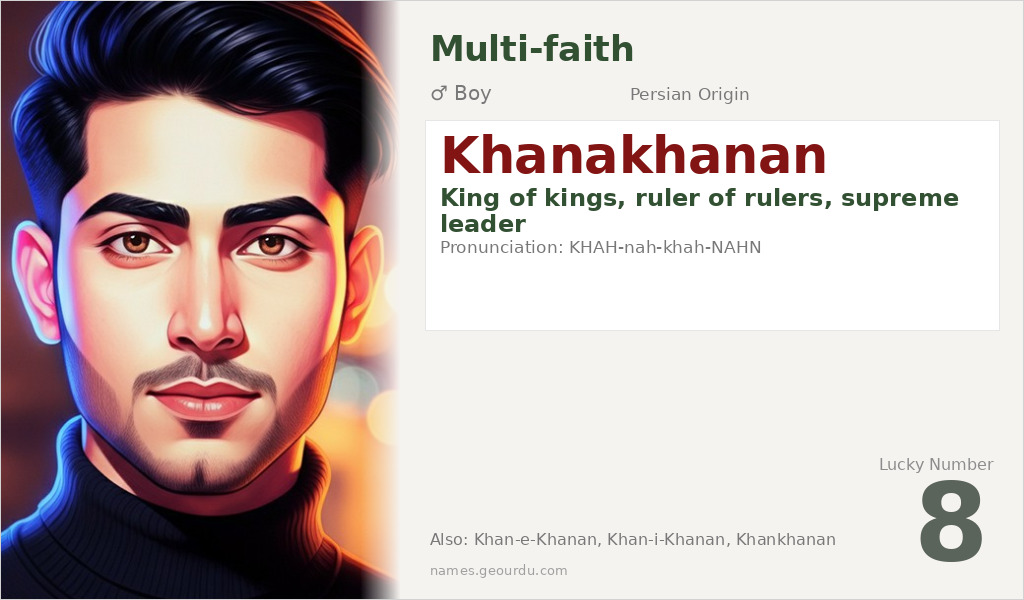
| 📛 Name | Khanakhanan |
| 💎 Meaning | King of kings, ruler of rulers, supreme leader |
| 👤 Gender | Boy |
| 🕌 Religion | Multi-faith |
| 🌍 Origin | Persian |
| 🗣 Pronunciation | KHAH-nah-khah-NAHN |
| ✍️ Urdu | خان خاناں |
| ✍️ Arabic | خان خانان |
| 🔢 Numerology | 8 |
| ✨ Spellings | Khan-e-Khanan, Khan-i-Khanan, Khankhanan, Khan Khanan |
Origin & Cultural Significance
The name Khanakhanan originated in Persian-speaking regions and gained prominence in South Asia during the Mughal Empire (1526-1857). It was used as an official title for the highest-ranking nobles and military commanders, particularly the commander-in-chief of the Mughal army. The most famous bearer was Mirza Abdul Rahim Khan-i-Khanan, a celebrated general, poet, and statesman in Akbar’s court. While associated with Muslim rulers, the title transcended religious boundaries and appears in Sikh and Hindu historical contexts as well. Its usage reflects the Persianate cultural sphere that extended from Iran through Afghanistan to the Indian subcontinent.
Personality Traits
Those named Khanakhanan are often associated with leadership qualities, strategic acumen, and natural authority. They may exhibit protective instincts toward their community or family, combined with organizational abilities that make them effective managers. The name’s historical weight suggests someone who carries themselves with dignity and expects respect, while potentially demonstrating generosity and patronage reminiscent of historical noble bearers.
Similar Names
If you like Khanakhanan, consider: Shahanshah, Padishah, Sultan, Amir, Mirza
Famous People Named Khanakhanan
- Mirza Abdul Rahim Khan-i-Khanan — 16th-century Mughal general and poet, son of Bairam Khan
- Khan Jahan Lodi — Mughal noble during Akbar's reign who held the title Khan-i-Khanan
Frequently Asked Questions About Khanakhanan
What does Khanakhanan mean?
Khanakhanan means 'king of kings' or 'ruler of rulers' in Persian. It's a compound title where 'Khan' means ruler, and 'Khanan' creates the superlative 'of Khans.'
Is Khanakhanan a boy or girl name?
Khanakhanan is exclusively a boy's name. Historically, it was a title for male military commanders and nobles in Persianate cultures, particularly Mughal India.
What is the origin of Khanakhanan?
Khanakhanan originates from Persian language and culture. It gained prominence as a noble title in the Mughal Empire of South Asia, though its roots are in Persian linguistic traditions.





