
Table of Contents
Ma’bud is a deeply meaningful Arabic name that carries significant theological weight in Islamic tradition. Meaning ‘the worshipped one’ or ‘the adored’, this name reflects the core Islamic principle of monotheism and devotion to God. While uncommon as a personal name due to its exclusive reference to the Divine, it remains a powerful choice for Muslim families seeking a name with profound spiritual resonance. Understanding its linguistic roots and religious context reveals why Ma’bud represents the ultimate object of worship in Islam.
Meaning of Ma'bud
Ma’bud (مَعْبُود) originates from classical Arabic, specifically from the triliteral root ‘ayn-bā-dāl’ (ع-ب-د), which forms words related to worship, servitude, and devotion. As a passive participle (ism maf’ūl), it literally means ‘the one who is worshipped’ or ‘the object of worship’. In Islamic terminology, this word is exclusively reserved for Allah, as Muslims believe only God deserves complete worship and devotion. The name emphasizes tawhid (monotheism) – the fundamental Islamic concept that there is no deity worthy of worship except Allah. Linguistically, it’s related to names like Abdullah (‘servant of God’) and Abid (‘worshipper’), but Ma’bud occupies a unique position as the recipient rather than the performer of worship.
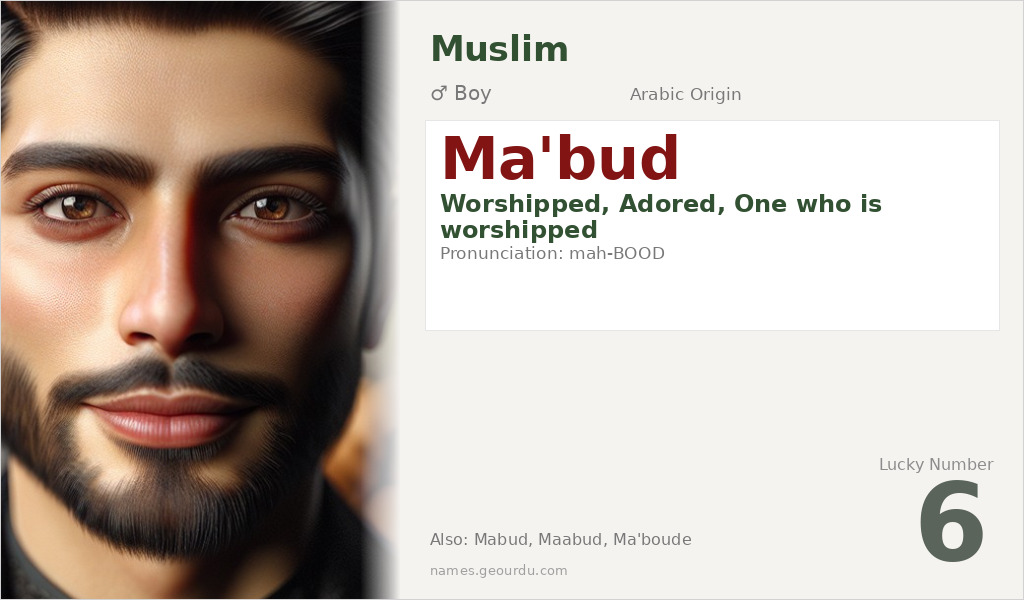
| 📛 Name | Ma'bud |
| 💎 Meaning | Worshipped, Adored, One who is worshipped |
| 👤 Gender | Boy |
| 🕌 Religion | Muslim |
| 🌍 Origin | Arabic |
| 🗣 Pronunciation | mah-BOOD |
| ✍️ Urdu | معبود |
| ✍️ Arabic | مَعْبُود |
| 🔢 Numerology | 6 |
| ✨ Spellings | Mabud, Maabud, Ma'boude, معبود |
Origin & Cultural Significance
Ma’bud has its origins in pre-Islamic and early Islamic Arabic language and culture. The concept of ‘ma’bud’ appears in the Quran and Hadith literature, always referring to the one true God. While the word existed in pre-Islamic Arabic poetry, Islam赋予了 it exclusive theological significance. Culturally, this name is almost never given to children in mainstream Muslim communities because it’s considered too sacred, though some might use it metaphorically or in specific regional contexts. The name’s usage reflects the careful linguistic boundaries Muslims maintain regarding divine attributes, distinguishing between names that describe God (like Ma’bud) and names that describe human relationship to God (like Abdullah).
Personality Traits
While personality traits associated with names are cultural rather than scientific, names like Ma’bud that carry deep religious meaning often influence how individuals are perceived and how they perceive themselves. Someone named Ma’bud might be expected to embody qualities of reverence, spiritual depth, and moral integrity. In many cultures, such names inspire the bearer to live up to their profound meaning, potentially developing into a person who commands respect through devotion and principle rather than authority or power.
Similar Names
If you like Ma'bud, consider: Abdullah, Ibad, Abid, Ubaid, Abdul
Famous People Named Ma'bud
- No widely known contemporary figures bear this name due to its theological weight, though it appears in classical Islamic texts as an attribute of God
Frequently Asked Questions About Ma'bud
What does Ma'bud mean?
Ma'bud means 'the worshipped one' or 'the adored' in Arabic. It is the passive participle form of the verb 'to worship', specifically referring to the one who receives worship.
Is Ma'bud a boy or girl name?
Ma'bud is exclusively a masculine name in Arabic grammar and Islamic naming tradition. The grammatical structure and usage throughout history confirm it as a boy's name.
What is the origin of Ma'bud?
Ma'bud originates from classical Arabic language and Islamic theology. It comes from the Arabic root 'a-ba-da' (ع-ب-د) meaning 'to worship', and has been used in Islamic texts for centuries to refer exclusively to God as the only being worthy of worship.





