
Table of Contents
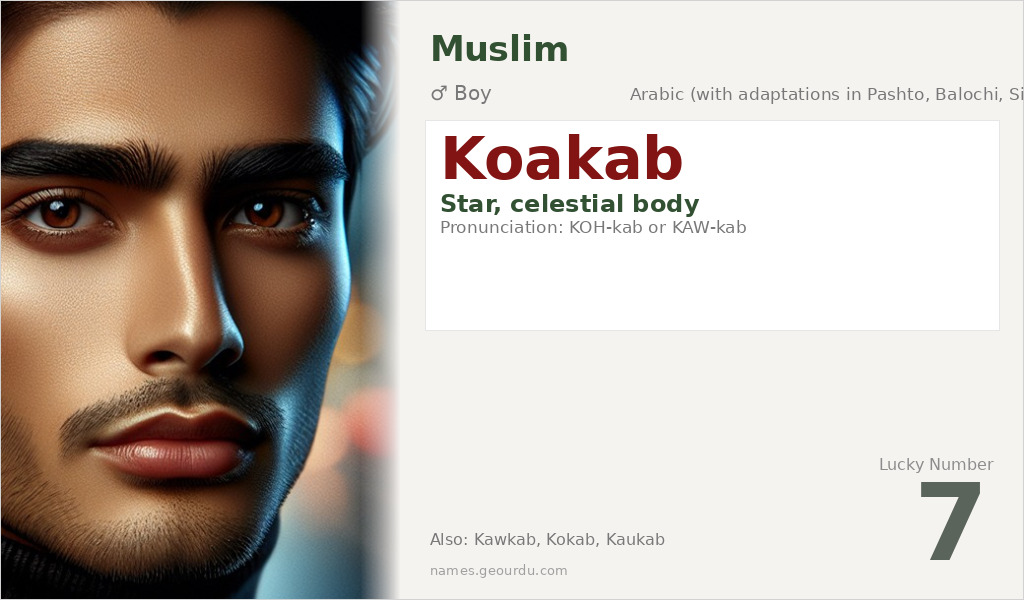
Koakab, more accurately spelled Kawkab or Kokab, is a beautiful name that literally means ‘star’ in Arabic. This celestial name has traveled across cultures, finding particular resonance in Muslim communities from the Middle East to South Asia. With roots in classical Arabic poetry and Islamic tradition, it carries connotations of guidance, beauty, and divine creation.
Meaning of Koakab
The name Koakab derives directly from the Arabic word ‘kawkab’ (كوكب), which refers to a star or celestial body. Linguistically, it comes from the Arabic root K-W-K-B, relating to stars and planets. In Islamic cosmology, stars are mentioned multiple times in the Quran as signs of God’s majesty and as navigation markers. The name has been adapted into various regional languages including Pashto, Balochi, and Sindhi, where it maintains the same stellar meaning while sometimes undergoing phonetic changes. Historically, Arabic astronomers used ‘kawkab’ specifically for planets, while ‘najm’ referred to fixed stars, though in modern naming contexts, the distinction has blurred.
| 📛 Name | Koakab |
| 💎 Meaning | Star, celestial body |
| 👤 Gender | Boy |
| 🕌 Religion | Muslim |
| 🌍 Origin | Arabic (with adaptations in Pashto, Balochi, Sindhi) |
| 🗣 Pronunciation | KOH-kab or KAW-kab |
| ✍️ Urdu | کوکب |
| ✍️ Arabic | كوكب |
| 🔢 Numerology | 7 |
| ✨ Spellings | Kawkab, Kokab, Kaukab, Kawkub, Kokub |
Origin & Cultural Significance
Koakab/Kawkab originated in the Arabic-speaking world but gained particular popularity in Pashtun, Baloch, and Sindhi communities where Arabic-derived names are common. The name appears in classical Arabic literature and poetry, often used metaphorically for something beautiful or guiding. In Islamic tradition, the significance of stars as mentioned in the Quran (6:97, 16:16) gave the name religious resonance. The adaptation into regional languages like Pashto and Balochi occurred through centuries of cultural exchange along trade routes and through the spread of Islam. Today, it remains a popular choice in Pakistan, Afghanistan, Iran, and among diaspora communities worldwide.
Personality Traits
Named after celestial bodies, individuals called Koakab/Kawkab are often associated with qualities of guidance, brilliance, and aspiration. They may be perceived as natural leaders who illuminate paths for others. The star symbolism suggests someone who stands out in their field and maintains a steady presence through challenges. These individuals often possess both practical navigation skills and poetic imagination.
Similar Names
If you like Koakab, consider: Najm (Arabic: star), Sitara (Persian/Urdu: star), Tara (Sanskrit: star), Hesper (Greek: evening star), Sterling (English: little star)
Famous People Named Koakab
- Kawkab Al-Durriya — 19th century Syrian poet and educator
- Kokab — common given name among Pashtun and Baloch communities in Pakistan and Afghanistan
Frequently Asked Questions About Koakab
What does Koakab mean?
Koakab (properly Kawkab) means 'star' or 'celestial body' in Arabic. The name comes from the Arabic root K-W-K-B and is used across Muslim cultures.
Is Koakab a boy or girl name?
Koakab/Kawkab is primarily a masculine name in Arabic and Muslim naming traditions, though some modern adaptations might use it for girls in certain regions.
What is the origin of Koakab?
The name originates from Arabic (كوكب) but has been widely adopted in Pashto, Balochi, and Sindhi cultures through Islamic influence and regional adaptations.





