
Table of Contents
Kasra is a name steeped in Persian imperial history, carrying the weight of ancient kingdoms and legendary rulers. Derived from the royal title Khosrow, this name evokes images of the mighty Sassanian Empire that once rivaled Rome and Byzantium. More than just a personal name, Kasra represents a legacy of leadership, culture, and historical significance that continues to resonate across Persian-influenced regions today.
Meaning of Kasra
Kasra originates from the Persian name Khosrow (خسرو), which itself derives from the Old Persian ‘Husravah’, meaning ‘of good fame’ or ‘kingly’. In historical and literary contexts, Kasra specifically refers to the kings of the Sassanian Persian Empire (224-651 CE), particularly Khosrow I Anushirvan (‘the Immortal Soul’) and Khosrow II Parviz (‘the Victorious’). The term became so synonymous with Persian monarchy that Arabic sources often referred to Sassanian rulers simply as ‘al-Kisra’. In Ferdowsi’s epic Shahnameh (Book of Kings), Kasra appears as a central heroic figure embodying ideal kingship, justice, and Persian cultural values. The name thus carries connotations of sovereignty, wisdom, and historical legacy.
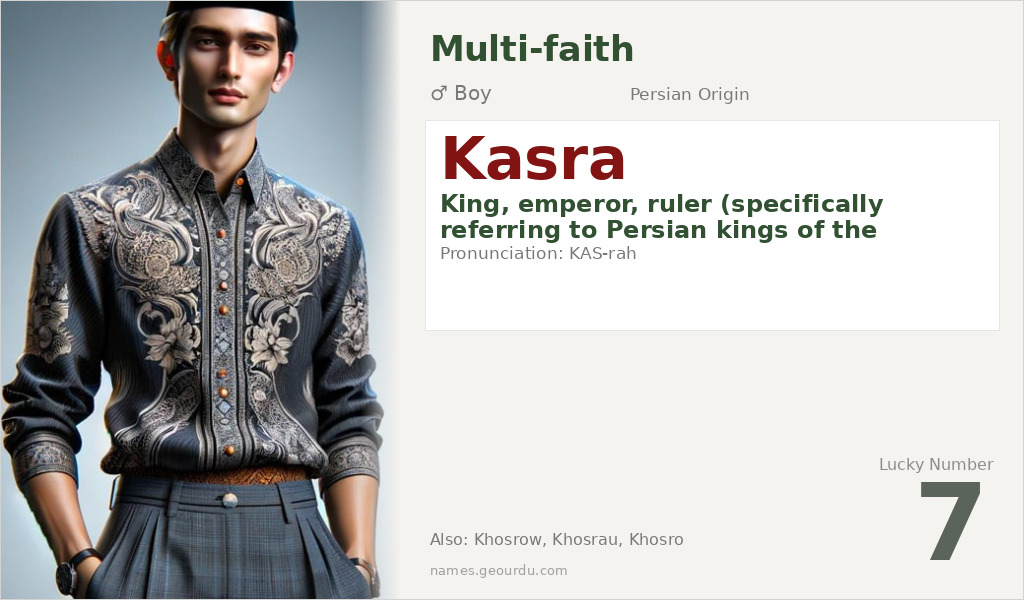
| 📛 Name | Kasra |
| 💎 Meaning | King, emperor, ruler (specifically referring to Persian kings of the Sassanian dynasty) |
| 👤 Gender | Boy |
| 🕌 Religion | Multi-faith |
| 🌍 Origin | Persian |
| 🗣 Pronunciation | KAS-rah |
| ✍️ Urdu | کسریٰ |
| ✍️ Arabic | كسرى |
| 🔢 Numerology | 7 |
| ✨ Spellings | Khosrow, Khosrau, Khosro, Kisra, Chosroes |
Origin & Cultural Significance
Kasra has its roots in pre-Islamic Persian civilization, specifically the Sassanian Empire that ruled from 224 to 651 CE. The name was originally the royal title Khosrow, borne by several Sassanian monarchs who were patrons of arts, architecture, and Zoroastrian religion. After the Arab conquest of Persia, the name persisted in Islamic contexts, with Arabic historians using ‘al-Kisra’ to refer to Sassanian kings. Today, the name is used across various faiths in Persian-speaking regions (Iran, Afghanistan, Tajikistan) and among diaspora communities, though it remains particularly associated with Persian cultural heritage. While commonly used in Muslim communities, it also appears among Zoroastrians, Baha’is, and others connected to Persian history.
Personality Traits
Those named Kasra often embody leadership qualities reminiscent of their namesake kings. They tend to be strategic thinkers who approach challenges with careful planning and historical perspective. With a natural authority and respect for tradition, Kasras often excel in positions requiring decision-making and cultural awareness. Their connection to this historic name may inspire them to value education, justice, and cultural preservation in their personal and professional lives.
Similar Names
If you like Kasra, consider: Khosrow, Cyrus, Darius, Xerxes, Shahryar
Famous People Named Kasra
- Khosrow I (Anushirvan) — Sassanian Persian king known for justice and administrative reforms
- Khosrow II (Parviz) — Last great Sassanian king whose reign marked the empire's peak before Arab conquest
Frequently Asked Questions About Kasra
What does Kasra mean?
Kasra means 'king' or 'emperor', specifically referring to Persian kings of the Sassanian dynasty. It derives from the Persian name Khosrow, which comes from Old Persian 'Husravah' meaning 'of good fame' or 'kingly'.
Is Kasra a boy or girl name?
Kasra is exclusively a masculine name, as it originates from royal titles borne by Persian kings. There are no documented feminine variants in historical or contemporary usage.
What is the origin of Kasra?
Kasra originates from Persian language and history, specifically from the Sassanian Empire (224-651 CE) where it was the royal title Khosrow. It has pre-Islamic Zoroastrian roots but has been adopted across various faiths in Persian-influenced cultures.





