
Table of Contents
Key Ghobad is a distinguished Persian name steeped in royal history and mythological significance. Combining the ancient title ‘Key’ meaning ‘king’ with ‘Ghobad,’ the name of a Sassanian emperor immortalized in Ferdowsi’s epic Shahnameh, this name carries the weight of Persian imperial heritage. Used primarily for boys, it represents a connection to Iran’s pre-Islamic past while remaining meaningful in contemporary naming traditions. Let’s explore the rich layers of meaning behind this regal name.
Meaning of Key Ghobad
Key Ghobad is a compound Persian name with two distinct components, each carrying significant meaning. The first element, ‘Key’ (also transliterated as Kay or Kai), is an ancient Persian royal title meaning ‘king’ or ‘ruler,’ originating from the Kayanian dynasty of Persian mythology. The second element, ‘Ghobad’ (also spelled Qobad or Kavadh), refers specifically to Kavadh I, a Sassanian Persian emperor who reigned from 488 to 531 CE and appears as a character in Ferdowsi’s 10th-century epic poem Shahnameh (Book of Kings). When combined, the name literally translates to ‘King Ghobad’ or ‘King Kavadh,’ creating a name that doubly emphasizes royal status through both title and specific historical reference. This naming pattern is characteristic of Persian tradition, where royal titles are often combined with the names of legendary or historical figures.
| 📛 Name | Key Ghobad |
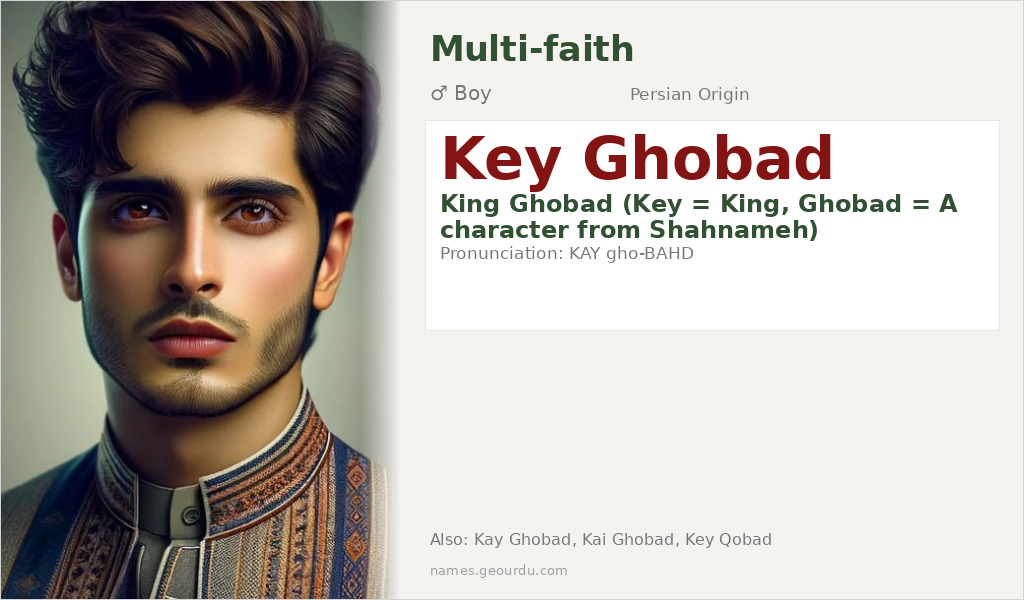
| 💎 Meaning | King Ghobad (Key = King, Ghobad = A character from Shahnameh) |
| 👤 Gender | Boy |
| 🕌 Religion | Multi-faith |
| 🌍 Origin | Persian |
| 🗣 Pronunciation | KAY gho-BAHD |
| ✍️ Urdu | کی قباد |
| ✍️ Arabic | كاي قباد |
| 🔢 Numerology | |
| ✨ Spellings | Kay Ghobad, Kai Ghobad, Key Qobad, Kay Qobad, Kai Qobad, Key Kavadh, Kay Kavadh |
Origin & Cultural Significance
Key Ghobad originates from Persian language and culture, specifically from the historical and mythological traditions preserved in Ferdowsi’s Shahnameh, the national epic of Iran. The name reflects the pre-Islamic Persian imperial heritage of the Sassanian Empire (224–651 CE), during which Kavadh I ruled as a significant emperor known for his religious reforms and military campaigns. While the name has Persian roots, it has been adopted by various communities including Persian-speaking Muslims, Zoroastrians, and others in regions influenced by Persian culture such as Afghanistan, Tajikistan, and parts of South Asia. The name’s preservation in the Shahnameh ensured its continued cultural relevance long after the Sassanian Empire’s fall, maintaining it as a symbol of Persian historical identity and royal legacy.
Personality Traits
Given its royal etymology and historical associations, Key Ghobad suggests qualities of leadership, dignity, and connection to tradition. Those named Key Ghobad might be perceived as having natural authority, a sense of historical consciousness, and respect for cultural heritage. The name’s double royal emphasis—through both the title ‘Key’ and the historical king ‘Ghobad’—implies a strong, commanding presence with deep roots in Persian imperial history.
Similar Names
If you like Key Ghobad, consider: Key Khosrow, Key Kavus, Ardashir, Darius, Cyrus
Famous People Named Key Ghobad
- Kavadh I — Sassanian Persian emperor (488–531 CE) who appears in the Shahnameh as Ghobad
- Ghobad Singh — Historical Sikh ruler in Punjab region
Frequently Asked Questions About Key Ghobad
What does Key Ghobad mean?
Key Ghobad means 'King Ghobad' — a compound Persian name where 'Key' is an ancient royal title meaning 'king,' and 'Ghobad' refers to the Sassanian emperor Kavadh I from Persian history and the Shahnameh epic.
Is Key Ghobad a boy or girl name?
Key Ghobad is exclusively a boy's name in Persian naming tradition, as both components ('Key' as a royal title and 'Ghobad' as a male historical figure) are masculine.
What is the origin of Key Ghobad?
Key Ghobad originates from Persian language and culture, specifically from the historical Sassanian Empire and Ferdowsi's Shahnameh epic. It combines the ancient Persian royal title 'Key' with the name of Emperor Kavadh I (Ghobad).





