Table of Contents
Khalaf is a distinguished Arabic name with profound historical and religious significance. Primarily used for boys in Muslim communities, it embodies themes of succession, legacy, and continuity. This name connects bearers to a rich linguistic heritage rooted in classical Arabic literature and Islamic tradition. Discover the authentic meaning and cultural context behind this timeless name.
Meaning of Khalaf
Khalaf originates from the Arabic root khā-lām-fā (خ-ل-ف), which fundamentally relates to the concept of succession and replacement. The verb khalafa means ‘to succeed’ or ‘to follow after,’ giving rise to terms like khalīfah (caliph or successor) and istikhlāf (succession). In Islamic theology, this root appears in the Quran where humanity is described as God’s successors (khalā’if) on Earth, tasked with stewardship. The name thus carries connotations of responsibility, heritage, and continuity, making it a meaningful choice emphasizing legacy and forward movement within family and community structures.
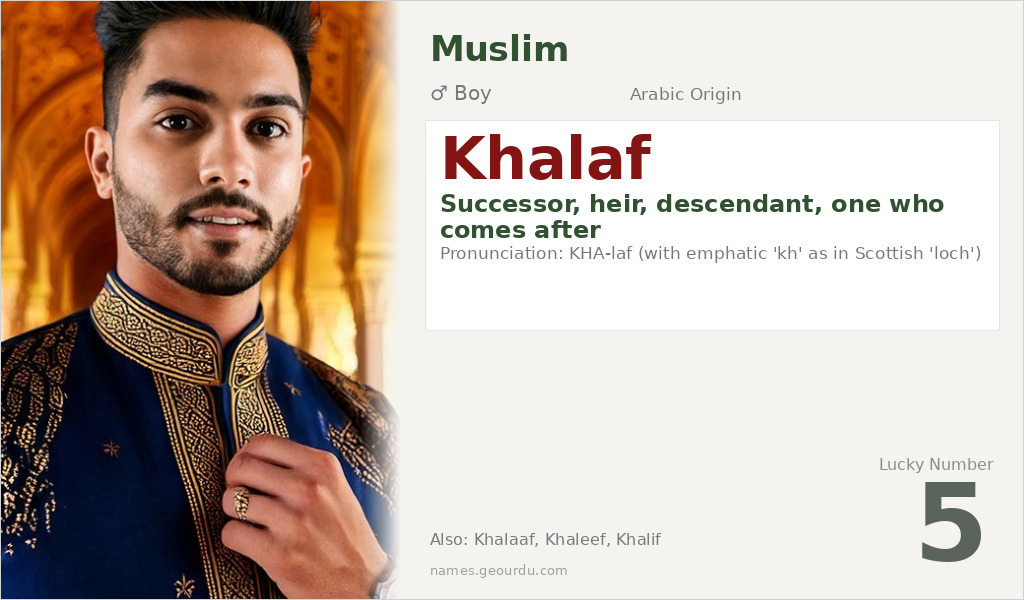
| 📛 Name | Khalaf |
| 💎 Meaning | Successor, heir, descendant, one who comes after |
| 👤 Gender | Boy |
| 🕌 Religion | Muslim |
| 🌍 Origin | Arabic |
| 🗣 Pronunciation | KHA-laf (with emphatic 'kh' as in Scottish 'loch') |
| ✍️ Urdu | خلف |
| ✍️ Arabic | خلف |
| 🔢 Numerology | 5 |
| ✨ Spellings | Khalaaf, Khaleef, Khalif, Khalef |
Origin & Cultural Significance
Khalaf has its origins in pre-Islamic and early Islamic Arabia, where it was used among Arab tribes. It gained prominence during the Islamic Golden Age, appearing in historical records of scholars, poets, and leaders. The name is particularly common in Arabic-speaking regions like Saudi Arabia, Egypt, and the Levant, as well as among Muslim communities in South Asia (e.g., Pakistan, India) and Southeast Asia due to Arabic’s influence on Islamic nomenclature. Unlike some names that cross religious boundaries, Khalaf remains predominantly within Muslim naming traditions, reflecting its Quranic associations and cultural resonance in Islamic societies.
Personality Traits
Named after the concept of succession, individuals called Khalaf often exhibit leadership qualities and a strong sense of duty. They are typically perceived as reliable, forward-looking, and respectful of traditions while being open to innovation. This name suggests a personality that values continuity and legacy, often inspiring others through thoughtful guidance and a commitment to future generations. Bearers may naturally assume roles that involve mentorship or stewardship in their personal and professional lives.
Similar Names
If you like Khalaf, consider: Khalid, Khalil, Khalid, Khalifa, Khaled
Famous People Named Khalaf
- Khalaf ibn Hisham — 9th-century Islamic scholar and Quran reciter from Baghdad
- Khalaf al-Aḥmar — 8th-century Arabic poet and grammarian from Basra
Frequently Asked Questions About Khalaf
What does Khalaf mean?
Khalaf means 'successor,' 'heir,' or 'descendant' in Arabic, derived from the root kh-l-f related to succession and replacement.
Is Khalaf a boy or girl name?
Khalaf is exclusively a masculine name in Arabic and Islamic naming traditions, with no documented feminine usage.
What is the origin of Khalaf?
Khalaf originates from classical Arabic, with deep roots in pre-Islamic and early Islamic culture, and is widely used in Muslim communities globally.