
Table of Contents
Miftah is a distinctive Arabic name that carries profound symbolic weight, meaning ‘key’ or ‘opener.’ Primarily used for boys in Muslim communities, it evokes imagery of unlocking potential, knowledge, and new beginnings. This name is rooted in classical Arabic language and Islamic tradition, offering a meaningful choice for parents seeking a name with both literal and metaphorical depth. In this guide, we explore the rich etymology, cultural context, and modern usage of Miftah.
Meaning of Miftah
Miftah (مفتاح) is derived from the Arabic root ف-ت-ح (f-t-ḥ), which conveys concepts of opening, unlocking, inaugurating, or conquering. As a noun, it specifically means ‘key’—whether referring to a physical object that opens locks or a metaphorical tool that provides access to understanding, success, or spiritual insight. In Islamic theology, the term can appear in contexts like ‘miftah al-ghayb’ (key to the unseen) or in prayers seeking divine openings. Linguistically, it is a well-established word in Arabic dictionaries and literature, with no significant variant meanings in other languages such as Persian, Urdu, or regional dialects, though it may be adopted into those languages with the same Arabic meaning. The name emphasizes qualities of accessibility, enlightenment, and initiative.
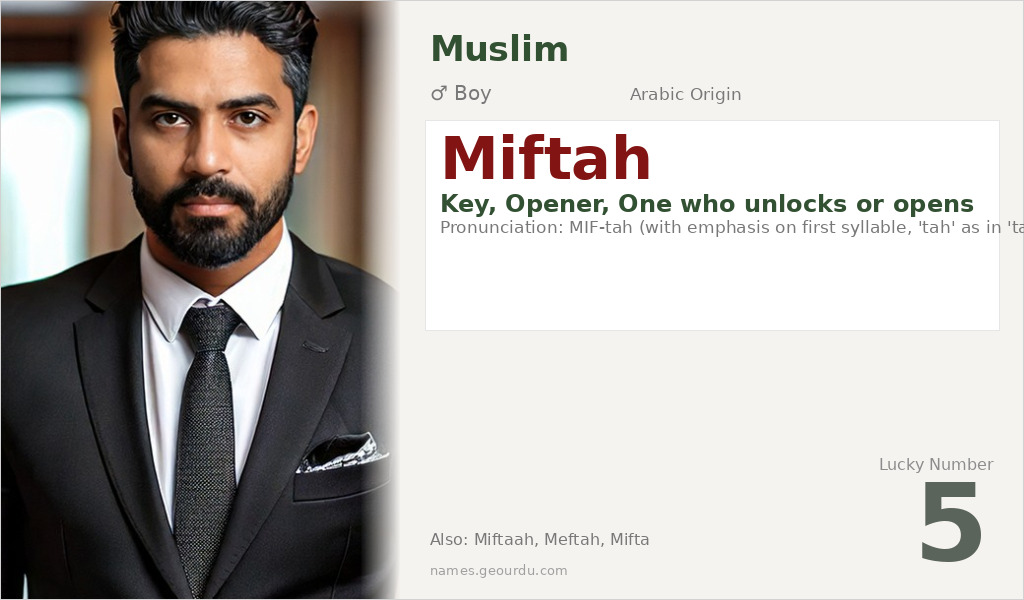
| 📛 Name | Miftah |
| 💎 Meaning | Key, Opener, One who unlocks or opens |
| 👤 Gender | Boy |
| 🕌 Religion | Muslim |
| 🌍 Origin | Arabic |
| 🗣 Pronunciation | MIF-tah (with emphasis on first syllable, 'tah' as in 'tall') |
| ✍️ Urdu | مفتاح |
| ✍️ Arabic | مفتاح |
| 🔢 Numerology | 5 |
| ✨ Spellings | Miftaah, Meftah, Mifta |
Origin & Cultural Significance
Miftah originates from the Arabic language and is deeply embedded in Islamic culture, where it is used predominantly as a masculine given name. It reflects the importance of knowledge and guidance in Muslim traditions, often symbolizing a person who opens doors to wisdom or community benefit. Historically, the name has been borne by scholars and leaders, such as Miftah al-Din al-Maqdisi, highlighting its association with intellectual and spiritual roles. While common in Arabic-speaking countries, it is also found in South Asia, Southeast Asia, and other regions with Muslim populations due to the global spread of Arabic Islamic nomenclature. Unlike some names with tribal or regional variations, Miftah maintains a consistent Arabic origin without significant shifts in meaning across cultures.
Personality Traits
People named Miftah are often perceived as insightful and pragmatic, with a knack for finding solutions and unlocking opportunities in challenging situations. They may exhibit traits of curiosity, leadership, and a desire to facilitate progress for themselves and others, mirroring the name’s essence as a ‘key.’ In social settings, they might be seen as reliable and thoughtful, often taking on roles that require analysis or mediation. This personality alignment stems from the name’s linguistic roots, which emphasize opening and accessibility, though individual characteristics will naturally vary.
Similar Names
If you like Miftah, consider: Fatih (Arabic: Conqueror, Opener), Fateh (Arabic/Persian/Urdu: Victory, Opener), Mubeen (Arabic: Clear, Evident), Basit (Arabic: One who expands or opens), Fattah (Arabic: One who opens, a name of God)
Famous People Named Miftah
- Miftah Ismail — Pakistani economist and former Finance Minister of Pakistan
- Miftah al-Din al-Maqdisi — 12th-century Islamic scholar and historian from Jerusalem
Frequently Asked Questions About Miftah
What does Miftah mean?
Miftah means 'key' or 'opener' in Arabic, derived from the root ف-ت-ح (f-t-ḥ), and it carries both literal and metaphorical connotations of unlocking or providing access.
Is Miftah a boy or girl name?
Miftah is traditionally a boy's name in Arabic and Muslim cultures, as it is a masculine noun in Arabic grammar, though naming practices can vary regionally.
What is the origin of Miftah?
Miftah originates from the Arabic language and is widely used in Muslim communities globally, with no verified origins in other languages like Pashto or Balochi beyond Arabic influence.





