
Table of Contents
Musa is one of the most significant names in Abrahamic traditions, borne by the prophet Moses in Islam, Christianity, and Judaism. This ancient name carries profound religious and historical weight, symbolizing deliverance and leadership. With roots stretching back to ancient Hebrew, Musa has been embraced across cultures and languages for millennia.
Meaning of Musa
The name Musa originates from the Hebrew name Moshe (Moses), derived from the Hebrew verb ‘mashah’ meaning ‘to draw out’. This refers directly to the biblical and Quranic account of the infant Moses being drawn from the Nile River. In Arabic, the name became Mūsā through linguistic adaptation, maintaining the same essential meaning. The name appears extensively in Islamic scripture, with Prophet Musa mentioned 136 times in the Quran, more than any other prophet except Muhammad. This etymological connection is well-documented across Semitic languages including Hebrew, Aramaic, and Arabic.
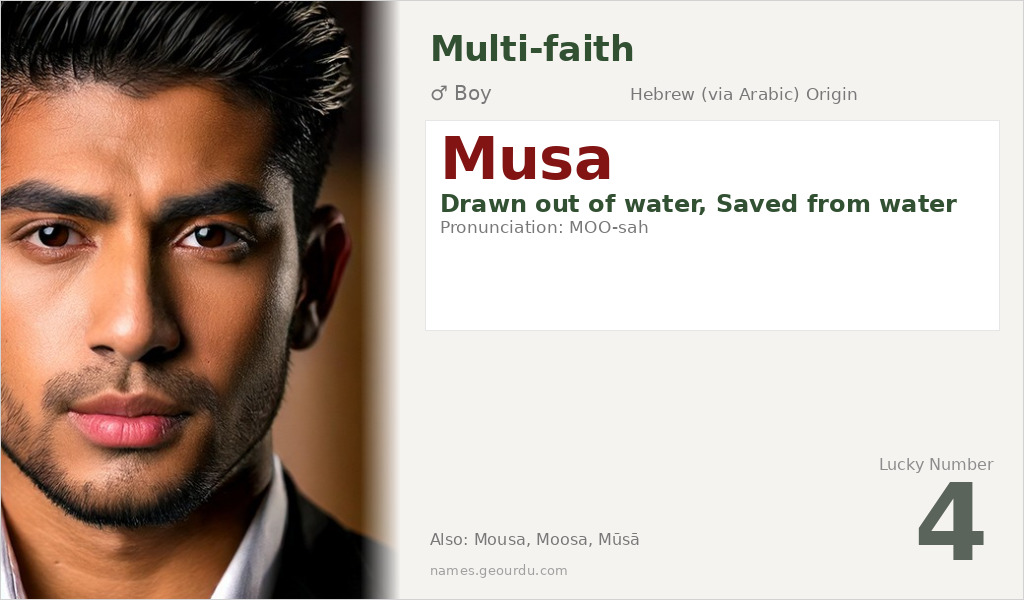
| 📛 Name | Musa |
| 💎 Meaning | Drawn out of water, Saved from water |
| 👤 Gender | Boy |
| 🕌 Religion | Multi-faith |
| 🌍 Origin | Hebrew (via Arabic) |
| 🗣 Pronunciation | MOO-sah |
| ✍️ Urdu | موسیٰ |
| ✍️ Arabic | موسى |
| 🔢 Numerology | 4 |
| ✨ Spellings | Mousa, Moosa, Mūsā, Musah |
Origin & Cultural Significance
Musa has its origins in ancient Hebrew culture as the name of the prophet Moses, leader of the Israelites. The name entered Arabic through religious texts and was adopted widely across the Islamic world following the revelation of the Quran in the 7th century. It is used by Muslims, Christians, and Jews throughout the Middle East, Africa, and South Asia. In many Muslim-majority regions, Musa is among the most popular prophetic names given to boys, reflecting the high status of Prophet Musa in Islamic tradition as one of the five greatest messengers (Ulul Azm).
Personality Traits
Those named Musa are often associated with leadership qualities, moral strength, and perseverance. The name carries expectations of integrity and justice, inspired by the prophetic example. In many cultures, the name suggests someone who stands for truth and guides others through challenges with wisdom and conviction.
Similar Names
If you like Musa, consider: Mus'ab, Mushtaq, Moses, Moshe, Moussa
Famous People Named Musa
- Musa ibn Nusayr — 7th-8th century Umayyad general who conquered North Africa and Spain
- Mūsā al-Kāẓim — 8th century Shia Imam, descendant of Prophet Muhammad
Frequently Asked Questions About Musa
What does Musa mean?
Musa means 'drawn out of water' or 'saved from water', originating from the Hebrew name Moshe (Moses). This refers to the biblical and Quranic story of Moses being drawn from the Nile River as an infant.
Is Musa a boy or girl name?
Musa is exclusively a masculine name across all cultures where it is used, named after the male prophet Moses in Abrahamic traditions.
What is the origin of Musa?
Musa originates from Hebrew (Moshe) and was adopted into Arabic as Mūsā. It is used across Abrahamic faiths including Islam, Christianity, and Judaism, with particular prominence in Muslim communities worldwide.





