
Table of Contents
Mirza is a distinguished name with deep roots in Persian aristocracy and Mughal history. Meaning ‘prince’ or ‘nobleman,’ this name carries centuries of cultural significance across South Asia, the Middle East, and Central Asia. Today, it remains popular as both a given name and surname, symbolizing leadership and noble heritage. Whether you’re drawn to its historical weight or elegant sound, Mirza offers a connection to rich Persianate traditions.
Meaning of Mirza
The name Mirza originates from Persian, combining ‘Mir’ (meaning prince, commander, or leader) with the suffix ‘-zada’ (meaning born of or son of). Literally translated, it means ‘son of a prince’ or ‘born of nobility,’ though it evolved to mean ‘prince’ or ‘high-ranking official’ in its own right. Historically, it was used as an honorific title in Persian, Mughal, and Ottoman courts, preceding or following given names to denote aristocratic status. In modern usage, particularly in Urdu, Turkish, and Central Asian languages, it functions as both a surname and given name. The name is distinct from ‘Sayyad’ (descendant of Prophet Muhammad), though both carry honorific weight in Muslim cultures.
| 📛 Name | Mirza |
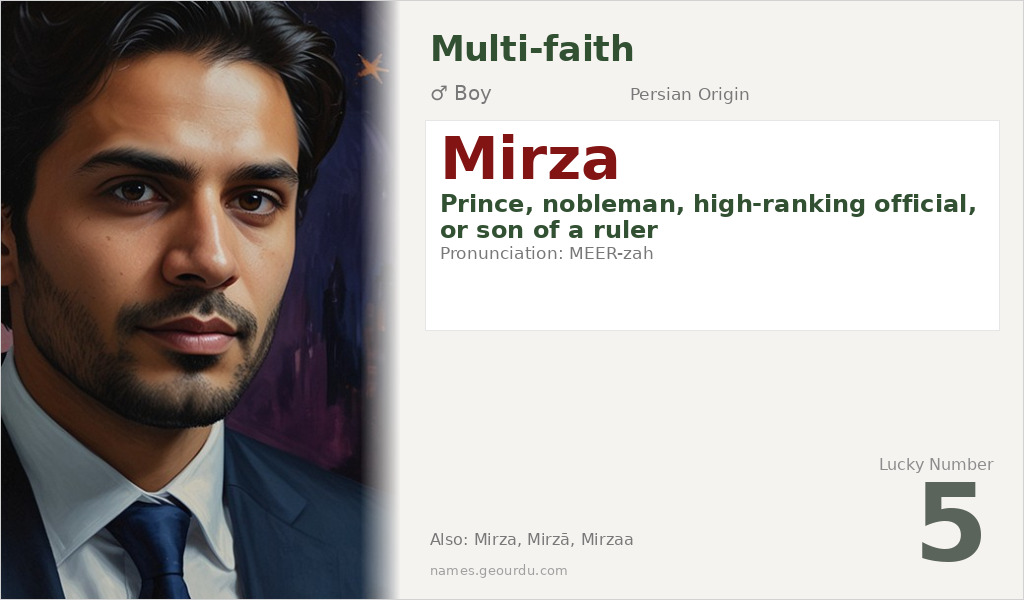
| 💎 Meaning | Prince, nobleman, high-ranking official, or son of a ruler |
| 👤 Gender | Boy |
| 🕌 Religion | Multi-faith |
| 🌍 Origin | Persian |
| 🗣 Pronunciation | MEER-zah |
| ✍️ Urdu | مرزا |
| ✍️ Arabic | ميرزا |
| 🔢 Numerology | 5 |
| ✨ Spellings | Mirza, Mirzā, Mirzaa, Mirzah |
Origin & Cultural Significance
Mirza emerged in medieval Persia as a title for princes and high officials, later adopted by the Mughal Empire in India where it became part of royal nomenclature (e.g., Prince Mirza). The name spread through Persian cultural influence across Ottoman Turkey, Central Asia, and South Asia. While commonly used in Muslim communities, it’s also found among Sikhs, Hindus, and others in regions with Persian historical influence, making it multi-faith in practice. In contemporary times, it’s particularly popular in Pakistan, India, Iran, Turkey, and Azerbaijan, reflecting its enduring appeal across diverse cultures that share Persian linguistic heritage.
Personality Traits
Those named Mirza are often associated with leadership qualities and noble characteristics. The name’s royal connotations suggest someone who may naturally assume positions of responsibility and authority. Culturally, Mirzas are expected to uphold dignity and tradition while demonstrating capability in governance or diplomacy. While these are stereotypical associations, the name certainly carries expectations of refinement and capability in social and professional spheres.
Similar Names
If you like Mirza, consider: Amir, Shahzada, Sultan, Khan, Pasha
Famous People Named Mirza
- Mirza Ghalib — Renowned 19th-century Urdu and Persian poet from Mughal India
- Mirza Asadullah Baig Khan — Full name of Ghalib, emphasizing the name's aristocratic usage
- Mirza Nasir Ahmad — Third Caliph of the Ahmadiyya Muslim Community
Frequently Asked Questions About Mirza
What does Mirza mean?
Mirza means 'prince,' 'nobleman,' or 'son of a ruler' in Persian. It originates from the Persian words 'Mir' (prince) and '-zada' (born of).
Is Mirza a boy or girl name?
Mirza is traditionally a masculine name, though in some modern contexts it might be used as a surname for all genders. As a given name, it's overwhelmingly male across all cultures where it's used.
What is the origin of Mirza?
Mirza originates from Persian language and culture, where it was used as an aristocratic title. It spread through Persian influence to Mughal India, Ottoman Turkey, and Central Asia, becoming a common name in Urdu, Turkish, and other languages.





