
Table of Contents
Sahban is a distinguished Arabic name with deep historical roots in pre-Islamic Arabia. Most famously associated with Sahban Wā’il, a legendary orator whose name became synonymous with eloquence in Arabic literature, this name carries cultural significance beyond its literal meaning. While primarily used in Muslim communities today, its origins predate Islam and reflect the rich linguistic heritage of the Arabian Peninsula.
Meaning of Sahban
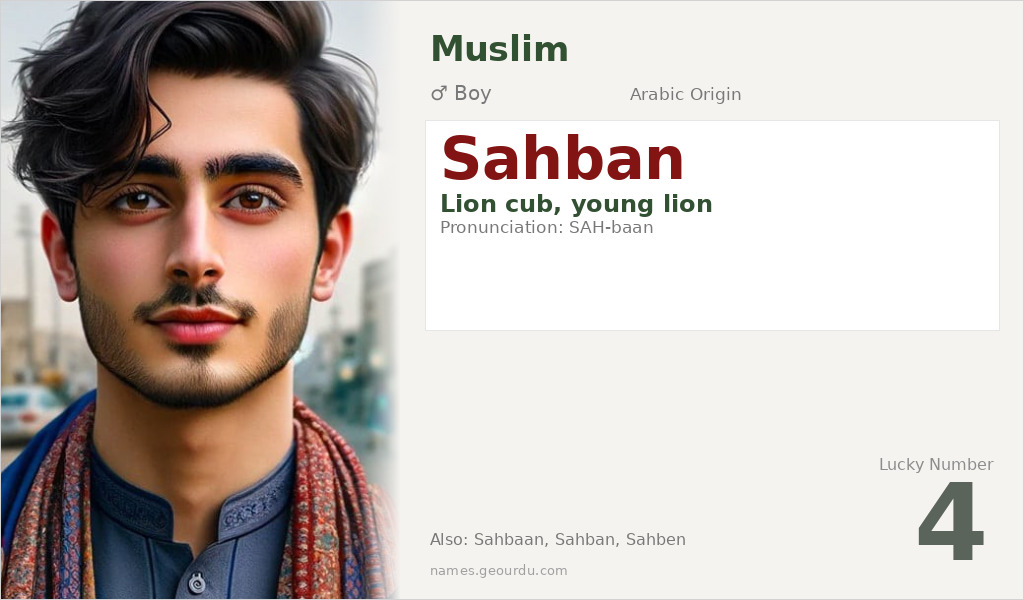
The name Sahban derives from the Arabic root ‘ṣ-ḥ-b’ (ص-ح-ب), which fundamentally means ‘to accompany’ or ‘to be a companion’. As a diminutive form (using the ‘ān’ pattern), Sahban specifically means ‘little companion’ or ‘young companion’, similar to how ‘ghulam’ means ‘youth’ or ‘young man’. In classical Arabic context, it can also metaphorically mean ‘lion cub’ or ‘young lion’, drawing on the lion’s symbolic association with companionship in its pride. The name’s most famous bearer, Sahban Wā’il, lived in the 6th century CE and was celebrated as one of the most eloquent speakers of his time. His reputation was so formidable that Arabic literature developed the proverb ‘more eloquent than Sahban’ to describe exceptional oratory skills. Thus, while the literal meaning relates to youthful companionship, the cultural connotation strongly associates the name with rhetorical excellence and persuasive speech.
| 📛 Name | Sahban |
| 💎 Meaning | Lion cub, young lion |
| 👤 Gender | Boy |
| 🕌 Religion | Muslim |
| 🌍 Origin | Arabic |
| 🗣 Pronunciation | SAH-baan |
| ✍️ Urdu | صحبان |
| ✍️ Arabic | صَحْبَان |
| 🔢 Numerology | 4 |
| ✨ Spellings | Sahbaan, Sahban, Sahben, Sahbin |
Origin & Cultural Significance
Sahban originates from classical Arabic and has particularly strong roots in pre-Islamic Arabian culture. The name gained prominence through Sahban ibn Wā’il, a member of the Banu Wā’il tribe who lived during the Jahiliyyah period (pre-Islamic era). His legendary eloquence made his name proverbial in Arabic literature, with references appearing in works by later scholars like Al-Jahiz and in various collections of Arabic proverbs. While the name predates Islam, it has been adopted by Muslim communities who appreciate its historical significance and positive associations with communication skills. The name appears primarily in Arab communities and among Muslims in South Asia (particularly Pakistan and India) where Arabic names are commonly used. Unlike many Arabic names that have direct religious connotations, Sahban’s appeal lies more in its cultural and linguistic heritage than specific religious meaning.
Personality Traits
Those named Sahban are often associated with strong communication abilities and social intelligence. Drawing from the historical Sahban Wā’il’s legacy, they may be perceived as naturally persuasive, articulate, and effective in expressing their ideas. The name’s root meaning of ‘companion’ suggests someone who values relationships and community, potentially making them socially adept and loyal friends. These personality associations, while cultural rather than deterministic, reflect how names can carry aspirational qualities across generations.
Similar Names
If you like Sahban, consider: Sahil, Sahir, Sahib, Sahm, Sahl
Famous People Named Sahban
- Sahban Wā'il — Legendary 6th-century Arab orator and poet from the Banu Wā'il tribe, famous in pre-Islamic Arabia for his eloquence
- Sahban al-Mu'allim — Contemporary Islamic scholar and author from Jordan
Frequently Asked Questions About Sahban
What does Sahban mean?
Sahban means 'young companion' or 'lion cub' in Arabic. It derives from the root 'ṣ-ḥ-b' meaning 'to accompany'. The name is famously associated with eloquence due to the 6th-century orator Sahban Wā'il.
Is Sahban a boy or girl name?
Sahban is exclusively a masculine name in Arabic and Muslim naming traditions. There is no feminine equivalent in common usage, and historical records only show male bearers of this name.
What is the origin of Sahban?
Sahban originates from classical Arabic language and pre-Islamic Arabian culture. It gained prominence through Sahban Wā'il, a legendary 6th-century orator from the Banu Wā'il tribe, and has been used in Muslim communities ever since.





