
Table of Contents
Rabb is a profoundly significant Arabic term with deep roots in Islamic theology and Semitic languages. While sometimes listed in baby name databases, it’s crucial to understand that Rabb is primarily a divine attribute referring to God as the Lord and Sustainer of creation. This article explores the true meaning, origin, and proper context of this sacred term that appears throughout the Quran and Islamic tradition.
Meaning of Rabb
Rabb (رب) originates from the Arabic triliteral root R-B-B (ر-ب-ب), which encompasses meanings of lordship, mastery, nurturing, sustaining, and bringing to completion. Linguistically, it’s related to similar terms in other Semitic languages like Hebrew (Rav) and Aramaic. In Islamic context, Rabb is one of the most frequently used names for God in the Quran, appearing in phrases like ‘Rabb al-‘Alamin’ (Lord of the Worlds) and ‘Rabbuna’ (Our Lord). The term emphasizes God’s role as the ultimate authority who creates, sustains, nourishes, and completes all existence. It conveys both sovereignty and compassionate care, distinguishing it from mere ‘master’ to include the dimension of nurturing providence.
| 📛 Name | Rabb |
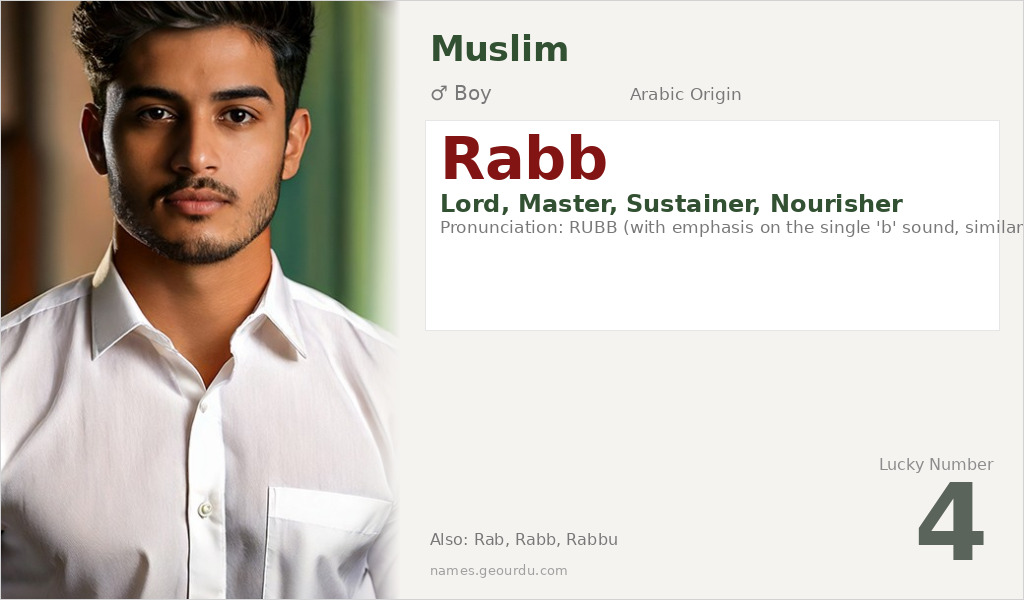
| 💎 Meaning | Lord, Master, Sustainer, Nourisher |
| 👤 Gender | Boy |
| 🕌 Religion | Muslim |
| 🌍 Origin | Arabic |
| 🗣 Pronunciation | RUBB (with emphasis on the single 'b' sound, similar to 'rub' with a slightly longer vowel) |
| ✍️ Urdu | رب |
| ✍️ Arabic | رَبّ |
| 🔢 Numerology | 4 |
| ✨ Spellings | Rab, Rabb, Rabbu |
Origin & Cultural Significance
Rabb has its origins in Classical Arabic and pre-Islamic Semitic languages, with cognates found across the Semitic language family. In Islamic tradition, it became elevated as a primary divine attribute from the earliest revelations of the Quran in 7th century Arabia. The term is used over 900 times in the Quran and is integral to Islamic theology, liturgy, and daily prayers. Culturally, while ‘Abd al-Rabb’ (Servant of the Lord) exists as a compound name, Rabb itself is virtually never used as a standalone personal name for humans in Muslim communities due to its exclusive association with divinity. This distinguishes it from other divine attributes that are commonly used in names like Rahman or Karim.
Personality Traits
As Rabb is a divine attribute rather than a conventional personal name, assigning human personality traits would be inappropriate and theologically problematic in Islamic context. The qualities associated with ‘Rabb’ in theological terms include absolute sovereignty, providential care, nurturing sustenance, and ultimate authority over all creation. Parents considering names with similar meanings might explore derivatives or compounds that incorporate the root while maintaining appropriate reverence, such as names beginning with ‘Rab’ or containing the root in modified forms.
Similar Names
If you like Rabb, consider: Rahman, Rahim, Malik, Sami, Karim
Famous People Named Rabb
- None found – Rabb is virtually never used as a personal name for humans due to its sacred connotation as a divine attribute in Islam
Frequently Asked Questions About Rabb
What does Rabb mean?
Rabb means Lord, Master, Sustainer, or Nourisher in Arabic. It comes from the root R-B-B and is primarily used as a divine name for God in Islamic theology, appearing extensively in the Quran.
Is Rabb a boy or girl name?
Rabb is grammatically masculine in Arabic, but it is essentially never used as a personal name for either gender. It is exclusively a divine attribute in Islamic practice and theology, making it inappropriate as a human name in Muslim cultures.
What is the origin of Rabb?
Rabb originates from Classical Arabic and has roots in broader Semitic languages. It comes from the triliteral root R-B-B and holds central importance in Islamic tradition as one of the primary names of God, with usage dating back to the earliest Quranic revelations in 7th century Arabia.





