
Table of Contents
Rabbi is a name rich with historical and spiritual significance, tracing its roots to ancient Semitic languages. While commonly recognized as an honorific title in Jewish tradition, it also serves as a meaningful given name in various cultures. This name carries connotations of wisdom, leadership, and reverence, making it a profound choice for parents seeking a name with deep roots.
Meaning of Rabbi
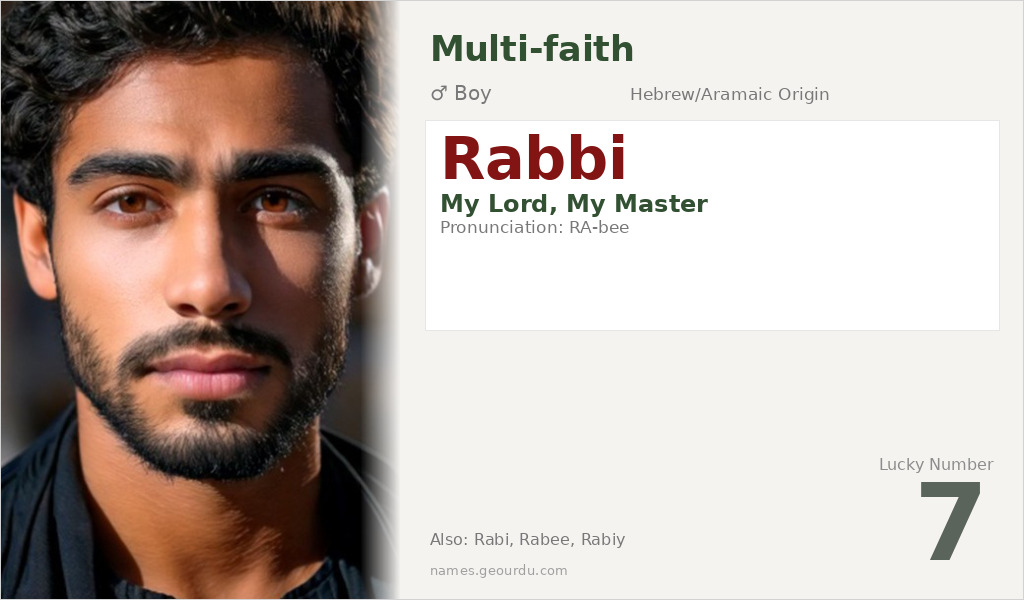
The name Rabbi originates from the Hebrew and Aramaic term רַבִּי (Rabbi), which literally translates to ‘my master’ or ‘my teacher.’ It is derived from the root word רַב (rav), meaning ‘great’ or ‘master,’ combined with the possessive suffix י (i), meaning ‘my.’ In its original context, Rabbi was used as a title of respect for Jewish scholars and religious leaders, particularly from the Talmudic period onward. The name embodies qualities of authority, knowledge, and spiritual guidance, reflecting its etymological roots in Semitic languages where it signifies reverence and leadership.
| 📛 Name | Rabbi |
| 💎 Meaning | My Lord, My Master |
| 👤 Gender | Boy |
| 🕌 Religion | Multi-faith |
| 🌍 Origin | Hebrew/Aramaic |
| 🗣 Pronunciation | RA-bee |
| ✍️ Urdu | ربی |
| ✍️ Arabic | رَابِّي |
| 🔢 Numerology | 7 |
| ✨ Spellings | Rabi, Rabee, Rabiy |
Origin & Cultural Significance
Rabbi has its origins in ancient Hebrew and Aramaic, languages spoken in the Levant and Mesopotamia. Historically, it emerged as a formal title in Jewish communities around the 1st century CE, used to address learned teachers of Jewish law. While primarily associated with Judaism, the name has also been adopted in some Arabic-speaking Christian communities, where it retains its meaning of ‘my lord.’ Unlike many names that spread through Islamic cultures, Rabbi’s usage is more closely tied to Jewish and Christian traditions, though it may be used by individuals of various faiths today.
Personality Traits
Those named Rabbi are often associated with intellectual depth and a calm, authoritative presence. They may naturally gravitate toward roles that involve mentoring, education, or spiritual leadership, mirroring the name’s meaning. Their personality might blend thoughtfulness with a strong sense of responsibility, making them reliable and respected figures in their communities.
Similar Names
If you like Rabbi, consider: Rafael, Raphael, Rabi', Rabin, Raviv
Famous People Named Rabbi
- Rabbi Akiva — 1st-2nd century Jewish sage and scholar
- Rabbi Yehuda HaNasi — 2nd-3rd century compiler of the Mishnah
Frequently Asked Questions About Rabbi
What does Rabbi mean?
Rabbi means 'My Lord' or 'My Master' in Hebrew and Aramaic, derived from the root 'rav' (great/master) with a possessive suffix.
Is Rabbi a boy or girl name?
Rabbi is traditionally a boy's name, though it is rarely used for girls. Its usage as a given name is most common for males, reflecting its origins as a masculine title.
What is the origin of Rabbi?
Rabbi originates from Hebrew and Aramaic, ancient Semitic languages. It was historically a title for Jewish religious teachers and scholars, and later adopted as a given name in some cultures.





