
Table of Contents
Sabil is a meaningful Arabic name that carries rich cultural and spiritual significance. Primarily given to boys, this name evokes images of guidance, charity, and purposeful direction. With roots in Islamic tradition and architecture, Sabil represents both metaphorical paths and practical humanitarian acts. Discover why this name has endured across centuries and regions.
Meaning of Sabil
The name Sabil originates from the Arabic word ‘سبيل’ (sabīl), which holds two distinct yet connected meanings. First, it signifies ‘path’, ‘way’, or ‘road’—both literally as a physical route and metaphorically as a life direction or spiritual journey. This usage appears frequently in Islamic texts, most notably in the phrase ‘fi sabil Allah’ (in the path of God). Second, Sabil means ‘public drinking fountain’ or ‘water fountain’, referring to charitable structures historically built throughout the Islamic world to provide water to travelers and communities. These sabils were often established as religious endowments (waqf) and became important architectural features in cities from Morocco to India. The name derives from the trilateral root س-ب-ل (s-b-l), which conveys concepts of flowing, pouring out, or making something accessible to others.
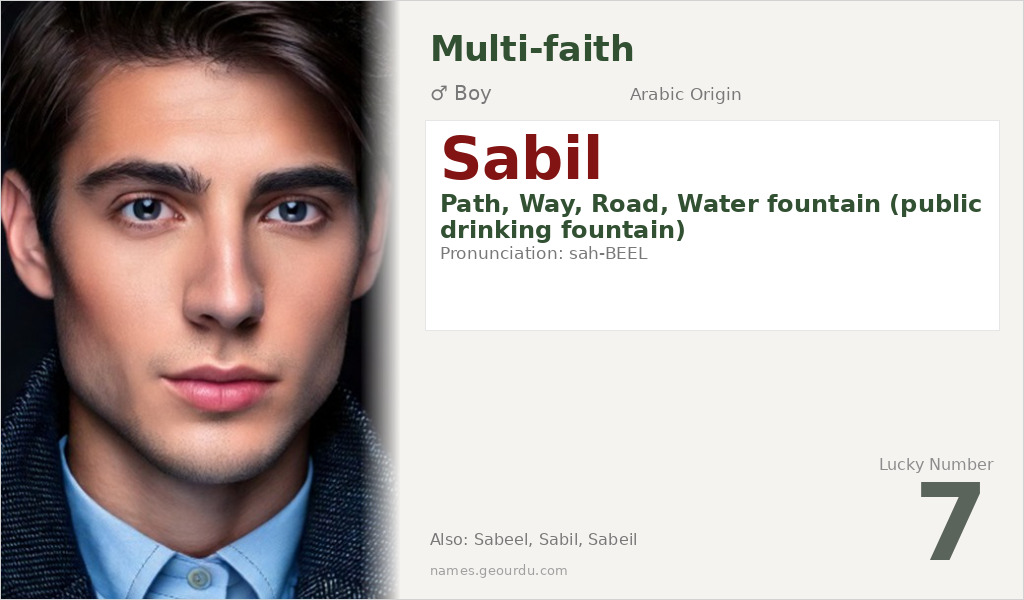
| 📛 Name | Sabil |
| 💎 Meaning | Path, Way, Road, Water fountain (public drinking fountain) |
| 👤 Gender | Boy |
| 🕌 Religion | Multi-faith |
| 🌍 Origin | Arabic |
| 🗣 Pronunciation | sah-BEEL |
| ✍️ Urdu | سبیل |
| ✍️ Arabic | سبيل |
| 🔢 Numerology | 7 |
| ✨ Spellings | Sabeel, Sabil, Sabeil, Sabeal |
Origin & Cultural Significance
Sabil has its origins in classical Arabic language and Islamic culture, dating back to pre-Islamic times with increased significance after the advent of Islam. The term gained prominence through Quranic usage and Islamic architectural tradition. As a given name, it became popular among Muslim communities across the Middle East, North Africa, South Asia, and Southeast Asia. The architectural sabil (water fountain) became particularly significant during the Ottoman Empire and Mamluk period, where elaborate sabils were constructed as charitable acts. While predominantly used in Muslim communities, the name has also been adopted by Arabic-speaking Christians and others who appreciate its linguistic beauty and universal meanings of guidance and charity.
Personality Traits
Those named Sabil are often associated with qualities of guidance, generosity, and clarity. They may exhibit natural leadership in helping others find their direction, whether through practical advice or spiritual wisdom. The dual meaning of the name suggests someone who is both a philosophical guide (the path) and a practical helper (the water fountain), combining idealism with tangible support for their community.
Similar Names
If you like Sabil, consider: Siraj, Tariq, Minhaj, Sabilullah, Masir
Famous People Named Sabil
- Sabil Francis — Indian film actor known for Malayalam cinema
- Sabil Al-Muhtadin — Classical Islamic legal text by Muhammad Arsyad al-Banjari
Frequently Asked Questions About Sabil
What does Sabil mean?
Sabil has two primary meanings in Arabic: 'path/way/road' (both literal and metaphorical) and 'public drinking fountain/water fountain' (referring to charitable structures in Islamic architecture).
Is Sabil a boy or girl name?
Sabil is traditionally a masculine name in Arabic-speaking cultures and Muslim communities, though its usage is almost exclusively for boys across regions where it appears.
What is the origin of Sabil?
Sabil originates from classical Arabic language and Islamic culture, with roots in both Quranic terminology and historical architectural traditions of charitable water fountains throughout the Muslim world.





