
Table of Contents
Sadam Khan is a powerful compound name with deep historical roots in Arabic and Central Asian cultures. Combining the Arabic element Sadam meaning ‘leader’ with the Turkic title Khan meaning ‘ruler’, this name carries connotations of authority and sovereignty. Used across Muslim-majority regions and beyond, it reflects naming traditions where personal names are combined with honorific titles. Understanding its etymology reveals fascinating insights into cross-cultural linguistic exchange.
Meaning of Sadam Khan
The name Sadam derives from the Arabic triliteral root ṣ-d-m (ص د م), which fundamentally means ‘to confront’ or ‘to face’, but in nominal forms evolved to signify leadership and authority. In Arabic and Persian usage, Sadam specifically means ‘leader’, ‘ruler’, or ‘chief’. The component Khan originates from the Turkic and Mongolic languages, where it was a royal title equivalent to ‘sovereign’, ‘prince’, or ‘ruler’, historically used by leaders across Central Asia. When combined, Sadam Khan creates a reinforced meaning of ‘leader-ruler’ or ‘chief sovereign’, following the Persianate naming pattern where a descriptive given name precedes an honorific. This construction is particularly common in South Asian Muslim naming traditions, though Khan itself is used by people of various faiths across the region.
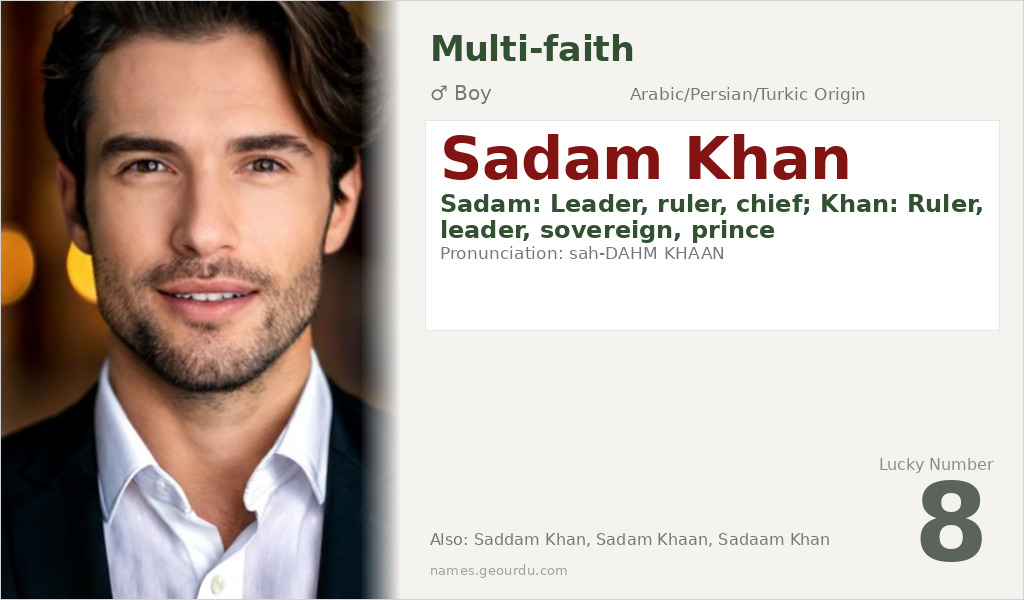
| 📛 Name | Sadam Khan |
| 💎 Meaning | Sadam: Leader, ruler, chief; Khan: Ruler, leader, sovereign, prince |
| 👤 Gender | Boy |
| 🕌 Religion | Multi-faith |
| 🌍 Origin | Arabic/Persian/Turkic |
| 🗣 Pronunciation | sah-DAHM KHAAN |
| ✍️ Urdu | صدام خان |
| ✍️ Arabic | صدام خان |
| 🔢 Numerology | 8 |
| ✨ Spellings | Saddam Khan, Sadam Khaan, Sadaam Khan |
Origin & Cultural Significance
Sadam Khan emerges from the intersection of Arabic, Persian, and Turkic naming traditions that spread across the Islamic world and South Asia. The Arabic element Sadam gained prominence in the 20th century, particularly in the Middle East, while Khan has ancient origins as a Central Asian title used by Turkic and Mongolic rulers since at least the 4th century. The combination became notable in modern times through historical figures, most famously the former Iraqi president Saddam Hussein (whose name uses a variant spelling). In South Asia, particularly Pakistan and India, Khan is a common surname and title among various ethnic groups including Pashtuns, Mughals, and others, regardless of religious affiliation. The name thus represents a fusion of linguistic elements that traveled along historical trade and conquest routes.
Personality Traits
Those named Sadam Khan are often associated with leadership qualities, strength, and protective instincts. The name’s meaning suggests someone who takes charge in difficult situations and values responsibility toward others. Culturally, such names often carry expectations of dignity, honor, and the ability to guide or protect one’s community. While individual personalities vary, the name’s historical associations with rulership may influence how bearers are perceived in social contexts.
Similar Names
If you like Sadam Khan, consider: Saddam Hussein, Salman Khan, Shahrukh Khan, Sultan Khan, Amir Khan
Famous People Named Sadam Khan
- Saddam Hussein — Former President of Iraq (1937-2006)
- Salman Khan — Indian film actor and producer (born 1965)
Frequently Asked Questions About Sadam Khan
What does Sadam Khan mean?
Sadam Khan means 'leader-ruler' or 'chief sovereign' – Sadam comes from Arabic meaning 'leader', while Khan is a Turkic title meaning 'ruler' or 'prince'.
Is Sadam Khan a boy or girl name?
Sadam Khan is exclusively a masculine name, following traditional naming patterns in Arabic, Persian, and South Asian cultures where both components are male-associated.
What is the origin of Sadam Khan?
The name has hybrid origins: Sadam is Arabic, while Khan is Turkic/Mongolic. The combination reflects Persianate naming traditions common in South Asia and the Middle East.





