
Table of Contents
Shiqdar is a distinctive name with deep historical roots in South Asian administration and governance. Derived from Persian administrative terminology, this name carries the weight of centuries of bureaucratic tradition while offering a unique choice for modern parents. With its connection to land revenue collection and district management, Shiqdar represents authority, organization, and practical leadership.
Meaning of Shiqdar
Shiqdar originates from the Persian word ‘شِقْدار’ (shiqdār), which literally translates to ‘holder of a division’ or ‘district keeper’. The term is composed of two elements: ‘شِق’ (shiq), meaning ‘portion, division, or district’, and the suffix ‘دار’ (dār), meaning ‘holder, keeper, or possessor’. In historical context, a Shiqdar was an administrative officer responsible for collecting land revenue and maintaining order in a subdivision of a district during the Mughal period and subsequent regional administrations. This title was adopted into various South Asian languages including Urdu, Bengali, and Hindi, where it retained its administrative connotations while occasionally being used as a surname or given name.
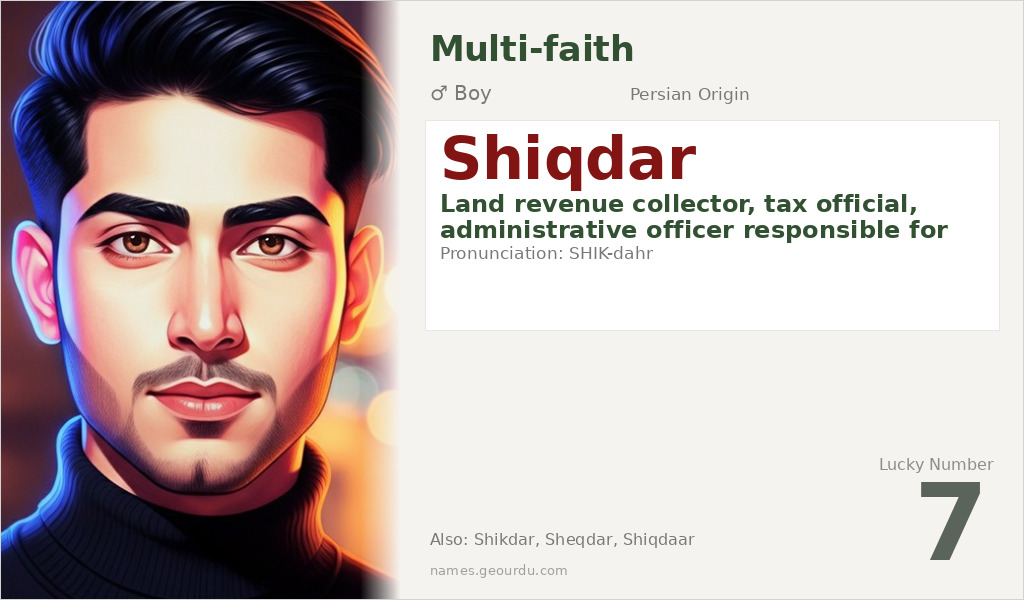
| 📛 Name | Shiqdar |
| 💎 Meaning | Land revenue collector, tax official, administrative officer responsible for revenue collection |
| 👤 Gender | Boy |
| 🕌 Religion | Multi-faith |
| 🌍 Origin | Persian |
| 🗣 Pronunciation | SHIK-dahr |
| ✍️ Urdu | شقدار |
| ✍️ Arabic | شقدار |
| 🔢 Numerology | 7 |
| ✨ Spellings | Shikdar, Sheqdar, Shiqdaar, Shikdaar |
Origin & Cultural Significance
The name Shiqdar has its origins in Persian administrative terminology that was introduced to South Asia during the Mughal Empire (1526-1857). As Persian served as the court language and administrative lingua franca of the Mughal administration, terms like Shiqdar became institutionalized in regional governance systems. The position of Shiqdar was an important mid-level administrative role responsible for revenue collection and law enforcement in specific territorial divisions. While the term is Persian in origin, its usage spread across various religious and ethnic communities in South Asia involved in administration, making it a multi-faith name rather than exclusively Muslim. The name continues to be used in parts of India, Pakistan, and Bangladesh, often as both a given name and surname.
Personality Traits
Those named Shiqdar often inherit the administrative qualities suggested by their name’s origin. They typically demonstrate strong organizational abilities, practical problem-solving skills, and a natural inclination toward leadership roles. With their methodical approach and attention to detail, Shiqdars excel in situations requiring structure and management, often becoming reliable figures in both professional and personal contexts.
Similar Names
If you like Shiqdar, consider: Amil, Karkun, Nazim, Tahsildar, Patwari
Famous People Named Shiqdar
- Shikdar Mohammad Hussain — 19th century Bengali landlord and philanthropist
- Shikdar Abdul Latif — Bangladeshi politician and former member of parliament
Frequently Asked Questions About Shiqdar
What does Shiqdar mean?
Shiqdar means 'land revenue collector' or 'administrative officer' in Persian. It comes from the Persian words 'shiq' (division/district) and 'dār' (holder/keeper), referring to an official responsible for revenue collection in a territorial division.
Is Shiqdar a boy or girl name?
Shiqdar is traditionally a masculine name, reflecting its origins as an administrative title held by men in historical South Asian governance systems. It is almost exclusively used for boys.
What is the origin of Shiqdar?
Shiqdar originates from Persian administrative terminology that was adopted in South Asia during the Mughal Empire. While Persian is its linguistic origin, the name has been used across various communities in India, Pakistan, and Bangladesh, making it multi-faith rather than exclusively associated with one religion.





