
Table of Contents
Sattaar is a profound Arabic name for boys, deeply rooted in Islamic spirituality. Derived from one of the 99 Names of Allah, it carries the meaning of ‘The Veiler’ or ‘The Protector,’ symbolizing divine mercy and concealment of faults. This name is cherished in Muslim communities worldwide for its spiritual resonance and meaningful etymology. Explore the rich linguistic and cultural layers of Sattaar in this detailed guide.
Meaning of Sattaar
Sattaar originates from the Arabic root س-ت-ر (s-t-r), which conveys concepts of covering, veiling, concealing, and protecting. In Islamic tradition, As-Sattaar (الستار) is one of the 99 Names of Allah (Asma ul-Husna), specifically meaning ‘The Veiler’ — referring to Allah’s attribute of hiding the sins and shortcomings of believers, offering them protection and mercy. The name is used for boys to invoke this divine quality, emphasizing values of discretion, compassion, and safeguarding. Linguistically, it is a noun form derived from the root, commonly found in classical Arabic texts and Islamic scholarship with consistent meaning across centuries.
| 📛 Name | Sattaar |
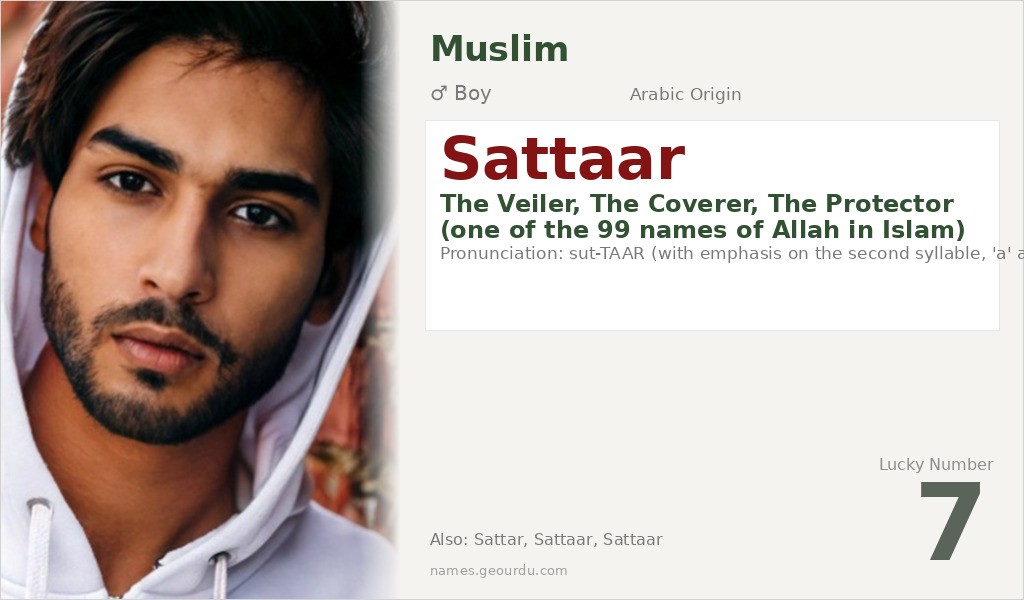
| 💎 Meaning | The Veiler, The Coverer, The Protector (one of the 99 names of Allah in Islam) |
| 👤 Gender | Boy |
| 🕌 Religion | Muslim |
| 🌍 Origin | Arabic |
| 🗣 Pronunciation | sut-TAAR (with emphasis on the second syllable, 'a' as in 'car') |
| ✍️ Urdu | ستار |
| ✍️ Arabic | ستار |
| 🔢 Numerology | 7 |
| ✨ Spellings | Sattar, Sattaar, Sattaar, Sattar |
Origin & Cultural Significance
Sattaar has its origins in classical Arabic and Islamic theology, emerging from the Quranic and Hadith traditions that enumerate the 99 Names of Allah. It is widely used across Muslim-majority regions, including the Middle East, South Asia (e.g., Pakistan, India, Bangladesh), and among diaspora communities. The name reflects deep spiritual significance, often chosen by parents seeking to imbue their child with the qualities of divine protection and mercy. Culturally, it is associated with reverence and piety, and variations like Sattar are common in Persian, Urdu, and other languages influenced by Arabic. Historical usage includes notable figures in philanthropy and arts, such as Abdul Sattar Edhi.
Personality Traits
Those named Sattaar are often seen as protective, empathetic, and reserved, mirroring the name’s essence of veiling and safeguarding. They may exhibit a strong sense of discretion, preferring to handle matters privately and showing compassion towards others’ vulnerabilities. In social settings, they might be perceived as trustworthy confidants who offer support without judgment, fostering deep, meaningful connections based on mutual respect and care.
Similar Names
If you like Sattaar, consider: Sattar, Sattar Ali, Abdus Sattar, Sattar Khan, Sattar Bahlulzada
Famous People Named Sattaar
- Sattar Bahlulzada — Azerbaijani painter known for his landscape and portrait works
- Sattar Edhi — Pakistani philanthropist and founder of the Edhi Foundation (full name: Abdul Sattar Edhi)
Frequently Asked Questions About Sattaar
What does Sattaar mean?
Sattaar means 'The Veiler,' 'The Coverer,' or 'The Protector' in Arabic. It is derived from As-Sattaar, one of the 99 Names of Allah in Islam, referring to the divine attribute of concealing faults and offering protection.
Is Sattaar a boy or girl name?
Sattaar is exclusively a boy's name in Muslim naming traditions. It is used for males to invoke the divine attribute of As-Sattaar, and there is no common feminine variant in Islamic cultures.
What is the origin of Sattaar?
Sattaar originates from Arabic, specifically from the root س-ت-ر (s-t-r). It is deeply embedded in Islamic theology as one of the 99 Names of Allah, with usage spread across Arabic-speaking and Muslim-majority regions globally.





