
Table of Contents
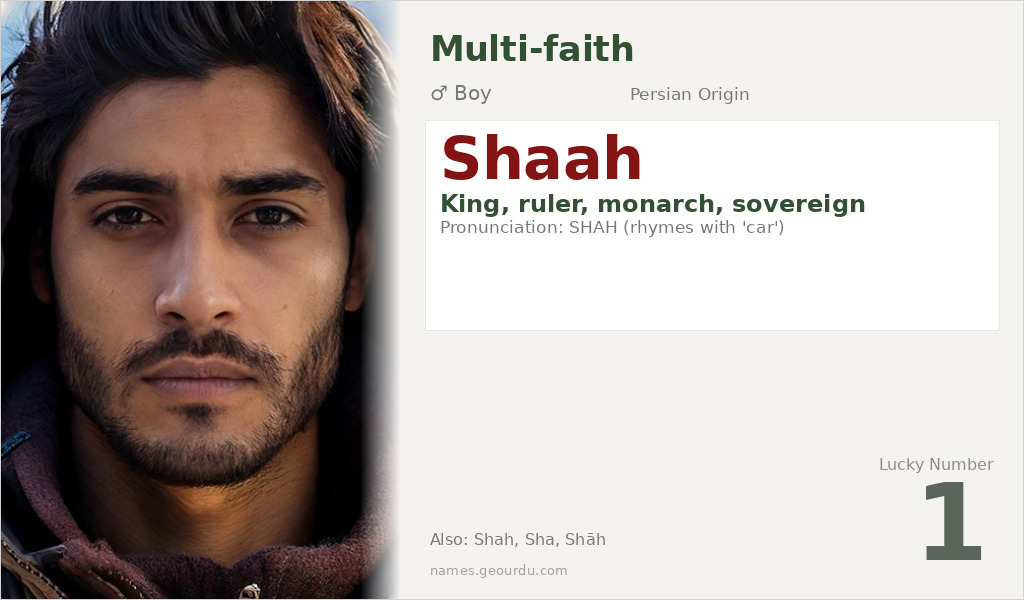
Shaah is a powerful name with regal connotations that has traveled across continents and centuries. Derived from the Persian word for ‘king’, this name carries the weight of history and authority. Used by emperors and commoners alike, Shaah represents leadership, sovereignty, and noble heritage. Its simplicity belies a rich cultural legacy that spans from ancient Persia to modern naming traditions.
Meaning of Shaah
Shaah originates from the Persian word ‘Shāh’ (شاه), which unequivocally means ‘king’, ‘monarch’, or ‘sovereign ruler’. This term has deep historical roots in Old Persian as ‘xšāyaθiya’, evolving through Middle Persian into the modern form. The name is not merely a title but carries the full semantic weight of royal authority and leadership. In linguistic context, it belongs to the Indo-European language family’s Iranian branch, specifically from the Proto-Iranian root *xšāya- meaning ‘to rule’. Across Persian-influenced cultures, including those in Iran, Afghanistan, Pakistan, India, and Central Asia, ‘Shaah’ maintains this core meaning without significant variation.
| 📛 Name | Shaah |
| 💎 Meaning | King, ruler, monarch, sovereign |
| 👤 Gender | Boy |
| 🕌 Religion | Multi-faith |
| 🌍 Origin | Persian |
| 🗣 Pronunciation | SHAH (rhymes with 'car') |
| ✍️ Urdu | شاہ |
| ✍️ Arabic | شاه |
| 🔢 Numerology | 1 |
| ✨ Spellings | Shah, Sha, Shāh, Şah, Şaah |
Origin & Cultural Significance
The name Shaah has its origins in ancient Persia, where ‘Shāh’ was used as a royal title for emperors of the Achaemenid, Parthian, and Sassanian empires. Through Persian cultural and linguistic influence, the term spread to neighboring regions including the Indian subcontinent, Central Asia, and the Ottoman Empire. In South Asia, it became incorporated into Urdu, Punjabi, Sindhi, and other languages, often as both a title and given name. While commonly used in Muslim communities, the name transcends religious boundaries and appears among Zoroastrians, Hindus, Sikhs, and others in Persianate cultural spheres. Its historical usage by Persian monarchs gives it particular prestige in naming traditions.
Personality Traits
Those named Shaah are often perceived as natural leaders with an inherent sense of authority and responsibility. They tend to approach life with confidence and determination, much like the monarchs from whom the name derives. While they can be ambitious and goal-oriented, they also typically demonstrate protective instincts toward family and community. The name’s royal connotations may influence both self-perception and social expectations, fostering qualities of dignity, strength, and decisiveness.
Similar Names
If you like Shaah, consider: Shahzad, Shahriyar, Shahin, Shapur, Shayan
Famous People Named Shaah
- Shah Rukh Khan — Indian actor and film producer known as 'King of Bollywood'
- Mohammad Reza Pahlavi — Last Shah (King) of Iran from 1941 to 1979
Frequently Asked Questions About Shaah
What does Shaah mean?
Shaah means 'king', 'ruler', or 'monarch'. It comes directly from the Persian word 'Shāh' (شاه) with this specific meaning.
Is Shaah a boy or girl name?
Shaah is traditionally and overwhelmingly a masculine name given to boys, reflecting its meaning of 'king' and historical usage for male rulers.
What is the origin of Shaah?
Shaah originates from Persian language and culture, specifically from the Old Persian 'xšāyaθiya' meaning 'king'. It has spread through Persian influence to many languages including Urdu, Pashto, Kurdish, and Turkish.





