
Table of Contents
Turan is a name rich with historical and cultural significance, evoking the vast lands and heritage of Turkic peoples. Often chosen for boys, it carries a sense of pride and identity rooted in ancient Persian literature. This name transcends religious boundaries, appealing to those with Turkic ancestry or an appreciation for its storied past. Discover the true meaning and origins of Turan in this detailed exploration.
Meaning of Turan
Turan derives from the Persian word ‘Tūrān’, which historically denotes the regions inhabited by Turkic tribes, particularly in Central Asia. In the Persian epic Shahnameh, Turan is portrayed as the opposing kingdom to Iran, symbolizing the Turkic peoples and their territories. The name literally translates to ‘Land of the Turks’ or ‘belonging to the Turks’, emphasizing geographical and cultural affiliation. It is not synonymous with generic terms like ‘powerful’ or ‘strong’, but rather conveys a specific ethnic and historical identity. Over time, Turan has come to represent Turkic unity and heritage, often used in names and places to honor this legacy.
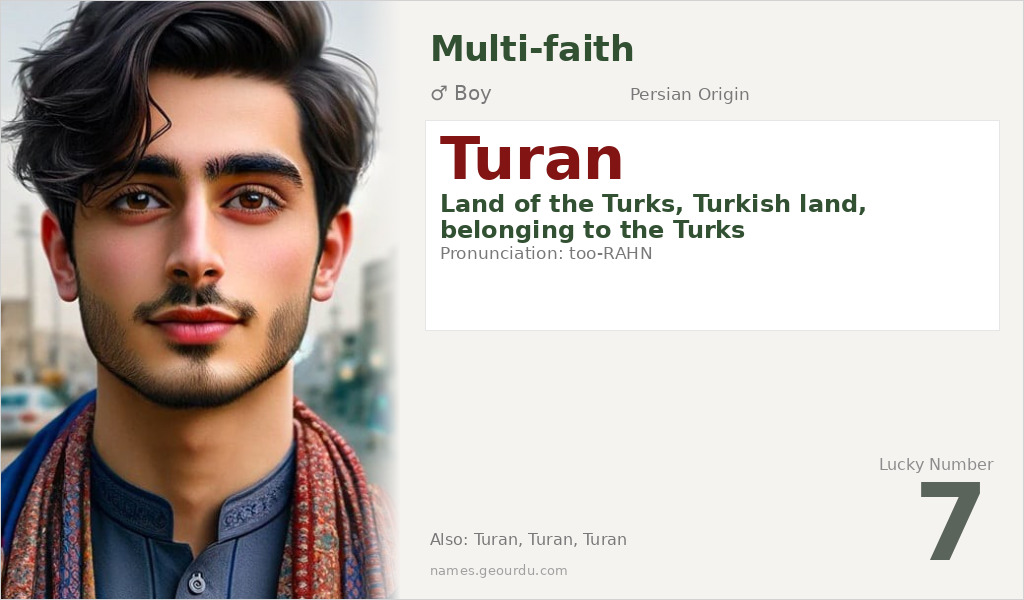
| 📛 Name | Turan |
| 💎 Meaning | Land of the Turks, Turkish land, belonging to the Turks |
| 👤 Gender | Boy |
| 🕌 Religion | Multi-faith |
| 🌍 Origin | Persian |
| 🗣 Pronunciation | too-RAHN |
| ✍️ Urdu | توران |
| ✍️ Arabic | توران |
| 🔢 Numerology | 7 |
| ✨ Spellings | Turan, Turan, Turan |
Origin & Cultural Significance
The origin of Turan is firmly rooted in Persian language and literature, dating back to the 10th-century epic Shahnameh by Ferdowsi. It was used to describe the lands north and east of Iran, associated with Turkic tribes such as the Seljuks and later the Ottomans. Culturally, Turan holds significance across Turkic-speaking communities, including in Turkey, Azerbaijan, and Central Asia, where it symbolizes shared history and identity. While popular in Muslim-majority regions due to historical Turkic empires, it is not exclusively Islamic and is used by people of various faiths. The name’s usage has persisted as a marker of Turkic pride and cultural continuity.
Personality Traits
Those named Turan are often perceived as confident and culturally grounded, with a strong sense of belonging to their heritage. They may demonstrate resilience and a protective nature, inspired by the historical narratives associated with the name. Their personality might reflect a blend of traditional values and modern adaptability, making them influential in their social circles.
Similar Names
No similar names found.
Famous People Named Turan
- Turan Dursun — Turkish writer and theologian known for his secularist views
- Turan Güneş — Turkish politician and former Minister of Foreign Affairs
Frequently Asked Questions About Turan
What does Turan mean?
Turan means 'Land of the Turks' or 'belonging to the Turks', originating from Persian language and literature.
Is Turan a boy or girl name?
Turan is primarily a boy's name, though it can be used as a unisex name in some cultures, reflecting its historical and geographical connotations.
What is the origin of Turan?
Turan originates from Persian, specifically from the word 'Tūrān' used in the Shahnameh epic to refer to Turkic lands, and it is widely used in Turkic cultures.





