Table of Contents
Camunda is a powerful and ancient name with deep roots in Hindu mythology. Derived from Sanskrit, it refers to a formidable aspect of the goddess Durga known for destroying demons. This name carries significant religious and cultural weight in Hindu traditions, symbolizing divine protection and the triumph of good over evil. Parents choosing this name often seek to invoke the goddess’s strength and protective qualities.
Meaning of Camunda
Camunda originates from the Sanskrit language, specifically from the compound words ‘cha’ (and) and ‘munda’ (head or severed head). The name directly references the Hindu mythological episode where the goddess Durga manifested as Camunda to slay the demons Chanda and Munda. In this context, ‘Camunda’ literally means ‘she who severed the heads of Chanda and Munda.’ The name appears in ancient Hindu texts like the Markandeya Purana and Devi Mahatmya, where Camunda is described as a fierce, dark-complexioned goddess with emaciated features, wearing a garland of skulls and holding weapons. This etymology establishes Camunda not as a general descriptor but as a specific theonym with precise mythological origins.
| 📛 Name | Camunda |
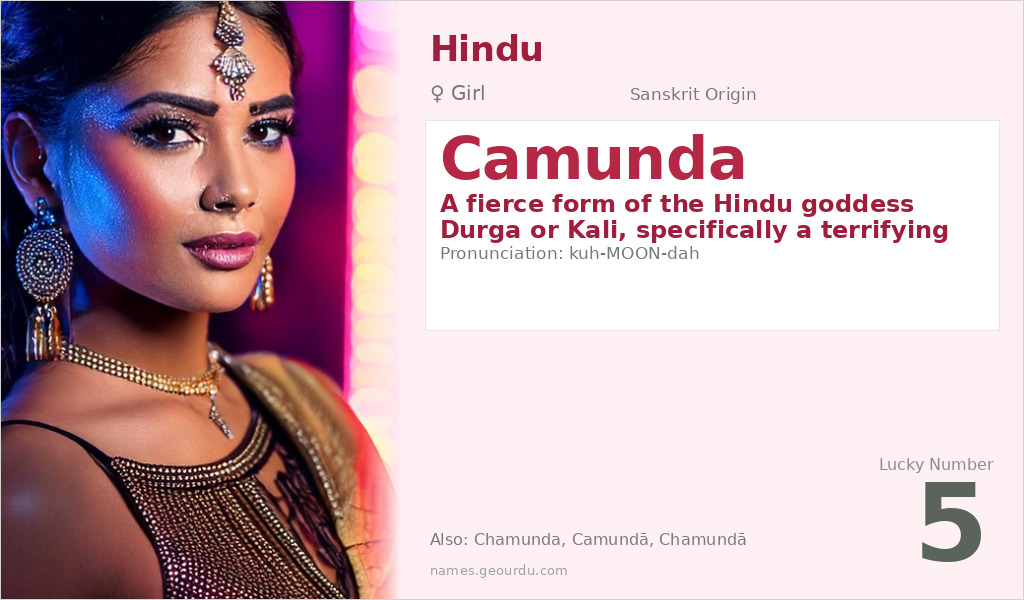
| 💎 Meaning | A fierce form of the Hindu goddess Durga or Kali, specifically a terrifying aspect associated with destruction of demons |
| 👤 Gender | Girl |
| 🕌 Religion | Hindu |
| 🌍 Origin | Sanskrit |
| 🗣 Pronunciation | kuh-MOON-dah |
| ✍️ Urdu | کامونڈا |
| ✍️ Arabic | كاموندا |
| 🔢 Numerology | 5 |
| ✨ Spellings | Chamunda, Camundā, Chamundā |
Origin & Cultural Significance
Camunda has its origins in ancient Hindu scriptures and traditions dating back to at least the early centuries CE. The name first appears in Sanskrit texts like the Devi Mahatmya (circa 400-600 CE), which is part of the Markandeya Purana. Culturally, Camunda represents one of the seven mother goddesses (Sapta Matrikas) in Hinduism and is particularly worshipped in Shakta traditions that venerate the divine feminine. The name spread through South Asian regions including India, Nepal, and parts of Southeast Asia where Hinduism was practiced. Temples dedicated to Camunda/Chamunda exist across the Indian subcontinent, with notable sites in Mysore, Himachal Pradesh, and Odisha, demonstrating the name’s enduring religious significance.
Personality Traits
Those named Camunda are often associated with traits of strength, determination, and protective instincts, mirroring the goddess’s mythological attributes. They may demonstrate resilience in facing challenges and a natural inclination to defend what they value. While the name carries connotations of fierceness, it also symbolizes the protective aspect of the divine feminine—the capacity to overcome evil and safeguard goodness.
Similar Names
If you like Camunda, consider: Durga, Kali, Chandi, Bhadrakali, Mahishasuramardini
Famous People Named Camunda
- Camunda Temple — ancient Hindu temple in Mysore, India dedicated to the goddess
- Chamunda Devi Temple — important pilgrimage site in Himachal Pradesh, India
Frequently Asked Questions About Camunda
What does Camunda mean?
Camunda means a fierce form of the Hindu goddess Durga who destroyed the demons Chanda and Munda. The name comes from Sanskrit 'cha' (and) and 'munda' (head), referring to this mythological episode.
Is Camunda a boy or girl name?
Camunda is exclusively a girl's name as it refers to a Hindu goddess. In Hindu tradition, it is used for females to invoke the protective and powerful qualities of the deity.
What is the origin of Camunda?
Camunda originates from Sanskrit and Hindu mythology, specifically from ancient texts like the Devi Mahatmya. It is a theonym (divine name) for a specific manifestation of the goddess Durga in Hindu religious tradition.