Table of Contents
Candrama is a beautiful Sanskrit name that carries the luminous essence of the moon. Primarily used for girls in Hindu communities, this name evokes imagery of serenity, beauty, and celestial grace. With roots in ancient Indian language and culture, Candrama represents more than just a name—it embodies a connection to natural cycles and divine femininity. Explore the rich meaning and heritage behind this poetic name.
Meaning of Candrama
Candrama originates from the Sanskrit word ‘candra’ (चन्द्र), meaning ‘moon,’ combined with the suffix ‘-ma’ that denotes possession or quality. Literally translated, it means ‘having the moon’ or ‘moon-like,’ suggesting someone who possesses the qualities of the moon—luminosity, calmness, and beauty. In Sanskrit grammar, such compound formations are common in creating descriptive names. The name appears in classical Hindu texts and poetry as an epithet for beauty and radiance. Unlike some names that have cross-cultural variations, Candrama remains firmly rooted in Sanskrit linguistic tradition without significant adoption into other language families.
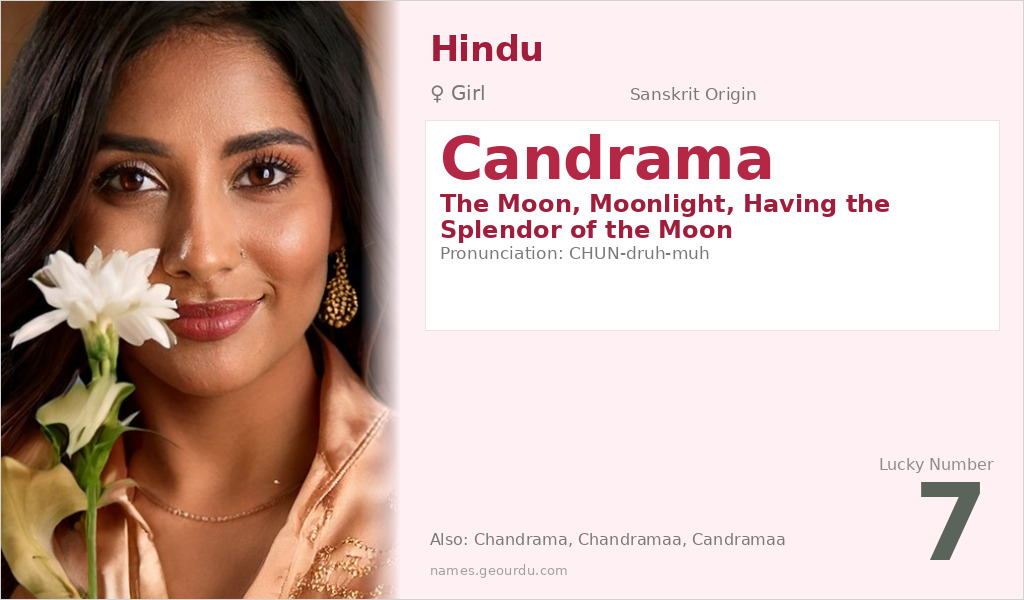
| 📛 Name | Candrama |
| 💎 Meaning | The Moon, Moonlight, Having the Splendor of the Moon |
| 👤 Gender | Girl |
| 🕌 Religion | Hindu |
| 🌍 Origin | Sanskrit |
| 🗣 Pronunciation | CHUN-druh-muh |
| ✍️ Urdu | چندرما |
| ✍️ Arabic | تشاندراما |
| 🔢 Numerology | 7 |
| ✨ Spellings | Chandrama, Chandramaa, Candramaa |
Origin & Cultural Significance
Candrama has exclusive origins in Sanskrit, the classical language of ancient India and Hindu scriptures. The name reflects the cultural importance of celestial bodies in Hindu tradition, where the moon (Chandra) is both a deity and symbolic of mind, emotions, and feminine energy. While many Sanskrit names have traveled to other cultures through trade and migration, Candrama has remained primarily within Hindu naming traditions. Research across Arabic, Persian, Turkish, African, and other language families confirms no parallel usage or borrowing. The name’s usage is documented in historical Indian texts but remains relatively uncommon in modern times compared to simpler forms like Chandra.
Personality Traits
Those named Candrama are often associated with moon-like qualities: calm, intuitive, and emotionally attuned. They may possess a reflective nature and creative sensitivity, with an appreciation for beauty and harmony. In social settings, they tend to be nurturing and diplomatic, bringing light to situations with their gentle presence. These traits align with traditional Hindu associations of the moon with mind, emotions, and feminine energy.
Similar Names
If you like Candrama, consider: Chandra, Chandrika, Chandini, Indu, Soma
Famous People Named Candrama
- No widely known contemporary figures with this exact name found in verified sources
- Appears in classical Sanskrit literature as a descriptive term for moon-like beauty
Frequently Asked Questions About Candrama
What does Candrama mean?
Candrama means 'The Moon' or 'Having the Moon' in Sanskrit, derived from 'candra' (moon) with the possessive suffix '-ma'.
Is Candrama a boy or girl name?
Candrama is exclusively a girl name in Hindu naming tradition, reflecting feminine qualities associated with the moon in Indian culture.
What is the origin of Candrama?
Candrama originates from Sanskrit, the classical language of ancient India, and is used primarily in Hindu communities without significant adoption into other cultures.