Table of Contents
Daksayani is a profound Sanskrit name with deep roots in Hindu mythology. Meaning ‘Daughter of Daksha,’ this name belongs to one of Hinduism’s most important goddesses—Sati, the first wife of Lord Shiva. Unlike modern invented names, Daksayani carries centuries of religious and cultural significance. This name represents divine femininity, devotion, and mythological heritage that continues to inspire parents seeking meaningful names.
Meaning of Daksayani
Daksayani is a classical Sanskrit compound name with transparent etymology. The first component ‘Daksha’ comes from the Sanskrit root √dakṣ, meaning ‘able, competent, skillful, or expert.’ Daksha was a revered sage-king and progenitor in Hindu texts. The suffix ‘-yani’ is a feminine patronymic in Sanskrit, equivalent to ‘-daughter of’ in English. Thus, Daksayani literally translates to ‘Daksha’s daughter.’ In linguistic context, this follows standard Sanskrit naming patterns seen in other mythological names like Kaunteya (son of Kunti) or Vaidehi (princess of Videha). The name specifically identifies the goddess Sati before her rebirth as Parvati, making it historically and religiously significant rather than merely descriptive.
| 📛 Name | Daksayani |
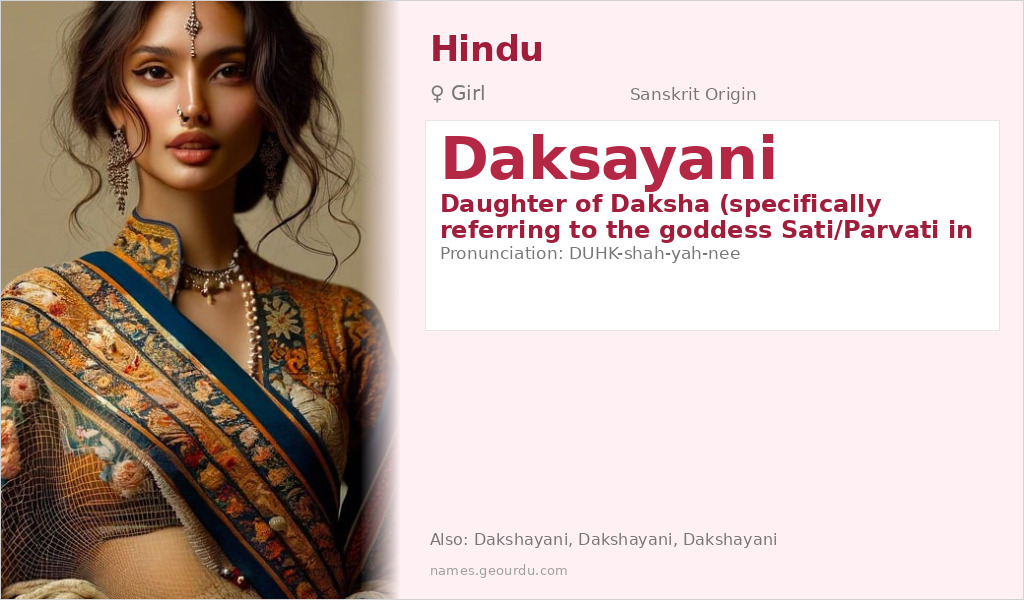
| 💎 Meaning | Daughter of Daksha (specifically referring to the goddess Sati/Parvati in Hindu mythology) |
| 👤 Gender | Girl |
| 🕌 Religion | Hindu |
| 🌍 Origin | Sanskrit |
| 🗣 Pronunciation | DUHK-shah-yah-nee |
| ✍️ Urdu | دکشاینی |
| ✍️ Arabic | داكشاياني |
| 🔢 Numerology | |
| ✨ Spellings | Dakshayani, Dakshayani, Dakshayani |
Origin & Cultural Significance
Daksayani originates exclusively from Sanskrit and Hindu mythology, with no verified connections to other language families despite extensive research across Arabic, Persian, Dravidian, Tibetan, and regional Indian languages. The name appears in ancient Hindu scriptures including the Puranas, Mahabharata, and various Shakta texts. Culturally, this name belongs to the Hindu tradition of naming children after deities and mythological figures, particularly popular in India, Nepal, and Hindu diaspora communities. Unlike some Hindu names that have cross-cultural adaptations, Daksayani remains specifically tied to its mythological narrative about Sati’s self-sacrifice and Shiva’s grief, making it a name of particular devotional significance rather than general usage.
Personality Traits
In Hindu naming philosophy, names are chosen for their spiritual and symbolic meanings rather than as personality determinants. However, the mythological Daksayani embodies qualities of unwavering devotion, courage in adversity, and transformative power. Her story represents the ultimate sacrifice for righteousness and the eternal nature of divine love. Those named Daksayani might be inspired by these qualities, but the name itself doesn’t prescribe personality traits in the way Western name-meaning traditions sometimes suggest.
Similar Names
If you like Daksayani, consider: Sati, Parvati, Uma, Gauri, Daksha
Famous People Named Daksayani
- Sati (Daksayani) — Hindu goddess, first wife of Lord Shiva and daughter of Daksha Prajapati
- No prominent modern figures with this exact name found in verified records
Frequently Asked Questions About Daksayani
What does Daksayani mean?
Daksayani means 'Daughter of Daksha' in Sanskrit, specifically referring to the Hindu goddess Sati/Parvati, the first wife of Lord Shiva.
Is Daksayani a boy or girl name?
Daksayani is exclusively a feminine name in Hindu tradition, as it uses the feminine Sanskrit suffix '-yani' and refers to a goddess.
What is the origin of Daksayani?
Daksayani originates from Sanskrit and Hindu mythology, with no verified connections to other language families. It appears in ancient Hindu scriptures like the Puranas and Mahabharata.