Table of Contents
Bhavatharini is a beautiful and profound Sanskrit name that carries immense spiritual weight in Hindu tradition. Meaning ‘Bearer of the Universe’ or ‘Sustainer of Existence,’ this name evokes images of divine feminine power and cosmic responsibility. Traditionally given to girls, it represents the nurturing, protective force that upholds creation. With roots in ancient Indian philosophy, Bhavatharini connects its bearer to timeless concepts of duty, protection, and spiritual strength.
Meaning of Bhavatharini
Bhavatharini is a compound Sanskrit name with two distinct elements that together create a powerful meaning. The first part, ‘Bhava’ (भव), derives from the Sanskrit root ‘bhū’ meaning ‘to be, to become, to exist.’ This gives Bhava the meanings of ‘world, universe, existence, being, or becoming.’ The second component, ‘Tharini’ (धारिणी), comes from the Sanskrit root ‘dhṛ’ meaning ‘to hold, to bear, to sustain.’ Tharini is the feminine form meaning ‘she who bears or sustains.’ Thus, Bhavatharini literally translates to ‘she who bears the universe’ or ‘sustainer of existence.’ This name appears in classical Sanskrit literature as an epithet for goddesses, particularly forms of Parvati and Lakshmi who are seen as sustaining forces in Hindu cosmology.
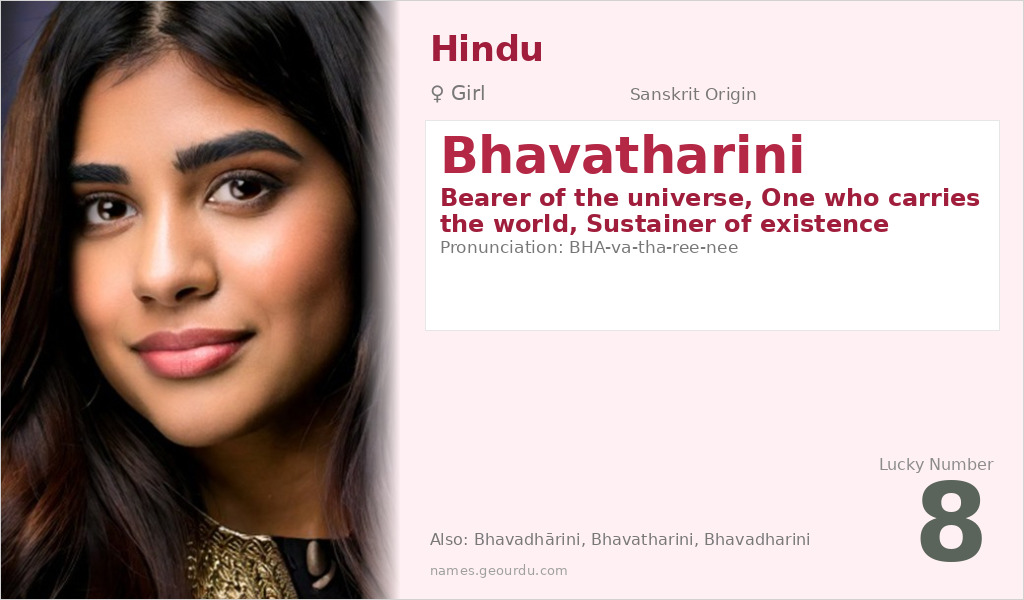
| 📛 Name | Bhavatharini |
| 💎 Meaning | Bearer of the universe, One who carries the world, Sustainer of existence |
| 👤 Gender | Girl |
| 🕌 Religion | Hindu |
| 🌍 Origin | Sanskrit |
| 🗣 Pronunciation | BHA-va-tha-ree-nee |
| ✍️ Urdu | بھوتھارنی |
| ✍️ Arabic | بهافاثاريني |
| 🔢 Numerology | 8 |
| ✨ Spellings | Bhavadhārini, Bhavatharini, Bhavadharini, Bhavatharinee |
Origin & Cultural Significance
Bhavatharini originates from classical Sanskrit, the ancient liturgical language of Hinduism, Buddhism, and Jainism. As a compound name, it follows traditional Sanskrit naming conventions where meaningful elements are combined to create names with spiritual significance. The name is particularly prevalent in South Indian Hindu communities, where Sanskrit names remain popular for their religious and philosophical depth. In temple traditions across Tamil Nadu, Kerala, and Karnataka, Bhavatharini appears as a name for goddess forms, especially those associated with protection and sustenance. The name reflects the Hindu philosophical concept of the divine feminine as the sustaining force of the universe, making it both a beautiful personal name and a spiritual invocation.
Personality Traits
Those named Bhavatharini often embody the qualities suggested by their name’s meaning. They tend to be responsible, nurturing individuals who naturally take on protective roles in their families and communities. There’s typically a strong sense of duty and a capacity to handle significant responsibilities with composure. Many display philosophical or spiritual inclinations, with an appreciation for life’s deeper meanings and interconnectedness. The name’s cosmic connotations often translate to broad-mindedness and an ability to see the bigger picture in challenging situations.
Similar Names
If you like Bhavatharini, consider: Bhavani, Bhuvaneshwari, Vasundhara, Prithvi, Dharini
Famous People Named Bhavatharini
- Bhavatharini Ilaiyaraaja — Indian playback singer and composer, daughter of legendary composer Ilaiyaraaja, known for her work in Tamil cinema and winning the National Film Award for Best Female Playback Singer in 2001
- Bhavatharini (spiritual figure) — Name used for various goddess forms in Hindu temples across South India, particularly in Tamil Nadu and Kerala
Frequently Asked Questions About Bhavatharini
What does Bhavatharini mean?
Bhavatharini means 'Bearer of the Universe' or 'Sustainer of Existence.' It's a Sanskrit compound name where 'Bhava' means world/universe and 'Tharini' means bearer/sustainer.
Is Bhavatharini a boy or girl name?
Bhavatharini is exclusively a girl's name. The '-tharini' ending is grammatically feminine in Sanskrit, and the name is traditionally given to girls in Hindu families.
What is the origin of Bhavatharini?
Bhavatharini originates from Sanskrit, the classical language of ancient India. It's a compound name with roots in Hindu philosophy and goddess worship, particularly prevalent in South Indian naming traditions.