Table of Contents
Bindiya is a beautiful and culturally rich name for girls that carries deep significance in South Asian traditions. Derived from the Sanskrit word for ‘dot’ or ‘point’, this name directly references the decorative forehead mark worn by women in Hindu culture. More than just a name, Bindiya represents spiritual awareness, marital status, and aesthetic beauty in Indian society. Its usage as a given name reflects parents’ desire to connect their daughter with traditional values and symbolic meaning.
Meaning of Bindiya
Bindiya originates from the Sanskrit root ‘bindu’ (बिन्दु), which literally means ‘dot’, ‘point’, or ‘small particle’. In linguistic evolution, the suffix ‘-iya’ creates a diminutive form, making ‘bindiya’ specifically refer to the small decorative dot worn on the forehead. This is distinct from the more general ‘bindu’ which can refer to any dot or point in various contexts. The name is directly tied to the cultural practice of wearing a bindi, which symbolizes the third eye in Hindu spirituality, representing wisdom, concentration, and spiritual insight. In some interpretations, it also represents the drop of divine consciousness or the point from which creation emerges.
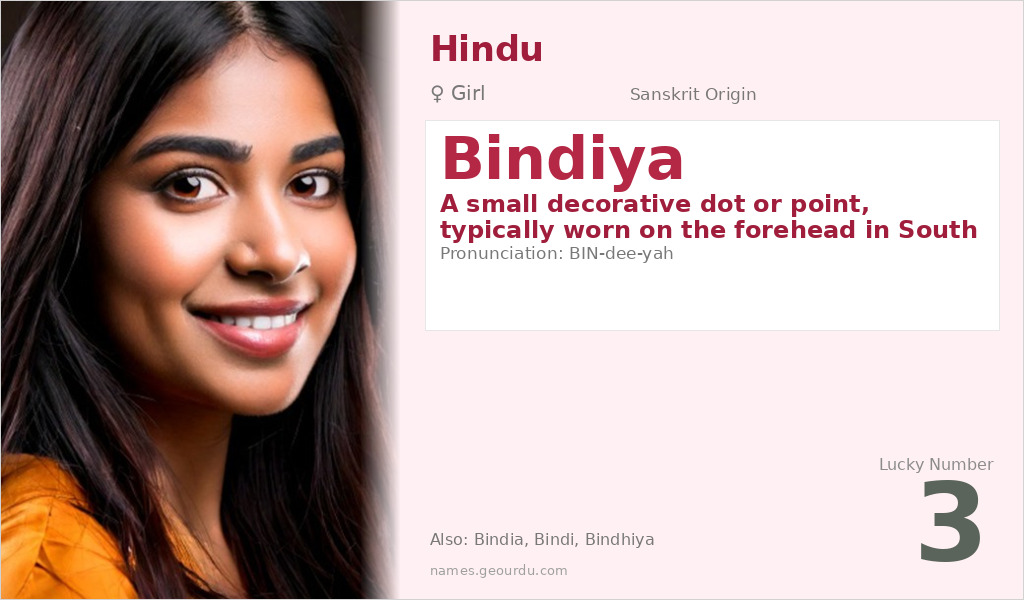
| 📛 Name | Bindiya |
| 💎 Meaning | A small decorative dot or point, typically worn on the forehead in South Asian cultures |
| 👤 Gender | Girl |
| 🕌 Religion | Hindu |
| 🌍 Origin | Sanskrit |
| 🗣 Pronunciation | BIN-dee-yah |
| ✍️ Urdu | بندیا |
| ✍️ Arabic | بنديا |
| 🔢 Numerology | 3 |
| ✨ Spellings | Bindia, Bindi, Bindhiya, Bindhya |
Origin & Cultural Significance
The name Bindiya has its roots in ancient Sanskrit texts and Hindu cultural practices dating back thousands of years. It emerged as a given name primarily in North India, particularly in Hindi-speaking regions, though it has spread throughout South Asia and the diaspora. The cultural practice of wearing a bindi has religious significance in Hinduism, where it marks the location of the ajna chakra (third eye) and is often made with kumkum, sindoor, or other auspicious materials. As a personal name, Bindiya gained popularity in the 20th century, reflecting a trend of using culturally significant terms as given names. It remains most common among Hindu families but is occasionally used by Jains and others appreciating its cultural symbolism.
Personality Traits
Those named Bindiya often embody qualities associated with their name’s symbolism—they tend to be centered, intuitive, and culturally aware individuals. Like the bindi mark that sits at the midpoint of the forehead, they often exhibit balance and focus in their approach to life. Many display artistic sensibilities and an appreciation for tradition, while also being socially engaging and expressive. The spiritual connotations of the name may influence some to be contemplative or drawn to philosophical pursuits.
Similar Names
If you like Bindiya, consider: Bindu, Tilaka, Pottu, Kumkum, Sindoor
Famous People Named Bindiya
- Bindiya Goswami — Indian actress from the 1970s-80s known for Hindi films
- Bindiya Chamkegi — Fictional character from Indian television show 'Bhabi Ji Ghar Par Hai'
Frequently Asked Questions About Bindiya
What does Bindiya mean?
Bindiya means 'a small decorative dot or point', specifically referring to the forehead decoration worn in South Asian cultures. It comes from the Sanskrit word 'bindu' meaning dot or point.
Is Bindiya a boy or girl name?
Bindiya is exclusively a girl's name, as it refers to the decorative forehead mark traditionally worn by women in Hindu and related cultures.
What is the origin of Bindiya?
Bindiya originates from Sanskrit, the ancient language of India, and is directly derived from the cultural practice of wearing a decorative dot (bindi) on the forehead in Hindu tradition.