Table of Contents
Chunni is a beautiful and culturally rich name for girls, deeply rooted in South Asian traditions. Unlike common misconceptions, it doesn’t mean ‘star’ but refers to the elegant veil or scarf worn in traditional attire. This name carries connotations of femininity, grace, and heritage, making it a meaningful choice for parents valuing cultural symbolism. Let’s explore the true origins and significance of Chunni beyond speculative associations.
Meaning of Chunni
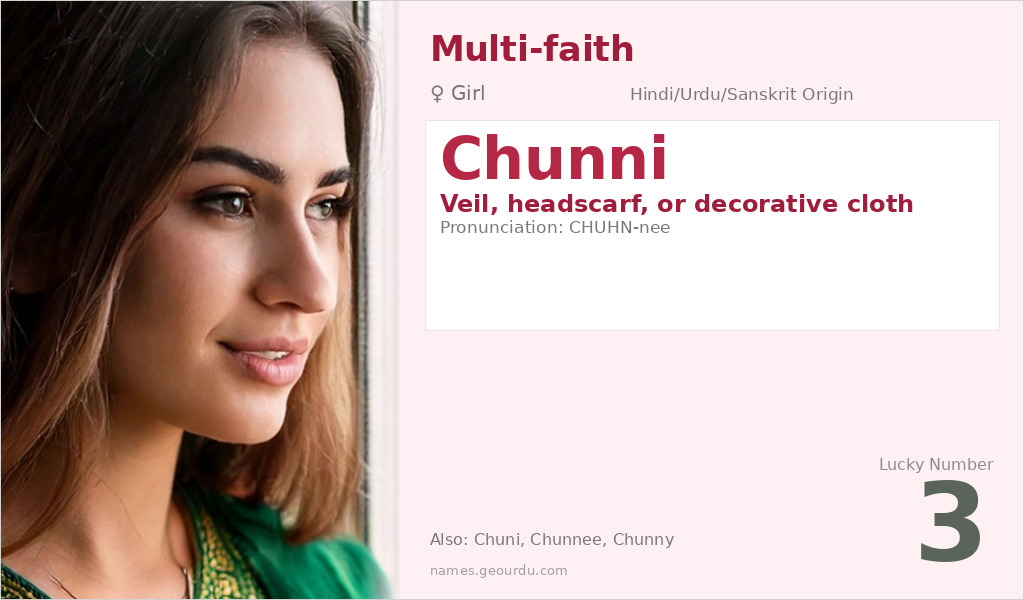
Chunni directly translates to ‘veil’, ‘headscarf’, or ‘decorative cloth’ in Hindi, Urdu, and related languages. Etymologically, it traces back to Sanskrit ‘चूलिका’ (chūlikā), meaning ‘crest’ or ‘tuft’, which evolved through Middle Indo-Aryan languages like Prakrit into the modern term. In linguistic context, it’s a common noun in daily use across India, Pakistan, and diaspora communities, specifically denoting the long, flowing scarf that complements outfits like salwar kameez. As a name, it metaphorically represents beauty, modesty, and cultural identity, often chosen for its melodic sound and feminine imagery. There is no verified connection to ‘star’ in any language, including Pashto, Balochi, or regional dialects where similar-sounding words might exist but with different meanings.
| 📛 Name | Chunni |
| 💎 Meaning | Veil, headscarf, or decorative cloth |
| 👤 Gender | Girl |
| 🕌 Religion | Multi-faith |
| 🌍 Origin | Hindi/Urdu/Sanskrit |
| 🗣 Pronunciation | CHUHN-nee |
| ✍️ Urdu | چُنّی |
| ✍️ Arabic | تشوني (transliteration) |
| 🔢 Numerology | 3 |
| ✨ Spellings | Chuni, Chunnee, Chunny |
Origin & Cultural Significance
Chunni originates from South Asia, with its linguistic roots in Sanskrit and widespread usage in Hindi, Urdu, Punjabi, and other regional languages. Culturally, it is associated with traditional women’s attire across Hindu, Muslim, Sikh, and other communities, making it a multi-faith name rather than exclusively Hindu. Historically, the chunni as a garment has been depicted in art, literature, and folklore for centuries, symbolizing femininity and social customs. The name gained popularity as a given name in the 20th century, particularly in rural and urban areas of North India and Pakistan, often reflecting pride in cultural heritage. It is not tied to specific religious rituals or astrological elements like lucky numbers or stones, contrary to some speculative online content.
Personality Traits
Those named Chunni are often perceived as graceful, traditional, and nurturing individuals. They may exhibit a strong sense of cultural identity and family values, with an artistic or expressive side that aligns with the name’s aesthetic connotations. In social settings, they might be seen as elegant and compassionate, embodying the warmth and beauty associated with the traditional scarf. While personality traits can vary widely, the name’s cultural resonance often inspires a connection to heritage and community.
Similar Names
If you like Chunni, consider: Chandni, Chhavi, Chitra, Chandrika, Chandani
Famous People Named Chunni
- Chunni Lal — Indian freedom fighter and politician from Punjab
- Chunni Kotal — Character in Indian folklore and regional stories
Frequently Asked Questions About Chunni
What does Chunni mean?
Chunni means 'veil', 'headscarf', or 'decorative cloth' in Hindi and Urdu, derived from the Sanskrit word 'चूलिका' (chūlikā). It does not mean 'star'.
Is Chunni a boy or girl name?
Chunni is exclusively a girl's name, as it refers to a feminine garment and carries strong cultural associations with women's attire in South Asia.
What is the origin of Chunni?
Chunni originates from South Asia, with linguistic roots in Sanskrit and common usage in Hindi, Urdu, Punjabi, and related languages. It is a multi-faith name used across various communities.