
Table of Contents
Dwaraka is a name steeped in ancient Hindu mythology and Sanskrit linguistics, carrying profound spiritual and historical significance. Unlike typical personal names, it originates from one of Hinduism’s most sacred cities—the legendary capital of Lord Krishna. This name symbolizes gateways, both physical and metaphysical, representing transitions and divine connections. While uncommon as a personal name today, it remains deeply respected in religious and cultural contexts.
Meaning of Dwaraka
Dwaraka derives directly from Sanskrit ‘द्वारका’ (Dvārakā), composed of ‘द्वार’ (dvāra) meaning ‘door, gate, or entrance’ and the suffix ‘-ka’ indicating possession or relation. Thus, the literal translation is ‘having many gates’ or ‘place of gates’. In Hindu scriptures, Dwarka was described as a fortified city with numerous entrances, built by Krishna after leaving Mathura. The name embodies both the physical architecture of the ancient city and metaphorical gateways to spirituality and divine realms. Etymologically, it’s closely related to other Sanskrit words like ‘dvāra’ (gate) and ‘dvārika’ (gatekeeper), emphasizing its foundational meaning of passage and transition.
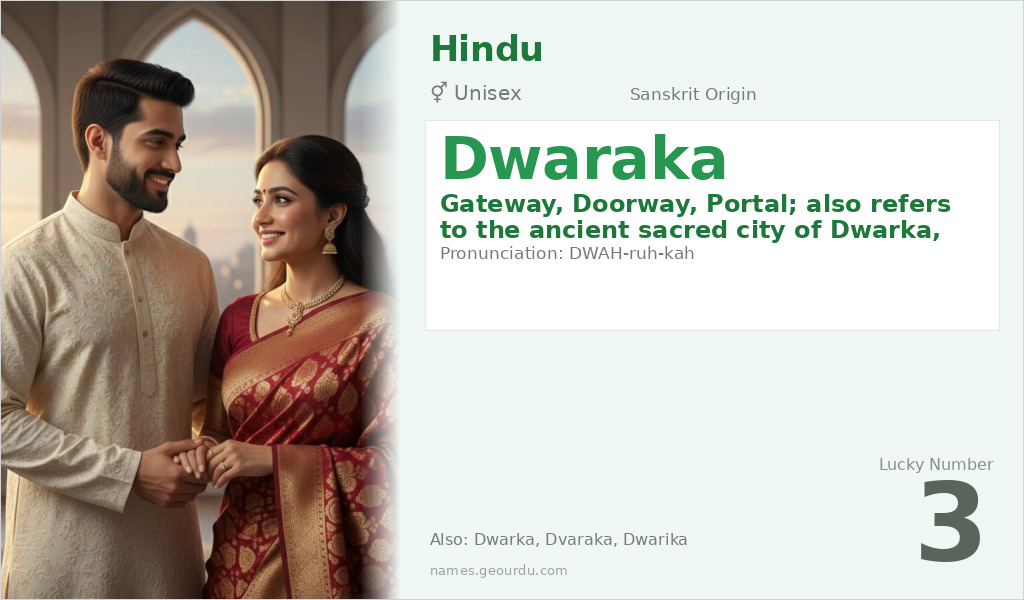
| 📛 Name | Dwaraka |
| 💎 Meaning | Gateway, Doorway, Portal; also refers to the ancient sacred city of Dwarka, capital of Lord Krishna's kingdom |
| 👤 Gender | Unisex |
| 🕌 Religion | Hindu |
| 🌍 Origin | Sanskrit |
| 🗣 Pronunciation | DWAH-ruh-kah |
| ✍️ Urdu | دوارکا |
| ✍️ Arabic | دواركا |
| 🔢 Numerology | 3 |
| ✨ Spellings | Dwarka, Dvaraka, Dwarika, Dwarakah |
Origin & Cultural Significance
The origin of Dwaraka is exclusively Sanskrit and Hindu, rooted in the epic narratives of the Mahabharata and Puranas. According to tradition, Lord Krishna established the city of Dwarka on the western coast of Gujarat (modern-day Dwarka, Gujarat) as his capital after migrating from Mathura. Archaeological and textual evidence suggests the city dates back to at least 1500 BCE, with submerged ruins discovered offshore. Culturally, Dwarka is one of the Char Dham (four sacred pilgrimage sites) and Sapta Puri (seven holy cities) in Hinduism. While rarely used as a personal name historically, it appears in modern times occasionally as a unisex name, reflecting devotion to Krishna or connection to the sacred site.
Personality Traits
Those named Dwaraka often exhibit traits aligned with its meaning of ‘gateway’—they are perceived as open, guiding, and spiritually inclined. They may naturally assume roles as mediators or connectors between people and ideas, embodying the symbolism of passage and transition. Their personality tends to blend traditional values with a welcoming demeanor, making them respected in communal settings. While not astrologically defined, the name’s historical gravity often inspires a sense of responsibility and cultural pride.
Similar Names
If you like Dwaraka, consider: Mathura, Vrindavan, Ayodhya, Kashi, Haridwar
Famous People Named Dwaraka
- Dwarka (ancient city) — Sacred city in Gujarat, India, one of the Char Dham pilgrimage sites and capital of Krishna's kingdom
- Dwarka Prasad Mishra — Indian politician and writer, former Chief Minister of Madhya Pradesh
Frequently Asked Questions About Dwaraka
What does Dwaraka mean?
Dwaraka means 'gateway' or 'doorway' in Sanskrit, and specifically refers to the ancient sacred city of Dwarka, capital of Lord Krishna's kingdom in Hindu mythology.
Is Dwaraka a boy or girl name?
Dwaraka is historically unisex, though it's rarely used as a personal name. In modern contexts, it may be given to any gender, primarily within Hindu families with spiritual or cultural connections to the city of Dwarka.
What is the origin of Dwaraka?
Dwaraka originates from Sanskrit, specifically from Hindu scriptures like the Mahabharata and Puranas, where it denotes the legendary city built by Lord Krishna in Gujarat, India.