Table of Contents
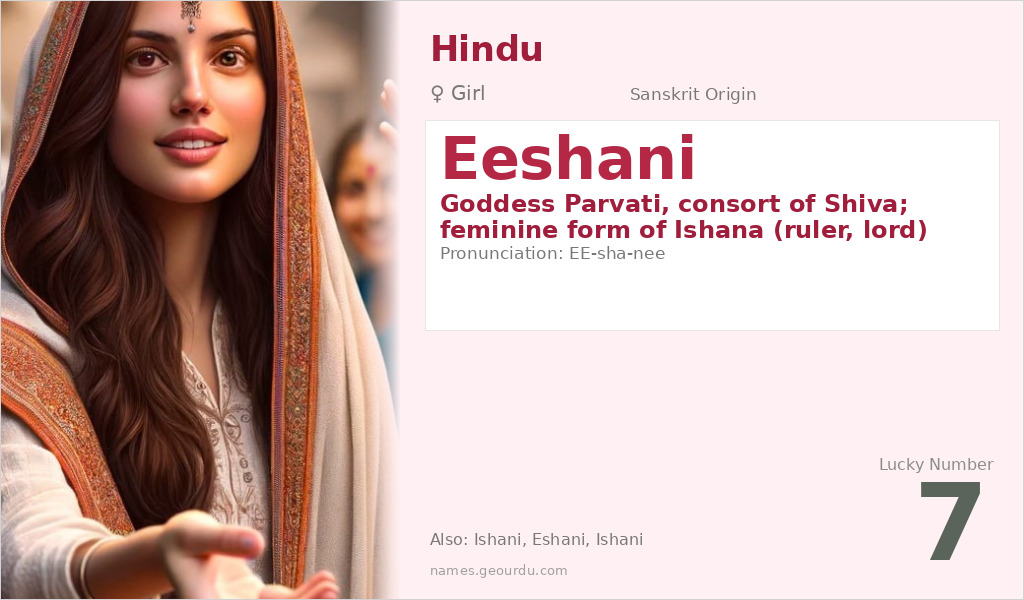
Eeshani is a beautiful and powerful Sanskrit name for girls that carries deep spiritual significance in Hindu culture. Derived from ancient roots meaning ‘to rule’ or ‘to own’, this name specifically refers to Goddess Parvati as the divine consort of Lord Shiva. With its melodic sound and profound meaning, Eeshani represents feminine divine power, protection, and sovereignty. This name continues to be cherished by Hindu families seeking a name with both traditional roots and contemporary appeal.
Meaning of Eeshani
Eeshani originates from the Sanskrit language, specifically from the root word ‘Ish’ which means ‘to rule’, ‘to own’, or ‘to govern’. It is the feminine form of ‘Ishana’, one of the primary names of Lord Shiva that signifies ‘ruler’ or ‘lord’. In Hindu mythology and scriptures, Eeshani directly refers to Goddess Parvati as the divine consort of Shiva (Ishana), embodying feminine divine authority and power. The name thus carries dual significance: both as a reference to the goddess herself and as a feminine form meaning ‘female ruler’ or ‘goddess’. This etymological connection places Eeshani within a family of Sanskrit names related to sovereignty and divine authority.
| 📛 Name | Eeshani |
| 💎 Meaning | Goddess Parvati, consort of Shiva; feminine form of Ishana (ruler, lord) |
| 👤 Gender | Girl |
| 🕌 Religion | Hindu |
| 🌍 Origin | Sanskrit |
| 🗣 Pronunciation | EE-sha-nee |
| ✍️ Urdu | ایشانی |
| ✍️ Arabic | إيشاني |
| 🔢 Numerology | 7 |
| ✨ Spellings | Ishani, Eshani, Ishani, Eesani |
Origin & Cultural Significance
Eeshani has its origins in ancient Sanskrit, the classical language of India and Hindu scriptures. The name appears in various Hindu texts and traditions as an epithet for Goddess Parvati, particularly emphasizing her role as the consort of Shiva (Ishana). Culturally, the name reflects the Hindu concept of divine feminine power (Shakti) complementing masculine divinity. Historically, names derived from ‘Ish’ roots have been used for centuries in Indian naming traditions, with Eeshani representing a specifically feminine form of this powerful concept. The name remains popular in Hindu communities across India and the diaspora, maintaining its religious and cultural significance.
Personality Traits
Those named Eeshani are often perceived as natural leaders with strong protective instincts and spiritual depth. They tend to exhibit determination and resilience, qualities associated with their namesake goddess. With a balance of authority and compassion, individuals with this name frequently demonstrate nurturing qualities alongside the ability to take charge when necessary. Their connection to the name’s meaning often inspires them to pursue paths of service, leadership, or spiritual growth.
Similar Names
If you like Eeshani, consider: Ishita, Ishwari, Parvati, Durga, Shivani
Famous People Named Eeshani
- Ishani (actress) — Indian actress known for her work in Telugu and Tamil cinema
- Ishani Dutta — Indian model and actress who appeared in Bengali films
Frequently Asked Questions About Eeshani
What does Eeshani mean?
Eeshani means 'Goddess Parvati' in Sanskrit, specifically referring to Parvati as the consort of Shiva. It is derived from the root 'Ish' meaning 'to rule' or 'to own', making it the feminine form of Ishana (ruler).
Is Eeshani a boy or girl name?
Eeshani is exclusively a girl's name in Hindu naming tradition. It is the feminine form of the masculine name Ishana and specifically refers to the feminine divine in Hindu mythology.
What is the origin of Eeshani?
Eeshani originates from Sanskrit, the ancient language of Hindu scriptures. It has been used for centuries in Indian culture as a name for Goddess Parvati and as a feminine given name meaning 'female ruler' or 'goddess'.