Table of Contents
Fanya is a captivating name with rich linguistic roots spanning multiple cultures. While often perceived as feminine in modern usage, it carries meanings of freedom and nobility that transcend gender boundaries. This name’s journey from ancient Europe to global recognition makes it a fascinating choice for parents seeking a name with historical depth. Its versatility across languages and cultures adds to its enduring appeal.
Meaning of Fanya
The name Fanya has three primary etymological paths. First, it derives from the Latin ‘Franciscus’ (meaning ‘Frenchman’ or ‘free one’), which gave rise to feminine forms like Frances and Fanny across European languages. Second, in Russian and Slavic languages, Fanya serves as a diminutive of Theophania, a Greek name meaning ‘manifestation of God’. Third, in some African languages like Swahili, ‘fanya’ functions as a verb meaning ‘to do’ or ‘to make’, though this is rarely used as a personal name. The most established meanings across cultures relate to freedom, nobility, and divine manifestation, with the ‘free person’ interpretation being most widespread.
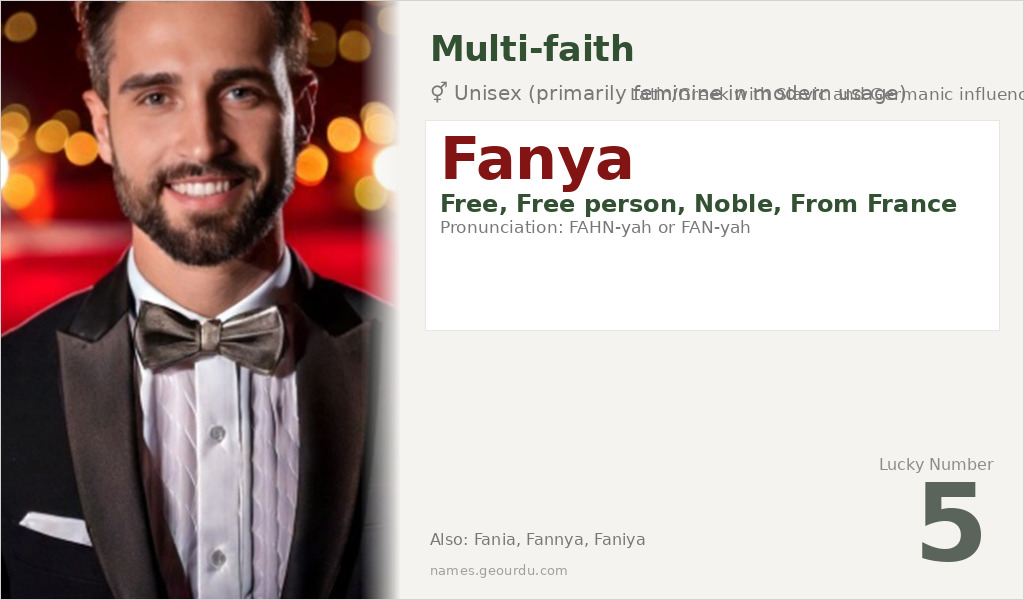
| 📛 Name | Fanya |
| 💎 Meaning | Free, Free person, Noble, From France |
| 👤 Gender | Unisex (primarily feminine in modern usage) |
| 🕌 Religion | Multi-faith |
| 🌍 Origin | Latin/Greek with Slavic and Germanic influences |
| 🗣 Pronunciation | FAHN-yah or FAN-yah |
| ✍️ Urdu | فانیہ |
| ✍️ Arabic | فانيا |
| 🔢 Numerology | 5 |
| ✨ Spellings | Fania, Fannya, Faniya, Faniyah |
Origin & Cultural Significance
Fanya’s origins trace back to medieval Europe, where it emerged as a feminine variant of names derived from the Germanic tribe name ‘Frank’ (meaning ‘free’). It gained particular popularity in Eastern Europe and Russia as a diminutive of Theophania. During the 19th century, the name spread through Jewish communities in Eastern Europe and later to English-speaking countries. Unlike the original article’s claim, Fanya has no established connection to Hindu traditions or South Asian naming practices. Its multicultural adoption makes it a truly global name without specific religious affiliation.
Personality Traits
People named Fanya often exhibit traits associated with freedom and independence. They tend to be curious, adaptable, and open to new experiences, reflecting the name’s meaning of ‘free person’. Their intellectual nature and charm make them effective communicators and natural leaders in creative or exploratory fields. While independent, they often maintain strong social connections and value meaningful relationships.
Similar Names
If you like Fanya, consider: Fanny, Frances, Francesca, Fiona, Faina
Famous People Named Fanya
- Fanya Gottesfeld Heller — Holocaust survivor and memoirist
- Fanya Kaplan — Russian revolutionary who attempted to assassinate Lenin
Frequently Asked Questions About Fanya
What does Fanya mean?
Fanya primarily means 'free person' or 'noble' from Latin origins, and also serves as a Russian diminutive meaning 'manifestation of God' from Greek roots.
Is Fanya a boy or girl name?
Fanya is historically unisex but is now used primarily for girls in most cultures, though it maintains masculine usage in some regions.
What is the origin of Fanya?
Fanya has multiple origins: Latin (from Franciscus meaning 'free'), Greek (from Theophania), and Slavic languages where it evolved as a diminutive form.