Table of Contents
Gandhari is a name steeped in ancient Indian history and mythology. Derived from the Sanskrit word for the Gandhara region, this name carries centuries of cultural significance. Most famously known from the Hindu epic Mahabharata, Gandhari represents devotion, strength, and maternal complexity. This name connects modern bearers to one of India’s most important literary and historical traditions.
Meaning of Gandhari
Gandhari originates from the Sanskrit term ‘Gandhāra’, which refers to an ancient kingdom located in what is now eastern Afghanistan and northwestern Pakistan. The name literally translates to ‘from Gandhara’ or ‘belonging to Gandhara’. This region was historically significant as a crossroads of cultures and a center of Buddhist and Hindu art and learning. In linguistic terms, the suffix ‘-i’ in Sanskrit often denotes feminine forms or association, making Gandhari specifically feminine. The Gandhara region itself was known in ancient texts for its strategic location along trade routes and its distinctive cultural synthesis.
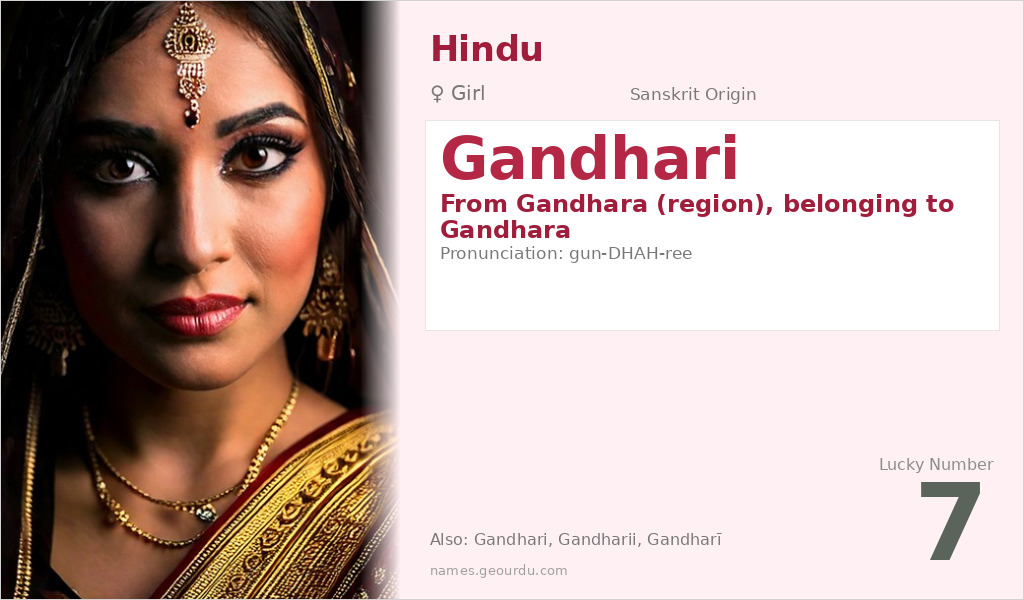
| 📛 Name | Gandhari |
| 💎 Meaning | From Gandhara (region), belonging to Gandhara |
| 👤 Gender | Girl |
| 🕌 Religion | Hindu |
| 🌍 Origin | Sanskrit |
| 🗣 Pronunciation | gun-DHAH-ree |
| ✍️ Urdu | گندھاری |
| ✍️ Arabic | غاندهاري |
| 🔢 Numerology | 7 |
| ✨ Spellings | Gandhari, Gandharii, Gandharī |
Origin & Cultural Significance
The name Gandhari has its roots in ancient Sanskrit literature and Hindu mythology. Most prominently, Gandhari appears in the Mahabharata as the wife of the blind king Dhritarashtra and mother of the hundred Kauravas. According to the epic, she blindfolded herself for life to share her husband’s blindness, symbolizing extraordinary devotion. The historical Gandhara region was an important center of civilization from approximately 1500 BCE to the 11th century CE, influencing both Hindu and Buddhist traditions. Today, the name remains primarily used within Hindu communities, particularly in India and Nepal, though its historical associations give it pan-South Asian recognition.
Personality Traits
Those named Gandhari are often associated with qualities of loyalty, sacrifice, and strong maternal instincts, reflecting the mythological character’s attributes. The name suggests someone deeply connected to tradition and family values, with a potential for great inner strength. While the mythological Gandhari made extreme sacrifices, modern bearers might embody more balanced forms of devotion and commitment. The name carries an air of historical gravitas and cultural depth.
Similar Names
If you like Gandhari, consider: Gandhara, Gandharva, Gauri, Ganga, Gayatri
Famous People Named Gandhari
- Gandhari — Wife of Dhritarashtra and mother of the Kauravas in the Hindu epic Mahabharata
- Gandhari — Historical figure from ancient Indian texts, known for her devotion and blindfolded life
Frequently Asked Questions About Gandhari
What does Gandhari mean?
Gandhari means 'from Gandhara' or 'belonging to Gandhara' in Sanskrit, referring to an ancient kingdom in what is now Afghanistan and Pakistan.
Is Gandhari a boy or girl name?
Gandhari is exclusively a girl's name in Hindu tradition, as evidenced by its feminine Sanskrit suffix and its association with the female character in the Mahabharata.
What is the origin of Gandhari?
Gandhari originates from Sanskrit and Hindu mythology, specifically from the Mahabharata epic where Gandhari was the wife of Dhritarashtra and mother of the Kauravas.