Table of Contents
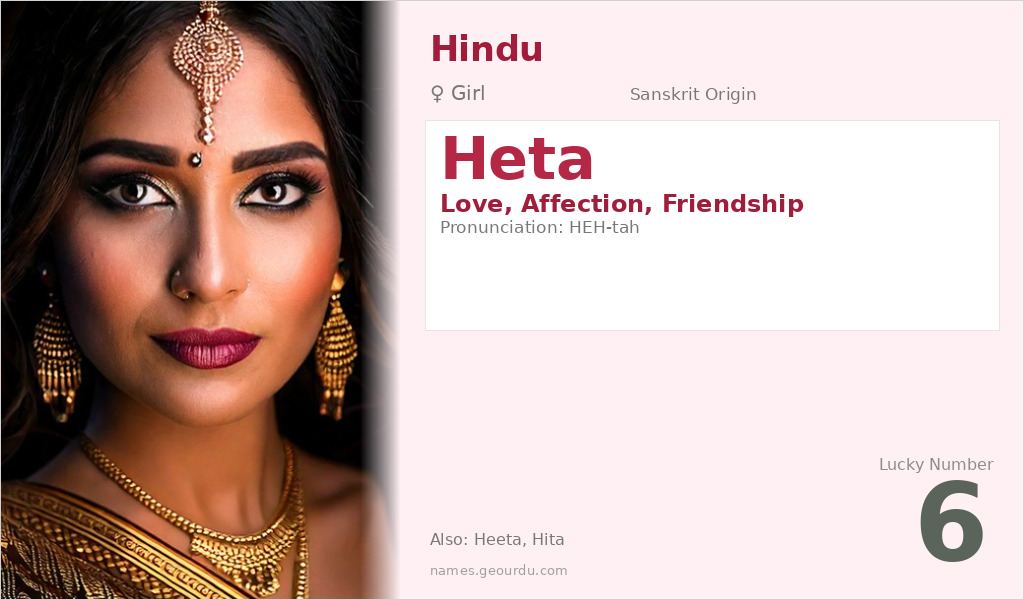
Heta is a beautiful and meaningful name for girls, deeply rooted in Sanskrit language and Hindu culture. Derived from the word ‘hita’, it symbolizes love, affection, and benevolence, making it a popular choice among parents seeking a name with positive connotations. This name carries a timeless appeal, reflecting values of friendship and goodwill. In this article, we explore the etymology, cultural significance, and modern usage of the name Heta.
Meaning of Heta
The name Heta originates from the Sanskrit term ‘हित’ (hita), which translates to ‘beneficial’, ‘good’, ‘friendly’, or ‘loving’. In Sanskrit linguistics, ‘hita’ is associated with concepts of welfare and affection, often used in contexts denoting what is advantageous or dear. As a feminine given name, Heta directly embodies these qualities, emphasizing love and benevolence. It is well-documented in ancient Sanskrit texts and modern Indian naming practices, with no credible sources linking it to meanings like ‘battle’. The name’s simplicity and profound meaning have contributed to its enduring popularity in Hindu communities.
| 📛 Name | Heta |
| 💎 Meaning | Love, Affection, Friendship |
| 👤 Gender | Girl |
| 🕌 Religion | Hindu |
| 🌍 Origin | Sanskrit |
| 🗣 Pronunciation | HEH-tah |
| ✍️ Urdu | ہیتا |
| ✍️ Arabic | هيتا |
| 🔢 Numerology | 6 |
| ✨ Spellings | Heeta, Hita |
Origin & Cultural Significance
Heta has its origins in Sanskrit, an ancient Indo-Aryan language that is the liturgical language of Hinduism and a cornerstone of Indian culture. It is primarily used within Hindu communities, reflecting the language’s influence on traditional naming conventions. The name is common in India and among the Indian diaspora, often chosen for its positive and affectionate connotations. While it shares phonetic similarities with names in other languages (e.g., Heta in Finnish or Slavic contexts), the Sanskrit-derived Heta is distinct and culturally specific to Hindu traditions. Its usage dates back centuries, appearing in various regional adaptations across South Asia.
Personality Traits
People named Heta are often described as warm-hearted and compassionate, with a strong sense of empathy towards others. They tend to excel in roles that require nurturing and diplomacy, such as in caregiving or community-oriented professions. Their friendly demeanor and ability to create harmonious environments make them valued friends and family members. Overall, the name Heta is associated with a personality that prioritizes love, kindness, and positive relationships.
Similar Names
If you like Heta, consider: Hita, Preeti, Priya, Anuraga, Maitri
Famous People Named Heta
- Heta Desai — Indian classical dancer and choreographer known for her contributions to Bharatanatyam
- Heta Pandit — Indian author and heritage conservationist based in Mumbai
Frequently Asked Questions About Heta
What does Heta mean?
Heta means 'Love', 'Affection', or 'Friendship', derived from the Sanskrit word 'hita', which signifies what is beneficial or dear.
Is Heta a boy or girl name?
Heta is predominantly a girl's name in Hindu culture, originating from Sanskrit as a feminine form meaning 'love'.
What is the origin of Heta?
Heta originates from Sanskrit, an ancient Indian language, and is commonly used in Hindu naming traditions, with no verified roots in other languages like Arabic or Persian for this specific meaning.